Art Talk: Division Intern Katherine Laursen

by Tim Storhoff

Division intern Katherine Laursen. Photo submitted and used by permission of Katherine Laursen.

Division intern Katherine Laursen. Photo submitted and used by permission of Katherine Laursen.

Katherine Laursen joined the team at the Florida Division of Cultural Affairs at the end of August as an intern for the 2013-2014 school year. Born and raised in Dunedin, Florida, Katherine graduated with honors from the Florida State University with a Bachelor of Music Education in 2005 and a Masters of Music Education in 2011. She taught in the Pinellas County Schools for six years: first as the Assistant Director of Band and Chorus at Largo High School for three years and then as the Director of Chorus and Strings at Dunedin Highland Middle School. Katherine has been a member of the Festival Singers of Florida since its formation in 2008 and has previously been a member of groups including the Master Chorale of Tampa Bay, the Zielinski Singers, Opera Tampa, and Tapped In, a professional tap company. In addition to all of that, she is also actively involved in the Scottish dance community, is a staff singer and Chorister Assistant at St. John’s Episcopal Church, and has another internship at the Tallahassee Ballet. Currently, she is working on her MA in Arts Administration at the Florida State University. I recently asked Katherine about her artistic background and her thoughts on the importance of the arts in Florida.

DCA: What are some of the earliest arts experiences you can remember?

Katherine: My earliest memory has to be from when I was around 4 years old. I remember dancing around in my bathing suit and Sunday school tights to Kiss Me, Kate, my favorite musical at the time. I grew up in a house filled with music. My great-uncle worked for MGM, so we would watch every movie musical he worked on. My parents realized they couldn’t wait any longer, so they enrolled me in ballet at Patricia Ann Dance Studio in Dunedin, FL. They couldn’t have known then what a great home it would become for me.

DCA: What made you decide on a career in the arts?

Katherine: Growing up whenever I was dancing, singing, playing, writing or making something, I knew who I was. I would spend hours at the dance studio only to come home to practice my flute. I wrote poem after poem in my journals. In the summers, my parents sent me to the Dunedin Fine Arts Center for classes, Writer’s Camp or the Florida Dance Festival multi-week intensives. When I got older, I added theater and voice to my experience. It was only in my senior year of high school that I chose voice as my main area of study. I continued to study dance and flute and my teaching experiences led me to add guitar, color-guard and viola to my arsenal. With the arts, you are never done learning and growing. I can’t imagine my life without the arts, so it makes perfect sense that my goal is to provide access to the arts to everyone who wants it.

47826_432964184067_1816806_n

Katherine dancing with other members of Tapped In, Inc. during an event in Tampa in 2011. Photo submitted and used by permission of Katherine Laursen.

DCA: While your arts background is largely in music, you’ll be working with arts more broadly here at the Division of Cultural Affairs.  What are some of your artistic interests outside of musical performance?

Katherine: My connections to the arts originally came from dance. I always make my way back to ballet because I feel the most connected to who I am there. Ballet has been in my life since my first memories, so I believe it’s connected to every part of who I am now. When I go back to dance class, even as an adult, the world disappears and everything is focused on the beauty of the art. Because of this connection, I am able to carry that passion and focus into all other aspects of art in my life. I discovered my love for music in dance class. I discovered my love of design and color through costumes and lighting. Dance is beautiful, but it is enhanced and complimented by all of the arts and that relationship goes both ways.

DCA: The Division of Cultural Affairs believes in the motto “Culture Builds Florida.”  What do you think when you hear that phrase?  Why do you believe arts and culture matter to our state?

Katherine: I know that I cannot separate the arts from their impact on my life. In that same way, I don’t think that you can separate the culture of Florida from its impact on building our state economically and otherwise. There is so much to be said for loving where you live. As a Florida native, I have grown up watching my state find its identity. When people feel a part of the place they live, they are more likely to contribute to making it better. Incorporating the diverse culture of our state is a challenge, but how lucky are we as Floridians to have such a plethora of arts and culture to embrace?

Spotlight On: Grant Season at the Division of Cultural Affairs

by Tim Storhoff

sizedcbf-dca-colorSummer is an extremely busy time here at the Florida Division of Cultural Affairs, particularly with all the activities related to our grant programs. We have grant periods beginning and ending with the state’s fiscal year, which starts on July 1. This means that between June and September of every year we are actively working with three years of grants: the year that just ended, the year that is just getting started, and the next year (currently in the application review stage). These grants are an extremely important part of what we do, and we know that many arts and culture organizations from across the state depend on them to keep their programs up and running. Therefore I wanted to give you some insight into what’s going on and how we keep these grants moving and on track.

2012-2013: Finishing Up and Closing Out

The official period for 2012-2013 grants ended on June 30. There were 314 total grants given to organizations in 45 Florida counties for a total of $8,868,534. This amount included a $5 million appropriation by the state legislature for General Program Support and approximately $3.9 million for Cultural Facilities (no money was appropriated in 2012-2013 for Specific Cultural Projects). For a full record of awards by county, take a look at this list.

After organizations with General Program Support grants finish up their June events, they have until July 30 to fill out their final reports online. It typically takes Sarah, Maureen, and I (the program managers for these grants) until sometime in the fall to read through everything, but it’s great to be reminded of all the wonderful activities that these grants made possible. These reports allow us to see specifically how all the grant money was used and what overall impact it had in terms of individuals from the the community who participated. In addition to getting overall numbers, we’re interested in the number of youth, elders, and artists that took part in events throughout the year. While we often stress the economic impact of the arts with Culture Builds Florida, these participation numbers help show the significance of the arts in a way that goes beyond dollars and cents. The arts create important social connections between people when they attend performances, visit museums, and perhaps most importantly, collaborate to create art together.

Some of the organizations and events funded with 2012-2013 DCA grants.

Some of the organizations and events funded with 2012-2013 DCA grants.

2013-2014: Getting Started (or at least trying to)

With the previous year’s grants ending on June 30, the current year’s grant period is scheduled to begin right away on July 1. Organizations applied for 2013-2014 grants in spring 2012. After panel meetings, eligible scores were sent to the Florida Legislature via the Department of State’s Legislative Budget Request. The Legislature appropriated $5 million for General Program Support, fully funded Specific Cultural Projects with $830,523 and funded Cultural Facilities for $3,328,000. Along with Fast Track and State Touring grants, the state totals came to 351 grants in 47 counties for $9,350,322. For a full record of awards by county, take a look at this list.

Contracts for this year’s grants typically would have been mailed out in June so payments could be processed on July 1. However, a new bill passed by the 2013 Florida Legislature (HB 5401), requires that all contracts include new elements and go through a new approval process. As one of the first state agencies to deal with these new requirements, we’ve been proactive in collecting all the required information from each grantee for insertion into the contracts. Now we’re just waiting for approval to start sending out payments. In the end this bill will provide a useful resource to Florida’s taxpayers. They’ll be able to log onto a website and see exactly where state dollars are going and what they’re being spent on. After signing the bill, Governor Scott applauded the transparency it will provide, saying, “As taxpayers, we deserve to know if we are getting a return on investment for our money.” We’re confident that through arts and culture, Floridians are getting a positive return on investment as the economic impact of the arts is clear and show that Culture Builds Florida. We just wish it didn’t create a delay in getting funds out to our grantees!

2014-2015: Looking Ahead and Panels, Panels, Panels!

In addition to dealing with grants that have just ended and are just starting, we’re spending a lot of time reviewing applications and preparing panel meetings for 2014-2015 grants. Applications were submitted on June 1 or June 15 depending on the program, and we received a total of 322 applications for General Program Support, 61 for Specific Cultural Projects, 29 for Cultural Facilities, and 169 for Individual Artist Fellowships. We’ve been busy going through and checking each application for eligibility and making sure that everything is in order to send it on to the panels. So far 125 panelists have been officially appointed for the 22 different panels that will take place between late August and early October, and additional panelists have yet to be appointed. Panelists serve on a volunteer basis and must be practicing artists or professionals who specialize in the area of the panels they serve on, and we are extremely grateful for the time they donate to this process. For the full grant panel schedule, check out our calendar.

Our file room is filled with stacks of support materials that were mailed in as part of applications.

Our file room is filled with stacks of support materials that were mailed in as part of applications.

After applications are scored, the Florida Council on Arts and Culture sends panel recommendations to the Secretary of State who then includes them with a request to the Legislature. In spring 2014 the Florida Legislature will make funding decisions and next summer this process will start all over again as organizations start their 2014-2015 grant period.

As you can see, this isn’t just a busy time for the DCA but for current grantees as well. As soon as they finish their application they need to start working on their final report while also filling out the required documentation for the grant that’s just starting. It can be a lot of work keeping everything straight while juggling three years worth of grants, and we’re rarely able to grant as much money as we’d like to Florida’s many deserving organizations. However, the end result is worth every document filed and phone call made because we believe that arts and culture are essential to the quality of life for all Floridians. The events funded through these grants stimulate tourism and enrich our communities. The arts provide jobs, bring people together, and remind us that Florida is a special place to live and work. 

If you have any questions about our grants, please contact a member of our program staff, and remember to let your community leaders and legislators know about the impact these grants have in your community so that we can continue to increase our support for Florida arts and culture.

Art Talk: Guiding Success with Richard Cuff

Richard Cuff with Ashlyn after she is fitted for her violin. Image used with permission of Richard Cuff.

Richard Cuff with Ashlyn after she was fitted for her violin. Image used with permission of Richard Cuff.

by Tim Storhoff

Guiding Success is a kindergarten to college pathway initiative, and The J.H. Walker String Ensemble is the only voluntary pre-kindergarten (VPK) orchestra program in the State of Florida. I spoke with Richard Cuff, who started these programs, about his work using music to unlock the potential of pre-kindergarten students that will allow them to have success through college and beyond.

What inspired the creation of Guiding Success?

Guiding Success unfolded over a number of years as a result of several failed attempts to find the perfect cultural fit.  The program was originally called No Strings Attached and the inspiration for this program initially came from my daughter, Korah.  Now a sixteen-year old, soon-to-be-junior at Douglas Anderson School of the Arts, Korah began reading on her own at eighteen months old.  By the time she was two years old she would walk around the house pretending to play the violin. She initially started studying violin at four years old. As a gift for her fifth birthday we gave her a violin as we threw her a surprise birthday party at the home of her violin teacher. This was her first private lesson. On the way home from her first lesson she was very excited and she asked if I would buy a violin for all of her friends in her kindergarten class as she called out each of their names. At first I said to her that there was no way that I would do that; but even while one side of brain was saying no, the other side of my brain was calculating the cost and mapping out the structure of the program.  By the time my daughter was ten years old our program had begun to take shape and was first featured in this news clip.

Four years later I was hired to serve as consultant to the Jacksonville Symphony Association and take on the role as manager of the Jacksonville Symphony Youth Orchestra (JSYO).  As orchestra manager, having the opportunity to see for myself from the inside out, I understood why there was very little minority participation in the JSYO.  I eventually designed, developed and launched two programs to increase minority participation in the JSYO.  The first program, Jump Start Strings is still being managed by the Jacksonville Symphony in six different elementary schools and the second program, Guiding Success, I continued to work on after my contract ended with the symphony ended.  In 2011 we partnered with All About Kids, Inc. to create the All About Kids VPK Music Academy. That summer we began with four students and today we have 35 students in the program with the expectation to increase that number to 74 by the end of this summer.
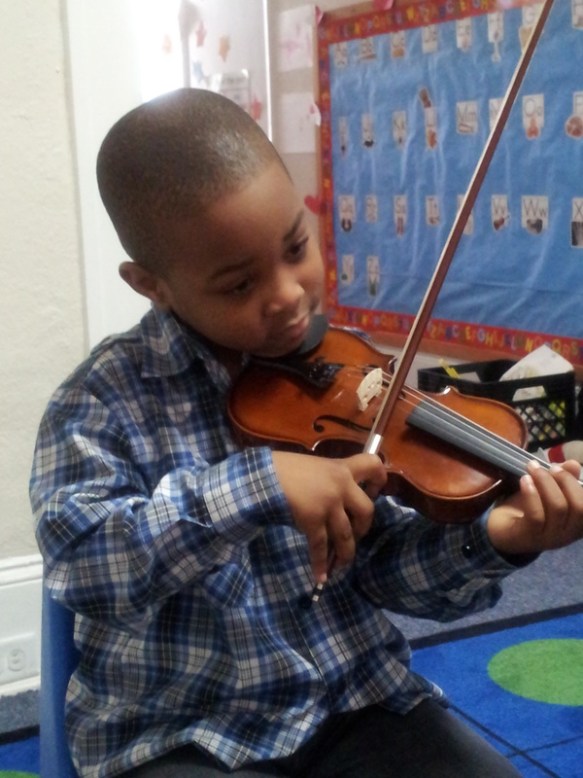
Ivan shows his form during a class on proper bowing technique.

Ivan shows his form during a class on proper bowing technique. Image used with permission of Richard Cuff.

This is the only Voluntary Pre-Kindergarten (VPK) orchestra program in the state. Why is it so important to get these children involved at the pre-school level?  

Most professionals agree that the best time to get a child involved in music education is around five years old. Very few professionals start earlier than that because of the challenges that come with a young child’s behavior. This poses a special challenge for minority children because by the time they are exposed to music at a later age in public school (if at all) they have also been exposed to the surrounding culture of rap and R&B that often makes listening to classical music unappealing. However, by beginning as early as three-years old we are able to capture the child’s mind while it is still shaping the child’s likes and dislike. Another major benefit is that at this young age the children do not become easily bored with repetition; in fact, they enjoy going over the same songs and basic lessons again and again. By the time they are four years old these children have habitually developed the discipline to begin learning the techniques that will help them master the skills to play the violin at a third grade level even before they are out of the K-5 kindergarten level.

How will that help guide them to success through college?

Each child, at the beginning of the program, learns the Rules of Music and the Musicians Pledge and repeats them on a daily basis.  These rules and the pledge sum up how this process helps guide them to success through college: 

Rules of Music – “Feet on the floor, hands to yourself, eyes on the teacher, ears open, and mouth closed so that you may breathe and relax.”
The Musician’s Pledge – “Because I am a well-behaved musician, I listen and follow directions, use self-control, respect people, instruments, and materials, and always do my best.”  

Initially it takes the parents and music mentors to remind them of the importance of the rules and the pledge, but eventually they become ingrained into the child’s mind and become the foundational tracks onto which everything else is built.

This is certainly not a solo act and it’s not every day that you see a program like this. Who are some of your partners and key people on your team?  What is your secret for success? 

If there is a secret for success it would be that we began in the early learning environment by partnering with All About Kids Preschool owned by Joann Walker, a retired Duval County Public School teacher.  She has been providing quality childcare for twenty five years and was will to underwrite the cost of the program in the first two years.  Ms. Walker already had a great relationship with the Department of Children and Families, the Duval County Early Learning Coalition, and the United Way’s Success By Six program.  This created the perfect environment in which we could build our program.  The next step was to get the buy-in of the parents and get them to understand that our program would treat the parent as the child’s first teacher and greatest mentor, holding them accountable for the child’s success.  Within the first few months we began to see evidence that the program was destined for success.

What method are you using to help the children learn so quickly; are you using any special type of music curriculum?

The moment Ms. Walker and I agreed to start this program I called on my good friend Andy Bruck, a violinist with the Jacksonville Symphony. Andy started playing violin as a child for over 45 years ago and fully understood the challenges we faced. He was also instrumental in helping me to launch the Jump Start Strings Program. He researched best practices, incorporated proven techniques, and even develop a special music notation system that helped accelerate the rate at which the children could learn to read music. We have a proven method that works and we now call it The Bruck Early Learning Music Method.

Guiding Success is now a couple of years old. Can you speak to some of the successes or impact the program has already had? 

The program is impacting the children in several ways. You only need to sit through one group practice session to know that the confidence level of the children is off the charts.  They have also developed a love for learning and sharing what they have learned with each other. One of our greatest success stories is Cedric Livingston (we call him Ceddy Bear). When he came into the program, because of being in an unstable protected custody environment, he was a shy introvert and would not talk much nor participate in class activities. After about three weeks I noticed he was beginning to clap his hands ever so slightly. Today Cedric is one of our best students. His out-going personality and brilliant smile would not give you a clue that this talkative, fun-loving, six-year old was once a shy three-year old introvert. All of our students are excelling in class as kindergarteners; our two oldest students (2nd grader and sixth-grader) are excelling as well.  After only four months in our program, then 5th grader Sarah auditioned on violin for Lavilla School of the Arts and was accepted, and this year, 2nd grader Daija will be auditioning for the Jacksonville Symphony Youth Orchestra.  There are now 35 students (a few of them adults) that are taking either daily or weekly music lessons. In the summer of 2011 we started with four students.

In addition to musical training, the program also provides other useful resources to the students and their families. How is something like a college savings account reinforced by the musical aspect of the program?

We teach our students and their parents that practice does not make perfect because, “You were perfect when you walked in the door.” Practice makes improvement. It is improvement in every area of life for which we strive. Our mission is to encourage literacy through entrepreneurship and the arts. This literacy component includes financial literacy as well as literacy for health and wellness. A college savings saving account allows us the help the parent and the child develop the habit of saving while at the same time developing the mindset to incorporate other wealth-building principles including investing and home ownership.

On the set at Fox 30 Action News during the morning show. This was the first public television performance for the students. Photo used by permission of Richard Cuff.

On the set at Fox 30 Action News during the morning show. This was the first public television performance for the students. Photo used by permission of Richard Cuff.

How do you see Guiding Success moving forward in the future?

I see Guiding Success becoming a statewide initiative and a national model. The program will become voucher-based and serve as wraparound funding to supplement VPK dollars on the State level and Head Start dollars on the Federal level. Each of our centers will feed into local public and private K-5 programs. Ultimately, I see Guiding Success being responsible for the State of Florida truly being known as a State of the Arts.  

The Division of Cultural Affairs truly believes that “Culture Builds Florida.” How will this program benefit Florida economically and otherwise as you work on expanding it to be statewide? 

This program will benefit Florida economically because as more people are encouraged to invest private dollars into early childhood education initiatives more of our young people will choose to stay in school rather than drop out, blighted buildings will be turned into rehearsal halls, parental involvement will become the norm rather than the exception and recidivism will become a thing of the past as the path to prison is circumvented by giving our children a clear path to college. It is well-known that for every dollar invested in early childhood education the state will see a return of $7 dollars. But that ROI is not only a monetary return it is also a return in social capital. Through Guiding Success we are building better citizens and equipping future leaders who now have a gift that can never be taken away and can only flourish in this positive environment.  

To learn more about Guiding Success and the J.H. Walker String Ensemble or to contact Richard about bringing this program to your community, visit guidingsuccess.org.
A Day in the Life: Karen Peterson and “Body without Text”

by Karen Peterson

Katrina Weaver, a dancer in Miami’s Karen Peterson and Dancers company, and I participated in a five-day dance workshop for individuals with and without disabilities in Belgrade, Serbia. I was the instructor of the inclusive movement classes and director of the final performance along with my Serbian colleagues, Boris Caksiran, the artistic director and Marko Pejovic, the managing director of Grupa “Hajde de” (group Let’s). This organization has a solid twelve-year history of inclusive arts and community social programs and serves a wide range of marginalized groups in the Balkans through hands on workshops and performance. They first brought inclusive dance to Belgrade in 2008 when London’s Canduco Company introduced equal rights in the dance studio.

Twenty six individuals, eight with documented disabilities, came from Slovenia, Serbia, Croatia and Bosnia came to participate in the workshop. Therapists, teachers, disability activists, students and dancers were among the participants. Many travelled six to seven hours by train or van to learn about mixed-ability dance in order to take information back to their home countries to start new groups or develop existing programs. Despite the past histories of these countries, the dance group moved seamlessly with cooperation and collaboration.

Many participants had years of dance education; others had little. However, everyone came with the curiosity of movement and the need to share and process. Self discovery was on everyone’s mind and all were encouraged to do their best and be engaged and committed to the creative process. We worked 10am – 5pm every day and dealt with movement improvisation tasks that were solved in solo, in duet or group form. Trust, honesty, challenge, understanding, patience, courage and dialogue were a few of the words that came up for discussion.  We created a safe space for communication and overcame barriers by showing what we could do by working intimately with each other.

A final structure was developed for the end performance by Boris, Marko and I. “Body without Text” looks at the labels, definitions and prejudices one places on a person before knowing the individual.  The final 35 minute performance with projections, new music and dance dealt with those many ideas.

There were eight participants with documented disabilities in the workshop (two blind, two deaf, two wheelchair users, two developmental disabilities). We were able to make a final structure for the performance where everyone participated equally. One hundred and twenty-five audience members came out to watch the performance at the Cultural Institution “Vuk Karadzic” theatre and audience members eagerly directed questions to the dancers after the showing.  New audiences experienced the joy of a diverse group moving harmoniously on stage while others cheered their favorite dance artist with audible applauds or the signing for clapping hands.

I would like to thank the sign language interpreters and the English to Serbian translators who were present for every class and rehearsal.

I would like to thank Miami Dade County Department of Cultural Affairs and the Cultural Exchange Grant from APAP for their support in making Miami / Belgrade Dance Exchange possible. In many ways, lives were changed and new possibilities discovered.

———

Karen Peterson is the Artistic Director of Miami’s Karen Peterson and Dancers, which was established in 1990. The group presents choreography created by dance artists with and without disabilities. The dancers collaborate, research, and integrate their personal movement styles and through improvisation discover an innovative dance language. The troupe acts as a positive role model for the disability community, offers new visual inspiration for traditional dance audiences, and provides the benefits of movement to children with disabilities. Learn more at karenpetersondancers.org.

Spotlight On: The Future of Arts and Culture Districts in Florida

by Bob Evans

I might dispute the claim that a river is the only feature missing from Tallahassee, but I won’t dispute that Johnny Cash lyrics always make a salient point. In a recent Emerging Leaders Blog Salon post at the Americans for the Arts ARTSblog, “Another Wide River to Cross: Incentivizing an Arts District in Tallahassee,” my colleague, Tim Storhoff, gives some excellent commentary as to why a centralized arts district can be a defining factor in the overall health of a city. The truth is that these arts and culture districts provide a community with a meaningful sense of place and purpose, the likes of which cannot be easily replicated.

Map of the Bradenton Riverwalk from http://www.realizebradenton.com

At the behest of the Florida Council on Arts and Culture, I’ve done some research on the subject of arts and culture districts. I found that these areas, intended to create a “critical mass” of places for cultural consumption, have 4 major outcomes:

  • Attracting artists and cultural enterprises
  • Fostering cultural development
  • Encouraging economic growth
  • Fulfilling community needs – both rural and urban

These outcomes are condensed from the National Association of State Arts Agencies Policy Brief on State Cultural Districts, which naturally also defines the state’s roles.  Currently, 12 states have enacted legislation for arts and cultural districts, but Florida is not among their ranks. Overall, I feel like the recognition, facilitation, and cultivation of these districts by the state is the most crucial part of the process.

Originally, I was unclear if the catalyst of these districts came from a grassroots or local effort or from the state; was it a top-down or bottom-up approach? Through my research, I discovered it was more of a growth from a younger program to an older program, where the criteria are established first, and grants, funding, and tax incentives are added later. The current models in states like Texas and Maryland support this.

Maryland is especially receptive to these districts, and has provided admissions and amusement tax exemption, income tax credit, and property tax credit for these districts, the most of any state. The benefits of these districts are astounding. Towson University conducted an economic impact study of these arts districts in Maryland, and found that “an estimated 1,621 jobs, $147.3 million in state GDP, and $49.8 million in wages were supported on average annually between 2008 and 2010.”

Florida has some excellent examples of arts and culture districts, from the Bradenton Riverwalk, to the Tampa River Arts and Channel Districts, Jacksonville’s CoRK District, Miami’s Design District, and on. But as of right now, there are no local or state systems to provide a forum for communication, nor are there direct tax incentives for these areas. If Tim’s dream comes true, there will be a vibrant district right in the middle of Tallahassee, and, as he theorizes, “If Florida’s policy makers can experience the benefits of an arts district firsthand, perhaps a statewide system can be implemented.”

Right now, it’s hard for anyone to see long term benefits of giving tax breaks, especially to relatively new programs. It’s going to take time, and we need to be cautious, which is exactly why states like Texas have adopted the certification-only approach without incentives. It’s a great way to test the efficacy of the program. But, as for the future, I’ll just have to defer back to Mr. Cash: “I don’t know. I can’t say. I don’t like it, but I guess things happen that way.

Inside the DCA: An Intern’s Perspective

by Bob Evans

Bob Evans, former intern and current staff member.

Bob Evans, former intern and current staff member at the Florida Division of Cultural Affairs.

I have this theory. The kids who dream about growing up and becoming astronauts, ballerinas, or other such fantastic professions usually end up as accountants or telecommunications network engineers. Not to say that those aren’t fantastic jobs, but to the average American eight-year-old, it’s much more accessible to imagine space or the stage. But the kids who shoot for, say, architecture or constitutional law might end up being astronauts, ballerinas, or…arts administrators?

Ok, it’s a little trite, as far as theories go.

All this to say I never would have pictured myself as a musician, let alone an arts administrator, let alone working for Florida’s state arts agency. I moved to Tallahassee to pursue an arts administration degree in the Florida State University’s College of Music, and, along the way, I somehow impressed someone enough to be invited to join the Division of Cultural Affairs as an intern.

I’ll be the first to admit to pretending I know more about the various branches and tendrils of state and local government than I actually do (with apologies to my dear, sweet, high school AP Government teacher). I understood that a state arts agency was typically a grant-making organization, but I had no clue how it functioned under the purview of state government. After seven months here at the DCA, I can assuredly say that it is just as complicated as expected but more wonderful than I could have imagined.

My duties include running for coffee, picking up dry cleaning, driving people to the airport…no, that’s wrong! All throughout my internship, I’ve been treated like a staff member, and given just as many responsibilities. I’ve worked with the Florida Artists Hall of Fame and seen firsthand the wealth of artists that promote and preserve Florida’s culture. I’ve helped organize Florida’s Poetry Out Loud contest, under the guidance of the recently retired Ken Crawford. This program, sponsored by the National Endowment for the Arts and the Poetry Foundation, encourages high school students to memorize and recite poetry by truly great poets. These students learn how to perform on stage, and by memorizing a poem, they internalize it, which is such an under-appreciated skill in today’s world of instant access. Along with my brilliant colleague Tim Storhoff, I co-author a monthly review of arts and culture events in Florida, titled “Culture in Florida” after the motto “Culture Builds Florida,” which we post at the end of each month on this very blog (shameless plug: check out March).

Florida Division of Cultural Affairs staff members in front of the Brokaw-McDougall House on Halloween.

Florida Division of Cultural Affairs staff members in front of the Brokaw-McDougall House on Halloween.

By far, the most heartening part of the job is reviewing reports where an individual or organization has received a grant of just a few thousand dollars and created inventive programming that is not only artistically resonant but engaging to a community. In those moments, when I realize what we’re doing at the DCA is directly impacting someone’s quality of life, I’m sure that this is what it’s all about. That’s the it.

Recently, due to my keenly honed ability to be in the right place at the right time, I was offered a part-time position working with Individual Artist Fellowships here at the Division. I can’t believe my luck! I’m getting paid to do what I love, and this blog post gets a happy ending after all.

Spotlight On: Poetry for All at the O Miami Poetry Festival

by Tim Storhoff

The goal of the O, Miami Poetry Festival is for every single person in Miami-Dade County to encounter a poem. This event returns in 2013 to once again attempt to deliver poetry to all 2.6 million+ residents of Miami-Dade County during the month of April, which is National Poetry Month. Created by University of Wynwood with founding sponsor the John S. and James L. Knight Foundation, O, Miami is both a celebration of contemporary poetry and an experimental project to turn a metropolitan area into a canvas for the literary arts.

In 2011, poems were flown behind airplanes, dropped out of helicopters, sewn into clothing, and attached to every single bus in Miami-Dade County. Events featured actors (James Franco); choreographers (Jonah Bokaer, Rashaun Mitchell); artists (Anne Carson, Sam Winston); and, yes, poets (W.S. Merwin, Tracy K. Smith, Raúl Zurita). The festival was covered nationally and internationally by The New Yorker, NPR’s Morning Edition, Dwell magazine, Best American Poetry, and the Associated Press, and chronicled in a new Knight Foundation report.

To continue trying to reach every person in Miami-Dade County this month, the festival organizers are undertaking a new series of projects and events to re-imagine what’s possible in the presentation of contemporary poetry, including:

  • A special celebration with Thurston Moore, lead singer of Sonic Youth; Richard Blanco, the Miami-raised poet who read at the 2013 Presidential Inauguration; and Megan Amram, a poet, comedian, and writer for the NBC show Parks & Recreation
  • A final weekend on South Beach that will feature readings and performances from the most diverse group of poets we’ve ever assembled, including Kevin Young, Chase Twitchell, Jean Portante, Jose Angel Leyva, Eduardo C. Corral, and Frank Báez
  • A book called “That’s So Miami!” published by the people of South Florida. Send us your poems that begin or end with the phrase #ThatsSoMiami and we’ll play them on WLRN 91.3 FM, post them online and select the best ones to go into the book.
  • “Poetry is Dead”: the first-ever poetry parade on South Beach featuring performances by well-known dead poets
  • A special “local poem” displayed pasted on 100 lampposts banners Will we ever see another month so full of poetry?”
  • Poems written by South Floridians flown behind airplanes
  • Brand-new “poetry films” commissioned from and created by those behind the Borscht Film Festival
  • A Tatoo + Poetry Night featuring legendary tattoo artist Duke Riley
  • A new dance + poetry piece by Merce Cunningham alumni Rashuan Mitchell and Silas Reiner commissioned and created for O, Miami
  • An opening ceremony with Miami legend Trick Daddy
  • The first-ever Miami Literary Trivia Night
  • An open mic reading series for locals
  • A “poetry soapbox”: everyday at 5 p.m., a poet will read on the front steps of The Betsy Hotel
  • A poetry-themed flash mob

“Today’s audiences demand to be engaged, and often that means taking art out of the symphony halls and into people’s everyday lives,” said Dennis Scholl, vice president/arts at Knight Foundation, whose art program inspired and funded the festival. “Whether you’re a poetry enthusiast or organizing a small music festival, the lessons from O, Miami will resonate.”

A new report commissioned by the Knight Foundation chronicles the rise of Miami’s art scene and the unorthodox, inaugural O, Miami festival. It also offers insights for any cultural organization trying to engage new audiences and reframe art for their communities. For some additional tips, check out O, Miami co-founder Scott Cunningham’s tips in Bringing Art to People: 8 Ways a Cultural Event can Transcend Genre, Geography and Demographics.

The O, Miami Poetry Festival will be taking place all throughout April, and you can visit their calendar for a list of scheduled events. If you’re a part of a cultural organization, we also encourage you to read the above reports and articles for useful information that can help us all in our goals to more successfully bring the arts and culture to all Floridians.

Culture in Florida: March

Culture In Floridaby Bob Evans and Tim Storhoff

Culture In Florida is a monthly news roundup to show our state’s wonderful diversity, spotlight the organizations and artists that contribute so much to our communities, and stress the comprehensive benefits of arts and culture to Florida’s economy and quality of life.

As promised last month, March was full of events across Florida. The Division of Cultural Affairs was busy, as were the many art, history, and science museums across the state.

Here in Tallahassee, the Florida Division of Cultural Affairs hosted our statewide Poetry Out Loud competition March 8th and 9th. The program is a contest that encourages the nation’s youth to learn about great poetry through memorization and recitation. Poetry Out Loud is a partnership between the National Endowment for the Arts and the Poetry Foundation. For a full breakdown of Florida’s event, replete with pictures, see our previous blog post.

The 2013 Poetry Out Loud Florida State Finals champion Kourtney Brooker, reciting her poem during the final round.

The 2013 Poetry Out Loud Florida State Finals champion Kourtney Brooker, reciting her poem during the final round.

Elsewhere in Florida, the Gasparilla International Film Festival was held in Tampa from March 19th to the 24th. Since its inception in 2006, the festival has continued to draw international crowds with its exciting crops of filmmakers, actors, and writers, who all come together for a week of brilliant cinema. This year’s festival was no different. One of Florida’s own independent filmmakers, Lawrence Feeney, president of Pasco Films, took home the Audience Award in the Narrative Feature category for his film, Pharmboy. The film, which was shot in Pasco County, is a fictional account of a teenager who was born addicted to prescription pills. The festival also features the work of another Floridian, Vaughn Wilkinson, who played the lead in the independent feature film Against the Grain. Wilkinson, who graduated from Tampa’s King High School in 2002, has had success in national commercials and a part on 90210.

March was also Florida Archaeology Month, and for two New College students, it paid off. Matt Andersen and Jodi Johnson won Cornelia D. Futor Archaeology Student Grants, sponsored by the Time Sifters Archaeology Society of Sarasota. The grant competition is open to undergraduate and pre-doctoral graduate students enrolled at a college in the Sarasota, St. Petersburg and Tampa area and is based on excellence in archaeology research papers.

At the Florida Museum of Natural History this month are the fossilized remains of a giant crocodile. The fossils are from the same coal mine in Colombia where the 48-foot-long “Titanoboa: Monster Snake” was discovered. “This is extremely exciting because we’ll be unpacking the first lower jaw discovered of this giant, 30- to 40-foot-long crocodile relative we believe may have actually battled Titanoboa,” says Florida Museum vertebrate paleontology curator Jonathan Bloch. University of Florida doctoral candidate Aldo Rincon discovered a tooth and lower jaw segments of an extinct hippo-like species while excavating in the Panama Canal. His research has recently been published in the Journal of Vertebrate Paleontology. The fossils are being held at the Florida Museum of Natural History for analysis.

The Jacksonville Zoo, seemingly in preparation for the upcoming 20th anniversary re-release of Steven Spielberg’s Jurassic Park, has opened its very own version of the fictional park. DinoTrek features 21 life-size animatronic dinosaurs, as well as a unique comprehensive experience. Visitors pass through a Jurassic Park-like gate, follow a foggy path to a moat, cross over on a floating dock and enter a heavily wooded area where the dinosaurs move, roar and snarl. DinoTrek also offers a dig site when kids can excavate fossils. The exhibit will continue through June 30th.

With the Voyager 1 spacecraft rapidly making its way out of the solar system, space is once again making the news in Florida. Space Florida, the state’s public/private space development corporation, wants to convince NASA to release 150 acres of its land now contained within the Merritt Island National Wildlife Refuge or Canaveral National Seashore to operate a commercial spaceport outside the security perimeter of NASA launch facilities. They will make their first appearance before the Volusia County Council on April 4th.

Saturn V rocket engines from the famous Apollo 11 mission to the moon were discovered by Jeff Bezos off of the coast of Florida. Bezos, founder of Amazon.com and its CEO, said in 2012 that he planned to recover those specific engines. The rocket engines remain property of NASA and the U.S. government, and Bezos has indicated that he would like to pull the engines to the surface and then have NASA put them on display at a museum in Seattle.

The noteworthy collaboration between the National Aeronautics and Space Administration (NASA), the John F. Kennedy Space Center Visitor Complex (KSCVC) and the Museum of Arts & Sciences (MOAS) continues with over forty pieces from the heart of the NASA art collection. Florida Celebrates Space is open at MOAS through April 28, 2013. The exhibition is offered in celebration of the 500th anniversary of Ponce de León’s discovery of Florida and illustrates the peninsula not only as a destination for the first explorers, but as a gateway for those launching to explore new worlds beyond Earth. Included are pieces by Annie Leibovitz, Andy Warhol, James Wyeth and Robert Rauschenberg. To accompany the exhibition, MOAS is offering special Florida Celebrates Space events and activities through April, 2013.

Frank J. Thomas being inducted into the Florida Artists Hall of Fame during the Florida Heritage Month Awards. Photo by Gary Pettit.

Frank J. Thomas being inducted into the Florida Artists Hall of Fame during the Florida Heritage Month Awards. Photo by Gary Pettit.

Florida Heritage Month began on March 15 and will continue until April 15. The Florida Heritage Month Awards Ceremony was held on March 20 at Mission San Luis in Tallahassee. The event included a reception, cultural performances, the Florida Folk Heritage Awards, Secretary of State Historic Preservation Awards, Florida Book Awards and the induction of artists into the 2013 Florida Artists Hall of Fame.

If you’re looking for things to do in April, it’s Jazz Appreciation Month so check out some live performances between now and Jazz Day on April 30. As always, keep your eye on the Viva Florida 500 calendar all year long and check out the local cultural calendars in your area!

Spotlight on: Italian Culture in Florida & The Italian Family Festa

Submitted by Elizabeth Ricci

This is the “Year of Italian Culture in the U.S.” according to the Italian embassy in Washington, DC. 2013 “commences a journey that will communicate and promote Italy, engage and enthuse Americans, strengthen the bonds that unite us and create new ones.” New bonds are being formed and old bonds strengthened every day here in the Sunshine State. According to the National Italian American Foundation, Florida is home to approximately eighteen Italian Festivals and just over one million people of Italian heritage.

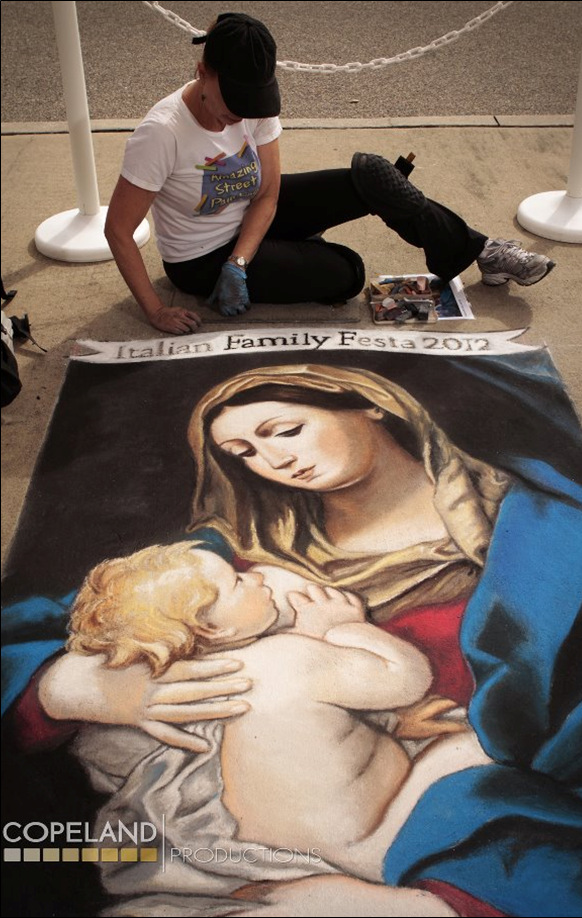
Photo by Mike Copeland. Submitted and used by permission of Elizabeth Ricci.

Photo by Mike Copeland. Submitted and used by permission of Elizabeth Ricci.

Photo by Mike Copeland. Submitted and used by permission of Elizabeth Ricci.

Photo by Mike Copeland. Submitted and used by permission of Elizabeth Ricci.

Two Italian-American women in Tallahassee, Shelley Duke and Elizabeth Ricci, recognized the need to celebrate their shared culture and founded the Tallahassee Italian Family Festa in 2010. The event was so popular that it was named “Best Inaugural Festival” by the National Association of Italian Festivals and one of the “Top Ten Festivals” to attend by the Miami Herald. Having run out of specialty Italian food the first year and out of space the second year, the third annual Italian Family Festa will celebrate all things Italian on new grounds and with an abundance of pastries and specialty foods as well as offering cultural activities and “famiglia” fun. An Italian consulate attaché will be on hand with words from the Italian Consul General in Miami.

The entertainment celebrates ancient Italian art forms including the Cirque Italiano, opera, stomping grapes and tossing tomatoes, to name a few. Artists from across the panhandle will create 3D sidewalk chalk masterpieces in the ancient Madonnari tradition which dates back to the 1500s and is named for the “Madonna” when itinerant artists painted streets near the cathedrals where they worked. The event will also feature Italian beer, wine and limoncello, bocce, a gondola, and exotic cars, and cooking demonstrations. The Italian Family Festa is not just celebrating yesteryear, however, as this year the Festa debuts the Italian Idol competition to encourage both young and old to compete in song. With separate competitions for kids and adults, two lucky winners will be crowned for their musical talents in this competition judged by local celebrities.

In addition to being the Year of Italian Culture, in 2013 Florida is celebrating Viva Florida 500 and commemorating the 500 years of history since Juan Ponce de Leon landed on Florida’s coast in 1513. Since that time, many cultures have come together in our diverse and vibrant state, and the Italian Family Festa is just one of the many cultural festivals that occur each year throughout the state.

Photo by Mike Copeland. Submitted and used by permission of Elizabeth Ricci.

Photo by Mike Copeland. Submitted and used by permission of Elizabeth Ricci.

Photo by Mike Copeland. Submitted and used by permission of Elizabeth Ricci.

Photo by Mike Copeland. Submitted and used by permission of Elizabeth Ricci.

The Italian Family Festa will take place on April 13 and 14 at the Tallahassee Automobile Museum. To learn more, visit http://www.italianfesta.org.

Spotlight On: “La Florida,” The Florida Artists Hall of Fame sculpture

by Tim Storhoff

Induction into the Florida Artists Hall of Fame is the highest honor bestowed upon creative individuals by the state of Florida. When three artists are inducted into the Hall of Fame on March 20, they will have a plaque in their honor added to the Florida Artists Hall of Fame Wall on the Plaza Level in the rotunda of the Capitol Building and receive a sculpture of La Florida by Florida sculptor Enzo Torcoletti.

Enzo Torcoletti with his most recent "La Florida" sculptures. Photo taken and used by permission of Tim Storhoff.

Enzo Torcoletti with his most recent “La Florida” sculptures. Photo taken by Tim Storhoff.

The state legislature established the Florida Artists Hall of Fame in 1986 and sought someone to produce the award that would be given to inductees. The following year, Mr. Torcoletti was contacted about the project and began working on potential designs for the sculpture.

Enzo Torcoletti was born in Italy and began studying art there before moving to Canada. He received a B.A. in English literature in 1968 and a B.F.A. in sculpture and printmaking in 1969 from the University of Windsor. He then came to Florida to continue his studies, and in 1971 received his M.F.A. in sculpture from Florida State University. He then taught sculpture, drawing, and art history at Flagler College in St. Augustine for years, and is now an Emeritus Professor. For the last forty years, Enzo has actively produced sculptures for exhibits and commissions.  His work has been shown extensively and is included in numerous private and public collections in Florida, across the U.S., and abroad. He now splits his time between his homes in Florida and Tuscany.

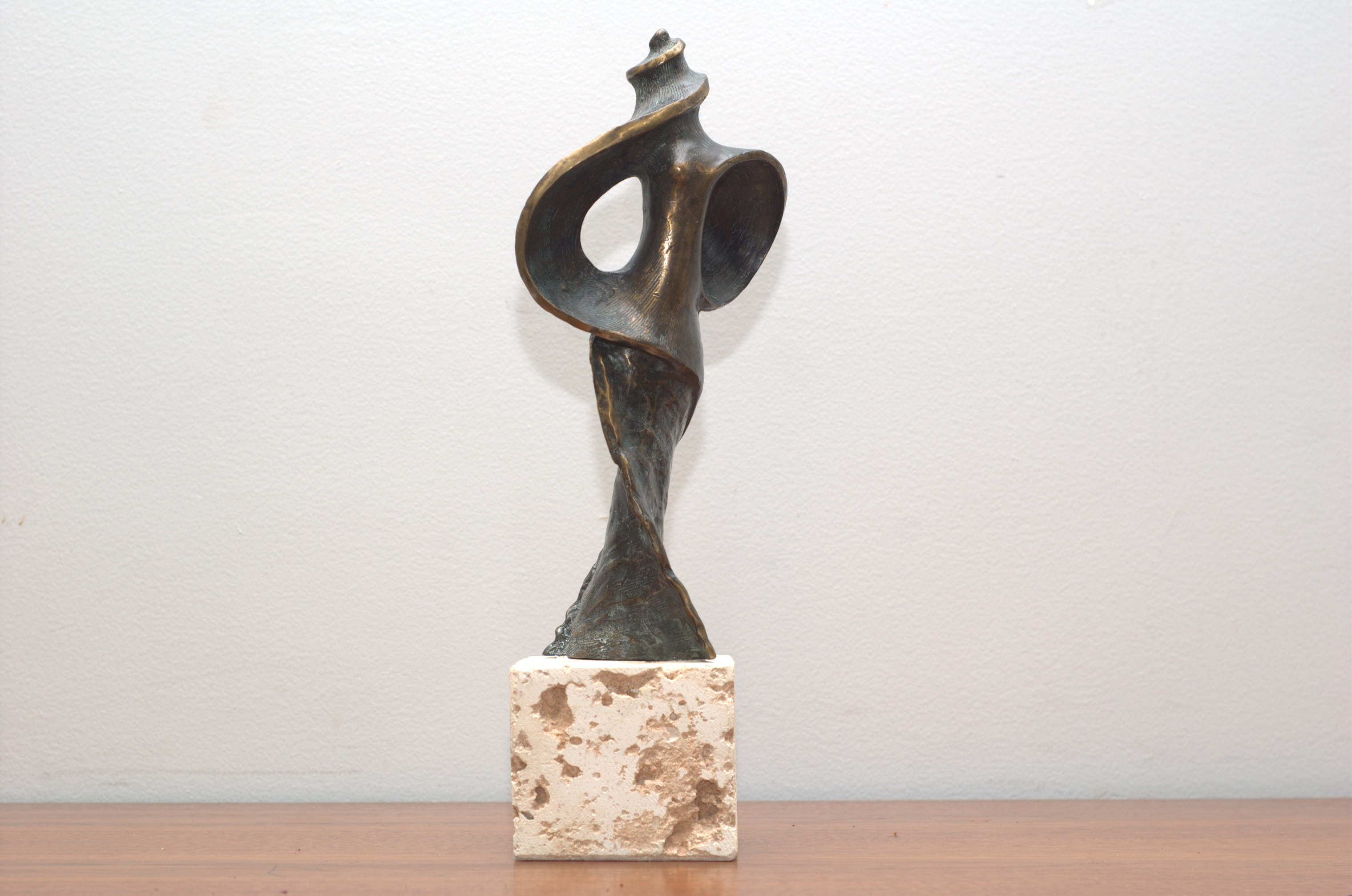
When he was selected to make the sculpture that would be given to Florida Artists Hall of Fame inductees, he began making sketches followed by more in-depth drawings. In coming up with his concept, he decided that it should be something unique to Florida. He wanted it to be semi-abstract but incorporate the female form, because when Juan Ponce de León named the land he used the feminine word La Florida. The feminine form is also representative of the Muses that according to Greek myth provide inspiration for the arts.

A preliminary drawing for a sculpture by Enzo Torcoletti. Photo by Tim Storhoff.

A preliminary drawing for a sculpture by Enzo Torcoletti. Photo by Tim Storhoff.

"La Florida," the Florida Artists Hall of Fame sculpture by Enzo Torcoletti.

“La Florida,” the Florida Artists Hall of Fame sculpture by Enzo Torcoletti. Photo courtesy of Florida Division of Cultural Affairs.

Enzo also wanted it to evoke the water and beaches associated with our state, so he chose to include elements of waves and to make it look partly like skeleton of a shell you might find after a storm. The spiral at the top of the sculpture, when viewed from above, is  like the eye of a storm during a hurricane. Enzo carved the initial model for the sculpture out of wax and then created a rubber mold before the final bronze casting using the lost-wax method. The base is made of Florida limestone resulting in a heavy and substantial award given to inductees. The original maquette prototype is on display in the Twenty-Second Floor Capitol Gallery in Tallahassee.

All of Florida’s artists contribute to our vibrant and diverse communities and show that this is a special place to live and work. We are pleased to honor those who have made the greatest contributions to the arts in Florida with this beautiful sculpture. The 2013 inductions to the Florida Artists Hall of Fame will take place during the Florida Heritage Month Awards on March 20. The award ceremony will take place in Tallahassee at Mission San Luis, Florida’s Apalachee-Spanish Living History Museum. This year’s Hall of Fame inductees include performer Gloria Estefan, singer/songwriter Frank Thomas, and painter Laura Woodward. This will make fifty-five artists who have been inducted into the Hall of Fame since the first ceremony in 1987. Other awards to be presented at Mission San Luis include the Florida Folk Heritage Awards, the Secretary of State’s Historic Preservation Awards, and the Florida Book Awards. To learn more about Florida Heritage Month, please visit http://www.floridaheritagemonth.com.

To learn more about the lost-wax method of creating a bronze sculpture, check out this video from artist Brian Owens who used it to create the St. Augustine Foot Soldiers monument: