Postcard from Martin County: Waterfront Wednesdays

submitted by Nancy Turrell, Executive Director at the Arts Council

The Arts Council of Martin County & Sunset Bay Marina invite you to come by land or sea to Waterfront Wednesdays at Sunset Bay, a weekly arts and fine handcrafts show featuring local artisans.  This new waterfront, sunset and sea focused event is a great opportunity during the Holiday Season to buy, hand crafted holiday gifts for everyone on your shopping list. The marina sets a perfect stage for select artisans to display their finest works portraying Stuart’s connection to the ocean, inlets, rivers, waterways, bays and lakes.

Visitors and arts patrons visit some of the artists booths at the inaugural Waterfront Wednesdays at Sunset Bay. Featured artists represent a variety of media including literature, painting, jewelry-making and photography. Photo Credit: Tom Winter

Enjoy art, music and nature’s stunning sunsets over the St. Lucie every Wednesday from 4 p.m. until sunset.  This free-to-the-public event includes free parking on and off site, shuttle service, valet parking, and dockage on the marina transient and dinghy docks.  Larger vessels may use the fuel dock after 5 p.m.

Participating artists include photographer Eric Wickstrom, painters Ruthann Hewson, Linda Schoppmeyer, and Bruce Wells; jewelers Francia Yaffe and Sam Uberbaum, clay artist Kym Sheppard, textile artist Judy Nichols.  The line up of artists will vary each week to offer an array of styles and genre, keeping the event interesting even for the most dedicated guest.  A variety of performers will be integrated in the event as it matures offering music, storytelling and other engaging experiences.
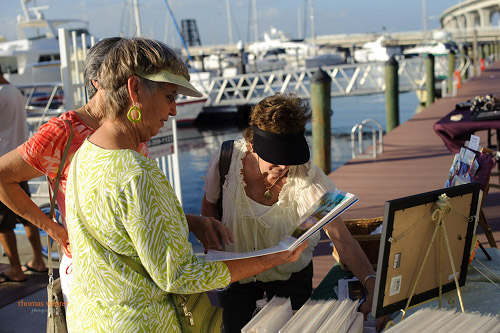
Patrons view the wide array of Palm City artist, Ruthann Hewson. Hewson is an award-winning “realistic impressionist” oil painter who grew up in Massachusetts but has resided in Martin County since the 1970s. Photo Credit: Tom Winter

Waterfront Wednesday was launched on November 16 in partnership with the Sunset Bay Marina and Anchorage in order to offers a weekly opportunity for artists to meet new customers and for residents and visitors alike to enjoy our natural beauty and the artists’ creativity.  As the designated local arts agency for Martin County, the Arts Council believes strongly in providing enhancements to our arts environment that allow artists to thrive as professionals and to provide opportunities for visitors and residents to engage in the arts.  This event will grow over time and will provide a positive economic impact to downtown Stuart, the participating artists and the sponsoring businesses.

Patrons shop at the jewelry created by “Clayworks” by Kym Shepard. Each week Waterfront Wednesdays at Sunset Bay’s Facebook page announces the artists and entertainment that will make that night special and unique. Photo Credit: Tom Winter

While speaking of economic impact, The Arts & Economic Prosperity III report provides compelling evidence that the nonprofit arts and culture are a significant industry in Martin County – one that generates $16.8 million in local economic activity. This spending – $12 million by nonprofit arts and culture organizations and an additional $4.7 million in event-related spending by their audiences – supports 456 full-time equivalent jobs, generates $9.9 million in household income to local residents, and delivers $1.4 million in local and state government revenue. This economic impact study sends a strong signal that when we support the arts, we not only enhance our quality of life, but we also invest in Martin County’s economic well-being.

The Arts Council of Martin County provides services to visual and performing artists, arts organizations, students and the public.  The Arts Council believes that the arts are a basic and vital component to an individual’s development and life fulfillment.   Programs and services of the Arts Council cultivate and celebrate the values of artistic appreciation, creativity and freedom of expression.  The Arts Council encourages programs that create opportunities for artists and arts organizations to strengthen their resources and reach all segments of our community.  For more information, please call 772-287-6676 or visit www.martinarts.org.  The Arts Council is sponsored in part by the Florida Department of State, Division of Cultural Affairs, the Florida Arts Council, the National Endowment for the Arts, the City of Stuart, Martin County Board of County Commissioners, and private contributions.
Five questions for Victor Merriam, VSA Florida Young Soloist

by Jennifer Hoesing

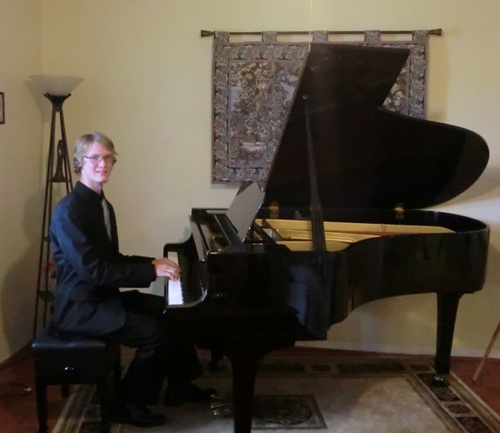
VSA Florida sponsors the Florida Young Soloists program, now in its fifth year. A statewide call for musicians and vocalists with disabilities age 25 and under is sent each spring. Three prominent music professionals adjudicate the applications and select the top two as Florida’s nominations to the VSA International Young Soloists program. The Florida finalists appear with the Florida Orchestra. Today we have five questions for Victor Merriam, one of this year’s Young Soloists.

Victor Merriam

DCA: What do you enjoy most about making music?
Victor: The thing that I enjoy the most about making music is probably the unparalleled freedom and beauty which accompanies it, where you can express yourself in beautiful ways that words never could grasp.

DCA: Why do you think it is important for people to make music?
Victor: I think it’s important for people to make music, because, like any other form of art, it’s a beautiful thing that could fade away if people just stop doing it one day.
Why are music and art important to Florida?

DCA: Do you think you will always perform music?
Victor: I believe I will always be performing music; there’s no describing the happiness it can bring to change peoples lives with what you do.

DCA: Who are your favorite musicians or artists?
Victor: Some of my favorite musicians/artists are (in no specific ranking) Valentina Lisitsa, Andre Rieu, Serge Tankian, Victor Wooten, Max Bemis, Andrea Bocelli, Salvadore Dali and Vincent van Gogh.

DCA: Why are music and art important to Florida?
Victor: Music and art are vital to parts of the economy and culture in Florida; there is an extremely large musical and artistic scene in many areas around the state, music is part of its culture since some styles of rock even originated in Tampa Bay (which continues is a melting pot for artists and musicians).

A Day in the Life: Glenn Lochrie of Glenn Lochrie Fine Art

by Jennifer Hoesing

Today’s Day in the Life feature showcases Glenn Lochrie, a fine art dealer and member of the Florida Council on Arts and Culture. Read on to learn about Glenn’s career in the arts, his involvement in his community and follow the link to his outstanding guide to Art Basel Miami Beach.

Glenn Lochrie, a fourth generation South Floridian from Fort Lauderdale, has spent his life promoting and participating in the arts.  For over 15 years he has been selling, appraising and judging fine art created by Floridians and has represented close to 60 Florida artists.  Glenn opened two award winning fine art galleries in Broward County that focused exclusively on the artists of Florida from 1850 to present. Glenn Lochrie Fine Art is currently previewing a collection of work by Miami’s own Purvis Young (1943 – 2010).

In addition to Mr. Young, Glenn’s favorite artists include A.E. Backus (mentor to the Florida Highwaymen), Skot Olsen, Todd Schorr, Mark Ryden, Andy Goldsworthy and Rembrandt.

Glenn Lochrie with Purvis Young. Image courtesy of Glenn Lochrie Fine Art.

“I have been involved in the arts in some form or another since I was a little boy.  I love Florida and spend most of my time promoting or enjoying our unique resources,” Glenn told me. “I believe the art business community is still a largely untapped resource and with the proper synergy [arts and culture] can find some new partners moving forward.”

Glenn has designed a young collectors program to introduce Florida’s young professionals to art collecting, and has given many lectures throughout the state on building a Florida art collection.  Working with local organizations in his community (including Art Serve and the Broward Art Guild), Glenn has judged art competitions and sponsored local art events and charities.  As a volunteer he helped organize an innovative art program and fundraising auction for the historic Bonnet House of Fort Lauderdale.

In his arts job, Glenn continues as an art consultant for his many clients and maintains an art gallery website; in 2010 he started a blog focusing on the arts in Florida that already has been read by people in over 134 countries.  Glenn is committed to increasing awareness and support of the unique cultural resources of Florida.

Glenn has shared the link to his annual guide to Art Basel, highlighting some of the events he plans to visit (along with some tasty treats along the way). Follow the link to learn more about the event that Glenn says makes Miami “for one week at least, the art capital of the world.”

Postcard from St. Augustine: The St. Augustine Foot Soldiers Monument

by Brian R. Owens

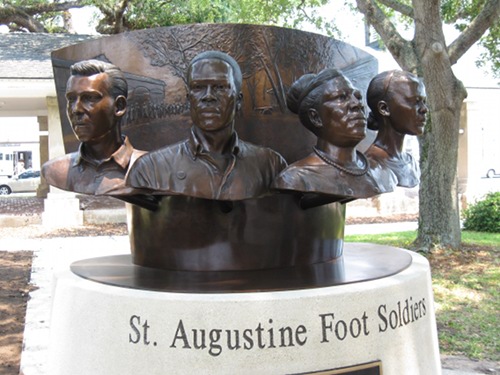
St. Augustine Foot Soldiers Monument. Bronze sculpture by Brian R. Owens of Deltona.

In May a bronze monument was unveiled in St. Augustine in remembrance of ordinary citizens who engaged in various forms of peaceful protest to advance the cause of civil rights there in 1963 and 1964. This was a critical period for the civil rights movement that had been unfolding in many states for nearly a decade. The citizens who marched in St. Augustine, who survived a staggering level of violence, are credited with helping to sustain the political pressure needed to pass the Civil Rights Act of 1964. Historian David Nolan describes it as “the most important event in St. Augustine’s modern history.” They called themselves Foot Soldiers.

Detail of monument.

I sculpted the monument for a non-profit, tax-exempt organization founded by Barbara H. Vickers, herself a Foot Soldier. Her mission: to create a monument to honor anonymous citizen-heroes connected to events that were largely unknown outside of her city; install it on the most prominent, historic property; get it done in a time when raising private funds is a challenge, when we are at risk of forgetting our own history and perhaps, of forgetting that there is nothing that can’t be done.

Vickers surrounded herself with people who knew the inner workings of city government and how to organize a project like this. The St. Augustine Foot Soldiers Remembrance Project, Inc. was driven by a small core of people but powered by over 200 individuals and 20 companies that contributed to the project. The monument is permanently installed in the Plaza de la Constitucion, a public park in downtown St. Augustine, near the corner of King and Charlotte Streets, 40 feet from a historic structure that was once used to sell slaves. The City contributed landscaping, concrete and engineering services and is now the owner of the monument. Not all public art projects can be handled this way, but this is a method worth noting.

Detail of monument.

Just after the installation, I stood around while the adhesive that connects the plaque to the stone base hardened. Two men walked up – one white and one black – seeing the monument for the first time. They were in a loud, enthusiastic discussion of how to rethink tourism, of new ways to include the monument in advertisements, of the monument as a symbol of our human ability to find creative solutions when the institutions that should protect us fail us. Neither of them was alive in 1964 and still, they connected with the art. They were so excited – so physically animated – that I had to step forward to keep one of them from accidentally knocking the plaque clean off.

Now that the epoch of the civil rights movement is over, we may see it from another angle – as those two men did. It was after all, a human achievement. I suspect that, for them, black and white is a kind of TV they don’t make anymore. Green is the color that preoccupied us at the moment and it’s not the green of the natural world. St. Augustine is a city that is dependent now, as it was in 1964, on tourism. I have no crystal ball to gauge how the monument affects their economy, but I do know how much lighter my own wallet is now that my lady-friend has rediscovered the place. Shortly after the monument was featured on the statewide public radio program “Florida Frontiers,” I received a happy message from the producer with feedback. Apparently, lots of people were planning a little weekend getaway to the “oldest city in north America.” And if the metrics of my website are to be believed, then many of the people who visit my site – and it’s a big number – get a gentle invitation to visit St. Augustine as well.

Art Talk: EcoArt South Florida

by Jennifer Hoesing

EcoArt on the West Palm Beach waterfront. Michael Singer served as the primary designer of this project, completed in 2010. This work is a significant example of the cross disciplinary work of a sculptor who has been doing large scale infrastructure related environmentally sensitive art for decades. (photo submitted by EcoArt South Florida)

Today’s Art Talk is a conversation with EcoArt South Florida. EcoArt is a multi- and cross-disciplinary practice that weds art with the best environmental science and community engagement.

A graduate of EcoArt South Florida's pilot apprenticeship program, Stuart artist Jesse Etelson works with Audubon Society staff and volunteers in providing sculptural bird nesting shelters in areas where removal of exotic trees has damaged avian habitat. (photo submitted by EcoArt South Florida)

DCA: Tell us about EcoArt South Florida.
EcoArt South Florida: EcoArt South Florida encourages broad support for environmental stewardship within communities by involving citizens of all ages and demonstrating innovative and aesthetically striking ways to create and save energy, reduce heat island effect, capture and reuse stormwater and many other positive approaches to enhancing the health of our interrelated ecosystems. EcoArt (short for ecological art) is not a new art practice. It is only new here in Florida!

Volunteers collect seeds as a part of EcoArtist Xavier Cortada's installation on Lincoln Road in Miami. Cortada is a multitalented artist whose projects to restore Florida's urban canopies and mangrove stands are large scale performance pieces involving hundreds of non artist volunteers, government agencies and philanthropic organizations. (photo submitted by EcoArt South Florida)

Cortada's EcoArt installation on Lincoln Road in Miami. (photo submitted by EcoArt South Florida)

DCA: How does EcoArt encourage the public, and in particular, elected officials, to incorporate arts and culture into everyday life?
EcoArt South Florida: EcoArt South Florida intends to assist targeted communities to establish “EcoArt Nodes” in each of South Florida’s five watersheds by 2015. We define an EcoArt Node as
a committed group of stakeholders, with a strong organization at its center (either as its own nonprofit, or as a subunit of an existing organization) dedicated to growing EcoArt and supporting emerging EcoArtists in their locale. An important stakeholder group that must always be included as each EcoArt Node is established, are elected and career officials of municipal and county governments.

The locations for our EcoArt Nodes have been scientifically identified by our GIS study of all five watersheds in South Florida, completed for us by Dartmouth College’s department of geography undergraduate students, Spring, 2011.

EcoArt South Florida’s comprehensive community education program and artist apprenticeship is specifically designed to engage key communities in best ways to establish and support strong EcoArt practices in their areas. We will work with the communities identified as EcoArt Nodes to field this program which will be the basis for ongoing development and support of EcoArt practice.

In addition to establishment of targeted EcoArt Nodes, starting in early 2012, EcoArt South Florida Board and Advisory Committee members will begin to meet where they live, with county and city officials.

To date, the only municipality in Florida we are aware of that has done this is Boynton Beach. Credit goes to Boynton’s Mayor and Commissioners for establishing a Green Alliance of local citizens involved in Green urban and community development that recommended key elements of a Green Ordinance for the city. EcoArt South Florida was a member of this alliance. The resulting new ordinance Includes mention of EcoArt at various places. We are delighted to encourage our city and county officials to follow the lead of Boynton Beach in assuring that EcoArt is included as their communities develop creative ways to “go green.”

Follow the link to learn more about how EcoArt has been integrated into Boynton’s many new green initiatives, please contact the administrator of Art in Public Places Debby Coles-Dobay.

Jackie Brookner (NY) and Angelo Ciotti (PA) are EcoArtists embedded in design team for restoration of West Palm Beach's largest urban green space, Dreher Park, revamped from 2002-2005 to expand water retention. Features "BioSculpture" (tm) in new retention pond which cleans waters with plants on the sculpture's surface, sculptural earthen mounds reminiscent of indigenous people's shell mounds, created from dirt excavated to create a large new retention pond, and a learning garden featuring plants used by inhabitants over a thousand year period to the present. (photo submitted by EcoArt South Florida)

DCA: What does EcoArt do for South Florida?

EcoArt South Florida: EcoArt practice has many identities. All contribute to the community. Most involve the community at every level of the planning, design and creation of EcoArt projects.

In addition to our consultations with communities we have identified as EcoArt Nodes, and continuing to develop our pilot community education and artist apprenticeship program, EcoArt South Florida is also currently working on three program aspects that we believe have great potential for inspiration, education and engagement of the public:

  1. First, the integration of Public EcoArt at the design stage of urban buildings and neighborhoods that will be seeking LEED or other green certification. EcoArt South Florida is working with the South Florida chapter of the US Green Building Council on this.
  2. Secondly, engaging EcoArt with greening the public schoolyard. EcoArt South Florida has been reaching out to public school districts, teachers and administrators through the annual LEARN GREEN conferences; and we are in the process of working with a math and science middle school to develop what will probably be the first comprehensive outdoor classroom in South Florida.
  3. And finally, modeling a new kind of urban streetscape featuring a variety of Florida native canopy trees (instead of the “monoculture” approach currently used) and understory vegetation that encourages the return of pollinators and birds. EcoArt South Florida is involved with a consortium of organizations developing a pilot of this kind of streetscape. Our partners include the grass roots West Palm Beach organization Northwood GREENlife that is taking the lead, the Palm Beach chapter of the Florida Native Plant Society, 1000 Friends of Florida and the Center for Creative Education. In addition to the creation of a multiple-species Florida native urban forest pilot streetscape that can be replicated widely, the project will also incorporate arts: sculpture, ceramics, video, storytelling, performance and a community celebratory procession/parade once the planting has been completed.

EcoArt South Florida believes EcoArt will not prosper in our region unless public officials, both elected and career, and our colleagues in the building, development and planning professions are given incentives to do so. It is for this reason that we will be focusing heavily over the next year to two years on insertion of EcoArt within city and county green ordinances as has been done in Boynton Beach.

DCA: What does the future of EcoArt hold for Florida?
EcoArt South Florida: We believe Florida can become one of the key centers for EcoArt practice. EcoArt South Florida is dedicated to making this happen. And this is as it should be. As we point out on our website, engagement of art and culture with environmental issues is still not widely done anywhere, not only in Florida. This is a shame, because, as those of us involved in the arts professions know well, art has the potential to inspire, educate and engage in so many ways. This inspiration and engagement will be necessary if we are to address successfully the many serious implications of climate change. And we have very little time to do this. Art is a form of knowledge, just as important as science. Unfortunately art and artists have not been adequately engaged with science in the struggle to bring our valuable ecologies back to health. Now is the time to bring EcoArt to the task.

DCA: Why do you believe arts and culture are important in the lives of Floridians and visitors to our state?
EcoArt South Florida: Art creates culture and has for as long as human being have inhabited the earth. The best time to have begun to bring art to the task of healing our fragile ecologies was many decades ago. The second best time is now. Florida needs us. The planet needs us. Let’s get to work applying artistic imagination and creativity in tandem with scientific advances to the challenges that face us.

Spotlight on Florida Symphony Youth Orchestra

by Jennifer Hoesing

High-achieving FSYO Students backstage at Orlando’s Amway Center with Josh Groban (photo submitted by FSYO)

Just last week, the Florida Symphony Youth Orchestra (FSYO) in Orlando announced its recent donation from multi-platinum singer-songwriter Josh Groban’s Find Your Light Foundation. FSYO is one of just 30 arts education nonprofit organizations selected for the honor. The Find Your Light Foundation is dedicated to enriching the lives of young people through arts, education and cultural awareness.

“Ensuring every child has the opportunity to experience an arts education is very important to me,” said Groban said in a press release about the donation. “FSYO shares this goal…and it gives me great pleasure to highlight the work they do.”

Groban was in Orlando at The Amway Arena to perform on last month as part of his “Straight To You” worldwide tour running through November. The tour supports his recent and fifth studio album, ‘Illuminations.’ The album has already been certified platinum in the U.S. Its No. 4 debut on Billboard’s Top 200 chart is Groban’s fourth consecutive Top 5 chart bow.

Cultural Conversation: Heather Stuyverson

by Jennifer Hoesing

Today’s post is an interview with our talented new intern, Heather Stuyverson. Heather is pursuing a Master’s degree in arts administration at the Florida State University College of Music. Why did Heather choose an arts administration career? Read on to find out.

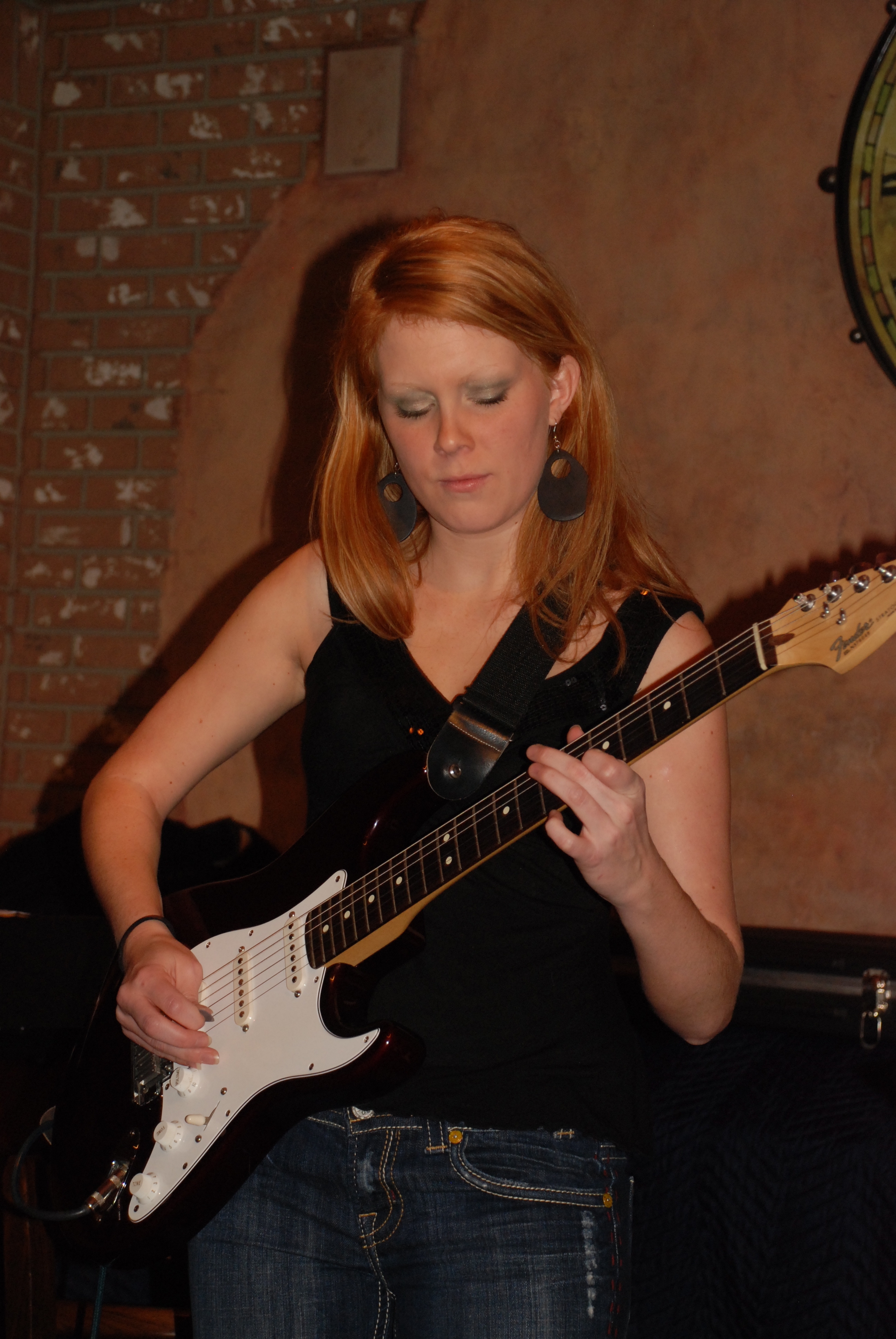
Heather Stuyverson wears many hats. Among them - rocking the Stratocaster. (photo submitted)

How long have you been involved in arts and culture?

The arts have been a part of my life ever since I was in my mother’s womb.  My mother –a ballet teacher 30 years of her life– taught dance while she was pregnant with me. At three years old my mother put me in dance classes and my experience with the arts began.  I continued to dance throughout my childhood, but it was until I was seven I discovered my true artistic passion, music.

The instrument that drew me to music was the guitar.  Throughout my life I have played various genres on the guitar, but I mainly focused on studying the genres of classical and jazz guitar during my studies as an undergraduate at The Florida State University College of Music.  In 2006, after completing a Bachelors of Arts in Commercial Music, I worked at a prominent studio in Nashville, TN and had an amazing experience in learning the process of the music industry.  Four years later, I decided to return to FSU to pursue a Masters in Arts Administration and to dedicate my career to working for non-profit arts organizations.

Today my continued involvement with the arts includes completing my masters degree, serving as the house manager for all of the Florida State University School of Dance performances, serving on FSU’s Friends of Dance board, working at the FSU College of Music Admissions office, working as an intern for the Division of Cultural affairs, teaching guitar to seven private students, and performing around town as a guitarist in various settings.

Why have you chosen arts administration as a career path?

The arts have helped shape me into the person I am today.  Whether it is an undeniable musical progression, a dance sequence, or a color scheme in a painting, the arts strike a chord within my soul.  They have impacted me to not only see life from different perspectives but they have also enhanced and broadened my views on life.

Yet when I observe my peers it seems the arts do not have the same impact on their lives.  My friends seem to have a lack of interest in attending a symphony, theater or dance performance.  Because of this I often wonder, “Is the concert arts audience dying and specifically, is it dying within my generation?”

In today’s culture, it seems to me that popular artists are reaching their audiences in ways that other artists are not.  I think there is somewhat of an emotional disconnect occurring within our culture in regards to specific art forms. In light this disconnect, I chose to pursue a career in arts administration first because of my passion for the arts, and second because of my desire to broaden the arts audience. 

What do you think arts and culture contribute to Florida?

The arts and culture industry contribute to the State of Florida both intrinsically and extrinsically.  I often think about how our world is painted in color and not black and white.  There is an indisputable beauty that surrounds us everyday in the nature of our world.  I believe arts and culture only enhance that beauty of our world and furthermore our state.  They help us identify who we are as individuals and who we are as Floridians.  The arts and culture help bring communities together and are monumental in the education of our children.

It’s also important for business-minded individuals to see how arts and culture contribute to Florida’s economy. The question is often raised, “Why should we invest in the arts over investing in something more practical?” It has been researched and proven that for every $1 that is invested in the arts, $5 is invested back into the economy of Florida.  That is a 500% return on investment!  As well, the arts and culture industry in Florida is the third largest industry in our state.  Thus arts and culture are creating jobs and furthermore attracting tourists to Florida.

What is the single greatest contribution of arts and culture to your community?

Although Tallahassee is considered a small town compared to some of Florida’s more metropolitan areas, we still have a wealth of amazing local arts organizations, universities who are known for the arts and an incredible local arts agency.  As a Tallahassee-born-and-raised girl, I have seen how the arts and culture build relationships right here in this community.  I believe that’s the single greatest contribution.  The arts bring people together and they unify community members under one purpose.  Relationships between art teachers and students, community chorus members, fellow actors in a play, just to name a few, are invaluable and only strengthen a community.

Who’s your favorite artist or musician?

How could I choose just one?  The musicians that have been the most influential to me as an artist are Ana Vidovic (classical guitarist), Pat Metheny (jazz guitarist), Alex Fox (flamenco guitarist), Dianna Krall (jazz artist) and Alison Krauss (as an all-around musician).

Cultural Conversation: The Intersection of Dance and Deviation

by Dr. Gaylen Phillips

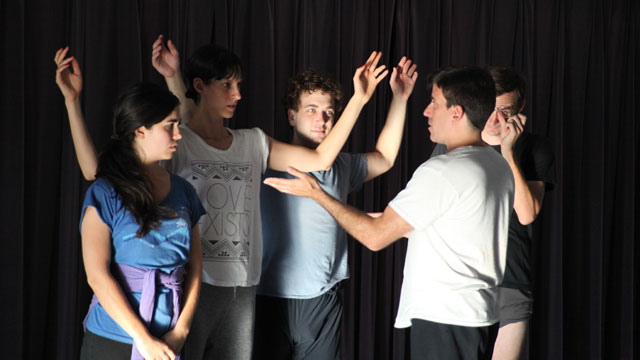
David Neumann researches movement for RESTLESS EYE. Image courtesy of mancc.org.

When Dr. Karin L. Brewster, Associate Professor and Director of the Center for Demography and Population Health at Florida State University, got a call from Ansje Burdick at FSU’s Maggie Allesee National Center for Choreography (MANCC), she was a little puzzled. Choreographer David Neumann and his collaborator Sybil Kempson wanted a meeting with Karin to discuss statistics. David is a 2007 MANCC Choreographic Fellow who is currently on the FSU campus as a Visiting Artist where his work RESTLESS EYE is currently in development.

This piece is scheduled to premier at the New York Live Arts Partnership (supported in part by the National Endowment for the Arts) on March 24, 2012. David and Sybil, accompanied by Ansje Burdick, MANCC’s Manager of Artist Services and Community Engagement, met with Karin on an October afternoon.

Dr. Karin Brewster

Karin didn’t know what to expect. What she did know is what David’s fact sheet said about his work: “Neumann’s company, advanced beginner group, will explore the realm between thought and behavior, between describing life and experiencing it . . . [they] will source various data sets and statistics based on everyday phenomena and translate this information into a deeply physical and human expression.” Sybil is developing the text.

“I liked David immediately; he has tremendous energy and charisma. What I really enjoyed was his curiosity. This drives his work,” Karin said.  David readily admits that his curiosity about everything has always been the biggest factor in his life and it is the most important tool in the development of his art. During this initial conversation, it became clear that David is interested in learning things that challenge his natural inclinations; he wants to follow where inquiry and process might lead with no preconceived ideas of the outcome.

Sybil, as the writer, was interested in the subjectivity of language/art versus the “hard rules” of science, and Karin responded that “science doesn’t exist without imagination.” But how do curiosity, data sets, and statistics translate into choreography? “That was the part I couldn’t grasp,” said Karin. “So the conversation with David and Sybil was fascinating.”

One thing the three talked about was the importance of repetition and variation to dance and to statistics; Karin even taught David and Sybil how to calculate a standard deviation, still not knowing how it would inform their work.  But, “when I attended his informal showing of the piece on October 27, I came to a new level of appreciation.” She laughed, “I’m not saying I fully understand how and what he does, but the process – the intellectual inquisitiveness – was a huge eye-opener for me. I had not thought about dance in such a way before. I now better appreciate the inspiration and originality that goes into choreographing a dance project, as well as the rigor. It was fascinating to see a performance piece in the making and, in particular, to realize the similarities in the process of creating a dance and ‘creating’ research. “

Karin was intrigued enough to ask to meet with David a second time; his visit on the FSU campus is limited and she said, “I don’t know whether this is silly, but it struck me during the October 27 showing as I listened to David explaining his process – particularly about the importance of data collection to his piece – that he might want to learn about how scientists evaluate the probability that their results represent what’s ‘true’ in the ‘real world.’ This evaluation process is where the standard deviation is truly important, and it reveals the leap of faith we make when we present our findings as reliable representations of reality.”

The second interview, then, took David a bit deeper into the underlying machinery of statistics, beyond the numbers to the realm of interpretation. “We can take ten random samples from the same population and get ten sets of statistics.  So, how do we know which set of statistics is right?  We can’t, but we can know that some sets are more likely to be right than others,” Karin recalls telling David.  “Statistics like dance is an approximation to something, a representation of some piece of the world.” This was an “aha!” moment for both of them as they realized the art of dance and the art of statistics are more connected than may at first seem obvious.

“This was one of the most fascinating and engaging encounters I have ever had,” Karin summed up. “David’s unique perspective has really given me some things to think about in my own research.”

Thanks to Karin Brewster, Ansje Burdick, Jennifer Caliennes, Ellie Couvault, Sybil Kempson and David Neumann.

Postcard from St. Lucie County

submitted by Jennifer Trefelner

In the first post of our Postcard From series, here are three cultural attractions to visit in St. Lucie county. “Come for a visit and see why we love calling this area home,” says Jennifer Trefelner, acting executive director of the Arts & Cultural Alliance of St. Lucie County.

The A.E. Backus Museum & Gallery

A.E. Backus Gallery, photo submitted

Located in historic downtown Fort Pierce, the museum is a worthwhile stop on any visitor’s itinerary. The museum’s ample free parking provides convenient access to other area attractions, casual waterside dining and boutique shopping. The A.E. Backus Museum & Gallery, a 5,000 sq. ft. public visual arts facility, was established in 1960 by A.E. Backus and a group of local art enthusiasts. Open five days a week from October through mid-June (summer hours by appointment) the museum features the Nation’s largest display of original paintings by Albert Ernest Backus.

Zora Heale Hurston Heritage Trail

Zora Neale Hurston Trail, photo submitted

The St. Lucie County Library System received a grant through the Florida Humanities Council to produce a Heritage Trail in honor of Zora Neale Hurston. The City of Fort Pierce, St. Lucie County School District, St. Lucie County Board of County Commissioners, St. Lucie County Historical Commission, the St. Lucie County Cultural Affairs Department and the St. Lucie Historical Society joined together to work on this project to chronologically represent Ms. Hurston’s impact on St. Lucie County. St. Lucie County and the City of Fort Pierce were awarded a 2004 Roy F. Kenzie Award by the Florida Redevelopment Association, naming the Trail the “Outstanding Cultural Enhancement” for the year.

The Sunrise Theatre for Performing Arts

The 1,200 seat Sunrise Theatre, located in historic downtown Fort Pierce presents national touring musical and comedy acts, Broadway shows, ballet and opera companies with full orchestras. The Sunrise Theatre directly benefits the economy and quality of life in St. Lucie County by attracting visitors from other cities, counties and states. Located within the Theatre complex is the 220-seat black box, a state-of-the-art multi-dimensional space, offering a variety of local/regional programming for organizations and renters throughout the season.

For more information on visiting St. Lucie County, point your browser to http://www.visitstluciefla.com/. Look for arts and culture activities under the “Cultural Activities” section of the site.

Postcard from Tampa: Culture Builds Florida Conference

by Jennifer Hoesing

The Culture Builds Florida Conference participants in the Jaeb Theatre at the David A. Straz, Jr. Center for the Performing Arts. Photo by Sandy Shaughnessy.

The David A. Straz, Jr. Center for the Performing Arts was the setting for Tuesday’s official launch of the Culture Builds Florida campaign. Our agency, the Florida Division of Cultural Affairs, planned a day-long conference to celebrate the successes of arts and culture, and to introduce the new Culture Builds Florida initiative. More than 200 arts and cultural administrators, artists, business representatives and cultural patrons joined us for the day’s events.

The day began with remarks from Florida’s Secretary of State and Chief Cultural Officer, Kurt S. Browning. Secretary Browning mentioned some of the tangible benefits arts and culture bring to Florida, like the 88,000 full time equivalent jobs non-profit arts and culture generated annually, the $3 billion of direct economic activity spurred by the same organizations and impressive statistics about out-of-state cultural tourists, who stay longer and spend more than other travelers.

We heard from three individuals who are making contributions to Florida’s arts and cultural community. The first was Fran Powers, executive director of Powerstories Theatre, whose organizations has served over 10,000 people in the past 12 years. Gus Nick Paras, AIA architect, spoke about the ways architecture contributes to Florida’s cultural landscape. Carol Mickett and Robert Stackhouse called on the audience to think of artists as small businesses, contributing to the economy and leading business innovation.

After a short break, Senator Nancy Detert, Representative Rich Glorioso and Representative Seth McKeel presented the group with tips for increasing advocacy success. The elected officials urged those present to educate their elected officials about arts and culture, and to shout from the mountain tops the value of arts and culture. The seventy-five minute session, which included time for questions and answers, was moderated by Malinda Horton, executive director of the Florida Association of Museums.

After a lunch break, the learning sessions resumed with sessions on social media and partnerships. The afternoon concluded with keynote remarks from Randy Cohen, Vice President for Research and Policy at Americans for the Arts. Mr. Cohen spoke about the economic impact of arts, culture and creative industries.

There has never been a more important time for our industry to speak about the benefits of arts and culture. Arts and culture can lead us to prosperity. They can and will make a difference. As our campaign moves ahead, we aim to show the ways arts and culture bring out the best in each of Florida’s 67 counties. We will tell the story loudly and proudly: Culture Builds Florida.

Tuesday’s conference was just the start.