Art Talk: Kelvin Hair

by Jennifer Hoesing

Florida artist Kelvin Hair is this year’s Black History Month featured artist. Kelvin’s work is on view in the 22nd Floor Capitol Gallery in Tallahassee through March 29 as a part of the Division of Cultural Affairs’ Capitol Complex Exhibitions program. Exhibit hours are Monday – Friday, 8:00 am – 5:00 pm. Admission is free.

Kelvin Hair grew up surrounded by art. A self-described passionate artist fueled by bold imagination, Kelvin was introduced to art as a toddler and has been creating original works of art since middle school. These days Kelvin is a widely collected Florida artist with a loyal fan base.

As a Lieutenant and 23-year veteran of the St. Lucie Fire Department, Kelvin treats art as an escape from his hectic work life. “When I paint I go into my own world and there are no worries,” Kelvin said. “I love my job as a firefighter but it is very stressful most of our calls are ambulance runs, so painting is my way of getting away from the stress at work.”

Kelvin Hair at work on a painting. (photo submitted)

Kelvin was first introduced to art by his father, famed Highwayman Alfred Hair. The younger Hair started painting on oils at age sixteen. That year A.E. “Beanie” Backus supported Hair by critiquing his artwork and encouraging his painting. Later another Highwayman, Johnny “Hook” Daniels, served as a mentor to Kelvin. “Working with these artists has been a remarkably positive thing. They have told me stories of the days of working with my father, and it gives me a feeling of being with him,” he said.

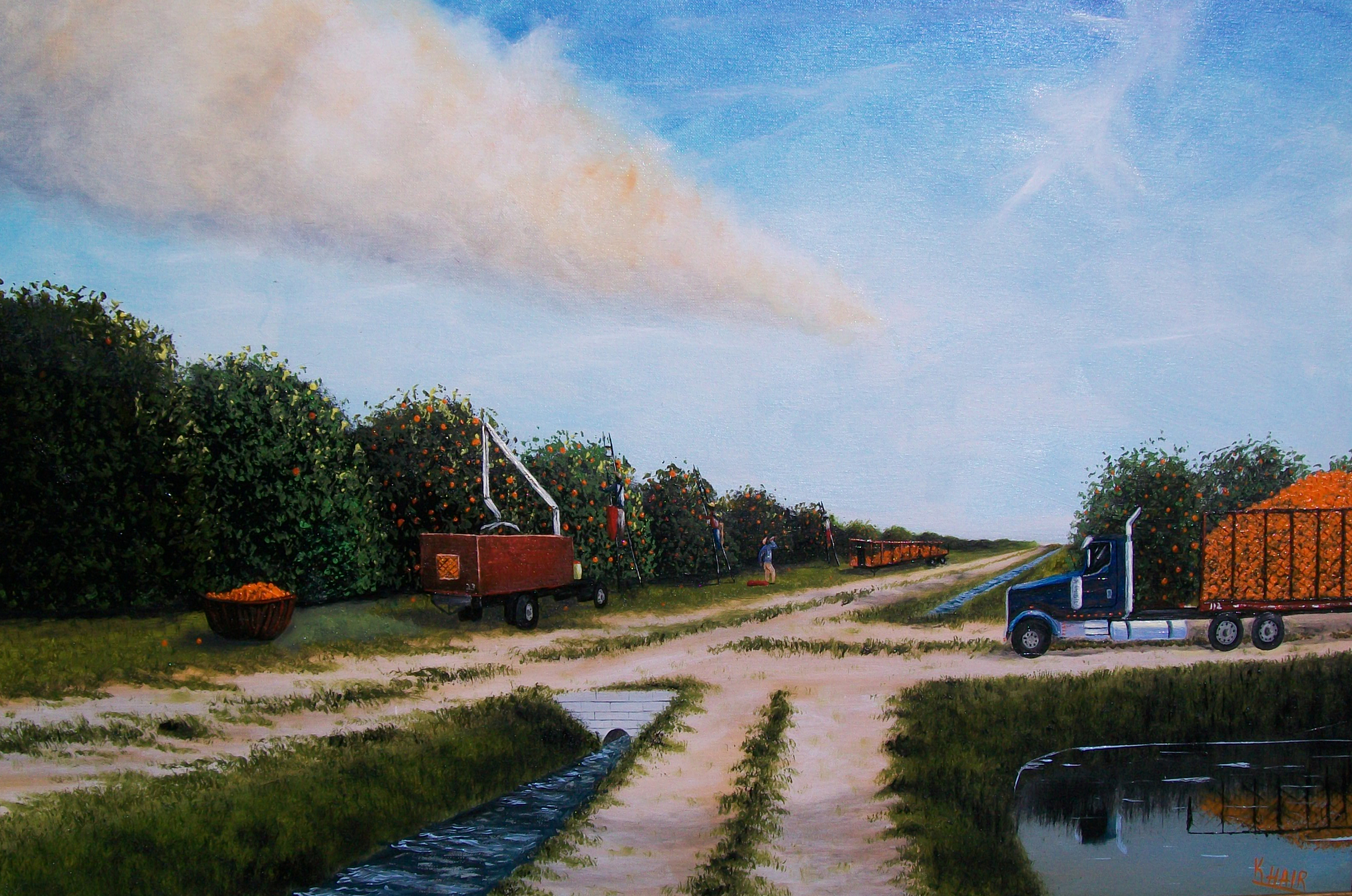
"Harvest Time" oil on canvas by Kelvin Hair on view in the 22nd Floor Capitol Gallery through March 29, 2012.

Teachers have been important and influential in Kelvin’s life and work, and in that great tradition, Kelvin is passing along art to students. He teaches at his home studio, and by offering free classes at the Children’s Home Society in Fort Pierce as well as at Macadonia Church in Gifford. “When I teach kids it is not only about the art. It’s also about teaching them to trust themselves and create something new out of what appears to be nothing,” Kelvin said. “Painting lets them know through experience that they can achieve.”

Kelvin told me all Floridians can benefit from arts and culture. “Art and culture preserve Florida’s rich history. Art & culture also show the world Florida’s creative abilities, and without those abilities you can not compete in the ever-changing world we live in.”

For more information about Kelvin and his artwork, visit www.khairart.com.

Postcard from Sarasota: The Sarasota Film Festival

submitted by Dania Permesly, The Sarasota Film Festival Outreach Coordinator

For fourteen years, The Sarasota Film Festival (SFF) has been inspiring audiences with the finest in international, independent and non-fiction cinema. The SFF celebrates the art of filmmaking and the contribution of filmmakers by hosting an international film festival. The SFF also brings important economic, educational and cultural benefits to the Sarasota community.

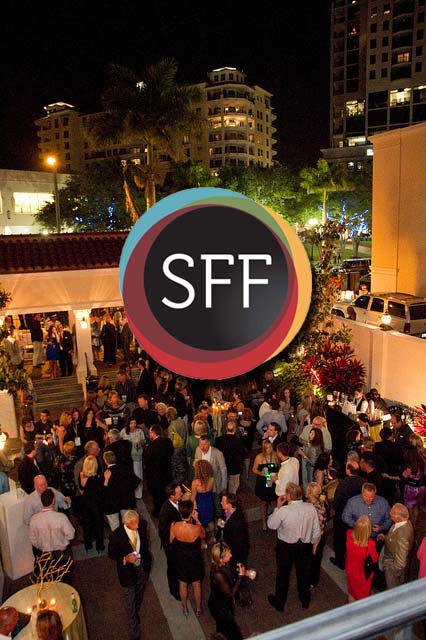
photo submitted by The SFF

The SFF truly believes that the future of film is built upon creative interaction between filmmakers and audiences. Along with screenings, which are often paired with introductions and Q&A sessions with filmmakers, the festival offers an “In Conversation” series with the most famous faces, a “Tribute” event with celebrated guests, and a variety of events encouraging mingling with industry guests in a more casual setting.

photo submitted by The SFF

The SFF invites attendees to “See Things Differently.” Through films and educational programs, The SFF provides opportunities to engage with people from different cultures, religions, genders and ages. Visitors to the festival have the opportunity to attend screenings of over 180 films from more than 45 nations.

The SFF hosted more than 50,000 patrons last year, making it one of the top ten regional film festivals in the U.S.  About half of these attendees are from outside Sarasota County and the city enjoys a great influx of enthusiasm and excitement during the Festival. Each year, local and out-of-town audience members alike enjoy the film selections and the dialogue with more than 100 filmmakers, actors and producers.

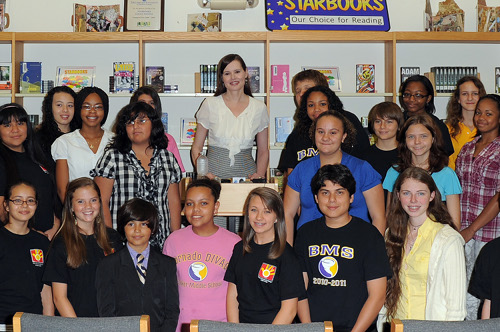
Beyond the annual festival, The SFF offers a number outreach programs. Last April, The SFF introduced a new partnership as a part of its year-round outreach activities. See Jane at SFF, is an exciting partnership with The Geena Davis Institute on Gender In Media. By encouraging young boys and girls to consider the ways gender roles are portrayed in film and in their own creative projects, the partnership creates opportunities for new cinematic stories and storytellers. The project will culminate in a film program where young filmmakers address their own ideas and concerns regarding gender representation, with Ms. Davis attending The 2012 SFF to view the completed projects and work with the young filmmakers.

Geena Davis with students participating in See Jane at SFF. Photo submitted by The SFF.

With women still dramatically underrepresented in Hollywood, The SFF is committed to putting the accomplishments of women in the film industry in the spotlight. Having established partnerships with additional organizations including The Gulf Coast Chapter of U.N. Women, Women Make Movies, and creating the Side By Side Women In Film mentoring program, SFF Women promotes independent films by women filmmakers that seek to expand awareness of the lives of women around the world.

The SFF is committed to building innovative programs to foster that growth within the community, offering a variety of ways for patrons to experience the art of filmmaking.  The SFF 2012 takes place April 13-22. Learn more at www.sarasotafilmfestival.com.

photo submitted by The SFF

Spotlight On: Faces of HIV

by Jennifer Hoesing

We Make the Change, a statewide campaign designed to increase the awareness of HIV/AIDS and its impact on communities throughout Florida, is using art to tell the story of Floridians living with HIV. Faces of HIV uses larger-than-life portraits, journal entries and interviews to explore the effects of stigmas, the personal relationships, and care issues associated with being HIV-positive.

The Faces of HIV mobile exhibit truck

It’s all part of a mobile art exhibit traveling the state.  The exhibit truck takes to the streets today at the Florida State University College of Medicine. The exhibit stops tomorrow at Tallahassee’s Governor’s Square Mall before traveling to Orlando, Miami, Jacksonville, and Tampa later this year.

“We need to eradicate stigmas,” said Thomas Liberti, Chief of the Bureau of HIV/AIDS for the Florida Department of Health, in a press release. “The Faces of HIV project allows people from across the state to experience real-life stories of inspirational and courageous individuals who have shared their difficulties, battles, and triumphs.”

Visit the Faces of HIV website to view photos, read journal entries and see videos from the participants.

A Day in the Life: Brian Owens

submitted by Brian R. Owens

Last November we featured Mr. Owens’ sculpture, the St. Augustine Foot Soldiers Monument. In today’s post, Mr. Owens shares details about a typical day in his life as a working sculptor. 

8:00 AM
The first thing I see when I open my eyes is a pile of art supplies. Eight o’clock is early for me. I’m not really awake. Carefully, I follow a path to my computer to play some upbeat light classical music that I found online. For me, music is like coffee. While my primary studio is in my home, the place only resembles a home from the outside. Inside, it would be a proper studio were it not for my current sculpture project that has transformed the studio into an unbelievable mess. This arrangement works for me but it’s easier to start working on art if I leave home and come back. I think it changes the chemistry of my brain.

9:00 AM – 10:30 AM
I start the day by re-drawing my concept for a sculpture commission that I’m competing for over coffee at a local cafe. I’ll continue this daily ritual until I’ve developed a composition I’m happy with. Naturally, I look outside myself for ideas and inspiration but I don’t wait to feel inspired before I put pen to paper. For me, habit succeeds over inspiration. Leonard Cohen said it best: “as a writer, you have to show up and go to work everyday. But you do so knowing that today it may not come … that you are not in command of this enterprise.” Today it came. I return home with a coffee in one hand and some good drawings in the other.

10:30 AM – 3:00 PM
Like most artists I know, I push myself hard. But I was unprepared for the level of sustained effort that goes into marketing and self-promotion. It’s 3 o’clock already and all I’ve done is move paper around. On average, I spend nearly half of my time doing this; a sobering statistic that I try not to think about. In a perfect world, I would have a spouse handle marketing and act as the central nervous system of this enterprise. I would also like to work in a castle overlooking the ocean, sculpt entirely from life and be loved by all. I’m not holding my breath.

5:00 PM – whenever
It’s five o’clock. Now the fun begins as I shift gears and continue work on my current sculpture commission. This one is paying the bills. Happily, I’m done with tasks that involve getting up early and working in daylight such as welding. For the next few weeks, I get to ignore the clock, work late into the night until exhaustion or collapse and wake up whenever I want, as is my custom. The plan is to apply clay to the armature I just completed. I’ve been looking forward to this part and to nightfall. With darkness comes tranquility. I enjoy company but I’m at my best when the rest of my world is asleep. The schedule requires that I accelerate progress and that’s fine, because the foundation of the sculpture is correct. One gentle, forward push of the throttle is all it will take now. The night-time is the right time.

Spotlight on Florida Symphony Youth Orchestra

by Jennifer Hoesing

High-achieving FSYO Students backstage at Orlando’s Amway Center with Josh Groban (photo submitted by FSYO)

Just last week, the Florida Symphony Youth Orchestra (FSYO) in Orlando announced its recent donation from multi-platinum singer-songwriter Josh Groban’s Find Your Light Foundation. FSYO is one of just 30 arts education nonprofit organizations selected for the honor. The Find Your Light Foundation is dedicated to enriching the lives of young people through arts, education and cultural awareness.

“Ensuring every child has the opportunity to experience an arts education is very important to me,” said Groban said in a press release about the donation. “FSYO shares this goal…and it gives me great pleasure to highlight the work they do.”

Groban was in Orlando at The Amway Arena to perform on last month as part of his “Straight To You” worldwide tour running through November. The tour supports his recent and fifth studio album, ‘Illuminations.’ The album has already been certified platinum in the U.S. Its No. 4 debut on Billboard’s Top 200 chart is Groban’s fourth consecutive Top 5 chart bow.

Cultural Conversation: Heather Stuyverson

by Jennifer Hoesing

Today’s post is an interview with our talented new intern, Heather Stuyverson. Heather is pursuing a Master’s degree in arts administration at the Florida State University College of Music. Why did Heather choose an arts administration career? Read on to find out.

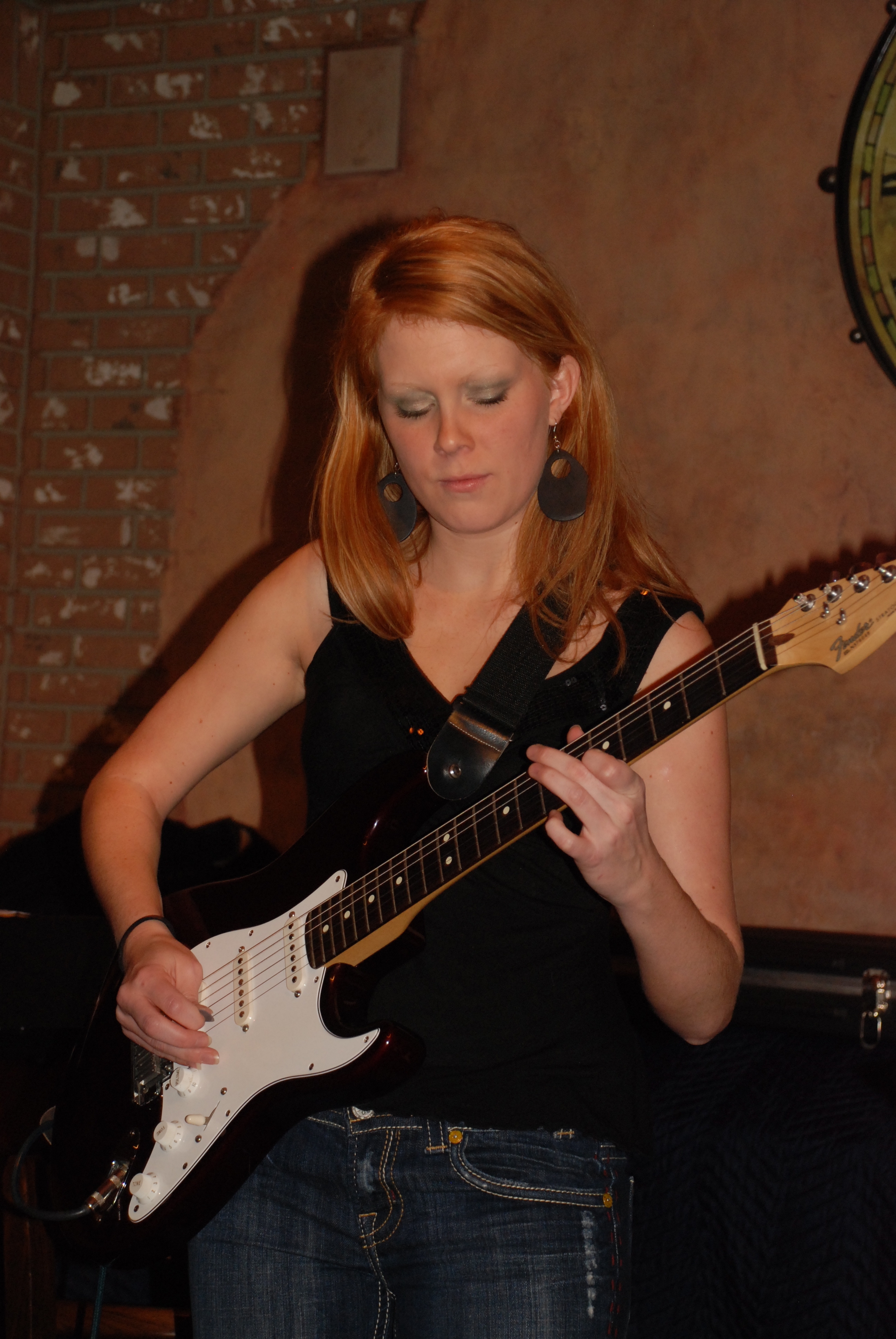
Heather Stuyverson wears many hats. Among them - rocking the Stratocaster. (photo submitted)

How long have you been involved in arts and culture?

The arts have been a part of my life ever since I was in my mother’s womb.  My mother –a ballet teacher 30 years of her life– taught dance while she was pregnant with me. At three years old my mother put me in dance classes and my experience with the arts began.  I continued to dance throughout my childhood, but it was until I was seven I discovered my true artistic passion, music.

The instrument that drew me to music was the guitar.  Throughout my life I have played various genres on the guitar, but I mainly focused on studying the genres of classical and jazz guitar during my studies as an undergraduate at The Florida State University College of Music.  In 2006, after completing a Bachelors of Arts in Commercial Music, I worked at a prominent studio in Nashville, TN and had an amazing experience in learning the process of the music industry.  Four years later, I decided to return to FSU to pursue a Masters in Arts Administration and to dedicate my career to working for non-profit arts organizations.

Today my continued involvement with the arts includes completing my masters degree, serving as the house manager for all of the Florida State University School of Dance performances, serving on FSU’s Friends of Dance board, working at the FSU College of Music Admissions office, working as an intern for the Division of Cultural affairs, teaching guitar to seven private students, and performing around town as a guitarist in various settings.

Why have you chosen arts administration as a career path?

The arts have helped shape me into the person I am today.  Whether it is an undeniable musical progression, a dance sequence, or a color scheme in a painting, the arts strike a chord within my soul.  They have impacted me to not only see life from different perspectives but they have also enhanced and broadened my views on life.

Yet when I observe my peers it seems the arts do not have the same impact on their lives.  My friends seem to have a lack of interest in attending a symphony, theater or dance performance.  Because of this I often wonder, “Is the concert arts audience dying and specifically, is it dying within my generation?”

In today’s culture, it seems to me that popular artists are reaching their audiences in ways that other artists are not.  I think there is somewhat of an emotional disconnect occurring within our culture in regards to specific art forms. In light this disconnect, I chose to pursue a career in arts administration first because of my passion for the arts, and second because of my desire to broaden the arts audience. 

What do you think arts and culture contribute to Florida?

The arts and culture industry contribute to the State of Florida both intrinsically and extrinsically.  I often think about how our world is painted in color and not black and white.  There is an indisputable beauty that surrounds us everyday in the nature of our world.  I believe arts and culture only enhance that beauty of our world and furthermore our state.  They help us identify who we are as individuals and who we are as Floridians.  The arts and culture help bring communities together and are monumental in the education of our children.

It’s also important for business-minded individuals to see how arts and culture contribute to Florida’s economy. The question is often raised, “Why should we invest in the arts over investing in something more practical?” It has been researched and proven that for every $1 that is invested in the arts, $5 is invested back into the economy of Florida.  That is a 500% return on investment!  As well, the arts and culture industry in Florida is the third largest industry in our state.  Thus arts and culture are creating jobs and furthermore attracting tourists to Florida.

What is the single greatest contribution of arts and culture to your community?

Although Tallahassee is considered a small town compared to some of Florida’s more metropolitan areas, we still have a wealth of amazing local arts organizations, universities who are known for the arts and an incredible local arts agency.  As a Tallahassee-born-and-raised girl, I have seen how the arts and culture build relationships right here in this community.  I believe that’s the single greatest contribution.  The arts bring people together and they unify community members under one purpose.  Relationships between art teachers and students, community chorus members, fellow actors in a play, just to name a few, are invaluable and only strengthen a community.

Who’s your favorite artist or musician?

How could I choose just one?  The musicians that have been the most influential to me as an artist are Ana Vidovic (classical guitarist), Pat Metheny (jazz guitarist), Alex Fox (flamenco guitarist), Dianna Krall (jazz artist) and Alison Krauss (as an all-around musician).

Cultural Conversation: The Intersection of Dance and Deviation

by Dr. Gaylen Phillips

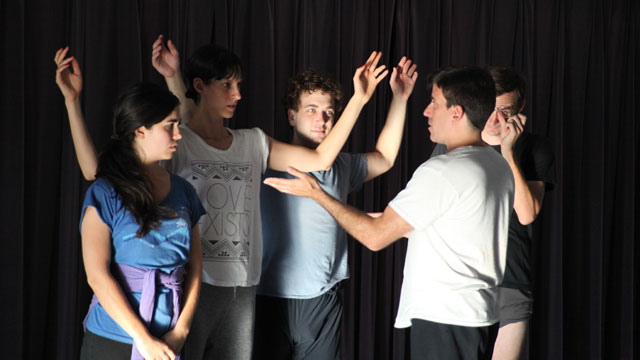
David Neumann researches movement for RESTLESS EYE. Image courtesy of mancc.org.

When Dr. Karin L. Brewster, Associate Professor and Director of the Center for Demography and Population Health at Florida State University, got a call from Ansje Burdick at FSU’s Maggie Allesee National Center for Choreography (MANCC), she was a little puzzled. Choreographer David Neumann and his collaborator Sybil Kempson wanted a meeting with Karin to discuss statistics. David is a 2007 MANCC Choreographic Fellow who is currently on the FSU campus as a Visiting Artist where his work RESTLESS EYE is currently in development.

This piece is scheduled to premier at the New York Live Arts Partnership (supported in part by the National Endowment for the Arts) on March 24, 2012. David and Sybil, accompanied by Ansje Burdick, MANCC’s Manager of Artist Services and Community Engagement, met with Karin on an October afternoon.

Dr. Karin Brewster

Karin didn’t know what to expect. What she did know is what David’s fact sheet said about his work: “Neumann’s company, advanced beginner group, will explore the realm between thought and behavior, between describing life and experiencing it . . . [they] will source various data sets and statistics based on everyday phenomena and translate this information into a deeply physical and human expression.” Sybil is developing the text.

“I liked David immediately; he has tremendous energy and charisma. What I really enjoyed was his curiosity. This drives his work,” Karin said.  David readily admits that his curiosity about everything has always been the biggest factor in his life and it is the most important tool in the development of his art. During this initial conversation, it became clear that David is interested in learning things that challenge his natural inclinations; he wants to follow where inquiry and process might lead with no preconceived ideas of the outcome.

Sybil, as the writer, was interested in the subjectivity of language/art versus the “hard rules” of science, and Karin responded that “science doesn’t exist without imagination.” But how do curiosity, data sets, and statistics translate into choreography? “That was the part I couldn’t grasp,” said Karin. “So the conversation with David and Sybil was fascinating.”

One thing the three talked about was the importance of repetition and variation to dance and to statistics; Karin even taught David and Sybil how to calculate a standard deviation, still not knowing how it would inform their work.  But, “when I attended his informal showing of the piece on October 27, I came to a new level of appreciation.” She laughed, “I’m not saying I fully understand how and what he does, but the process – the intellectual inquisitiveness – was a huge eye-opener for me. I had not thought about dance in such a way before. I now better appreciate the inspiration and originality that goes into choreographing a dance project, as well as the rigor. It was fascinating to see a performance piece in the making and, in particular, to realize the similarities in the process of creating a dance and ‘creating’ research. “

Karin was intrigued enough to ask to meet with David a second time; his visit on the FSU campus is limited and she said, “I don’t know whether this is silly, but it struck me during the October 27 showing as I listened to David explaining his process – particularly about the importance of data collection to his piece – that he might want to learn about how scientists evaluate the probability that their results represent what’s ‘true’ in the ‘real world.’ This evaluation process is where the standard deviation is truly important, and it reveals the leap of faith we make when we present our findings as reliable representations of reality.”

The second interview, then, took David a bit deeper into the underlying machinery of statistics, beyond the numbers to the realm of interpretation. “We can take ten random samples from the same population and get ten sets of statistics.  So, how do we know which set of statistics is right?  We can’t, but we can know that some sets are more likely to be right than others,” Karin recalls telling David.  “Statistics like dance is an approximation to something, a representation of some piece of the world.” This was an “aha!” moment for both of them as they realized the art of dance and the art of statistics are more connected than may at first seem obvious.

“This was one of the most fascinating and engaging encounters I have ever had,” Karin summed up. “David’s unique perspective has really given me some things to think about in my own research.”

Thanks to Karin Brewster, Ansje Burdick, Jennifer Caliennes, Ellie Couvault, Sybil Kempson and David Neumann.

Postcard from St. Lucie County

submitted by Jennifer Trefelner

In the first post of our Postcard From series, here are three cultural attractions to visit in St. Lucie county. “Come for a visit and see why we love calling this area home,” says Jennifer Trefelner, acting executive director of the Arts & Cultural Alliance of St. Lucie County.

The A.E. Backus Museum & Gallery

A.E. Backus Gallery, photo submitted

Located in historic downtown Fort Pierce, the museum is a worthwhile stop on any visitor’s itinerary. The museum’s ample free parking provides convenient access to other area attractions, casual waterside dining and boutique shopping. The A.E. Backus Museum & Gallery, a 5,000 sq. ft. public visual arts facility, was established in 1960 by A.E. Backus and a group of local art enthusiasts. Open five days a week from October through mid-June (summer hours by appointment) the museum features the Nation’s largest display of original paintings by Albert Ernest Backus.

Zora Heale Hurston Heritage Trail

Zora Neale Hurston Trail, photo submitted

The St. Lucie County Library System received a grant through the Florida Humanities Council to produce a Heritage Trail in honor of Zora Neale Hurston. The City of Fort Pierce, St. Lucie County School District, St. Lucie County Board of County Commissioners, St. Lucie County Historical Commission, the St. Lucie County Cultural Affairs Department and the St. Lucie Historical Society joined together to work on this project to chronologically represent Ms. Hurston’s impact on St. Lucie County. St. Lucie County and the City of Fort Pierce were awarded a 2004 Roy F. Kenzie Award by the Florida Redevelopment Association, naming the Trail the “Outstanding Cultural Enhancement” for the year.

The Sunrise Theatre for Performing Arts

The 1,200 seat Sunrise Theatre, located in historic downtown Fort Pierce presents national touring musical and comedy acts, Broadway shows, ballet and opera companies with full orchestras. The Sunrise Theatre directly benefits the economy and quality of life in St. Lucie County by attracting visitors from other cities, counties and states. Located within the Theatre complex is the 220-seat black box, a state-of-the-art multi-dimensional space, offering a variety of local/regional programming for organizations and renters throughout the season.

For more information on visiting St. Lucie County, point your browser to http://www.visitstluciefla.com/. Look for arts and culture activities under the “Cultural Activities” section of the site.

Postcard from Tampa: Culture Builds Florida Conference

by Jennifer Hoesing

The Culture Builds Florida Conference participants in the Jaeb Theatre at the David A. Straz, Jr. Center for the Performing Arts. Photo by Sandy Shaughnessy.

The David A. Straz, Jr. Center for the Performing Arts was the setting for Tuesday’s official launch of the Culture Builds Florida campaign. Our agency, the Florida Division of Cultural Affairs, planned a day-long conference to celebrate the successes of arts and culture, and to introduce the new Culture Builds Florida initiative. More than 200 arts and cultural administrators, artists, business representatives and cultural patrons joined us for the day’s events.

The day began with remarks from Florida’s Secretary of State and Chief Cultural Officer, Kurt S. Browning. Secretary Browning mentioned some of the tangible benefits arts and culture bring to Florida, like the 88,000 full time equivalent jobs non-profit arts and culture generated annually, the $3 billion of direct economic activity spurred by the same organizations and impressive statistics about out-of-state cultural tourists, who stay longer and spend more than other travelers.

We heard from three individuals who are making contributions to Florida’s arts and cultural community. The first was Fran Powers, executive director of Powerstories Theatre, whose organizations has served over 10,000 people in the past 12 years. Gus Nick Paras, AIA architect, spoke about the ways architecture contributes to Florida’s cultural landscape. Carol Mickett and Robert Stackhouse called on the audience to think of artists as small businesses, contributing to the economy and leading business innovation.

After a short break, Senator Nancy Detert, Representative Rich Glorioso and Representative Seth McKeel presented the group with tips for increasing advocacy success. The elected officials urged those present to educate their elected officials about arts and culture, and to shout from the mountain tops the value of arts and culture. The seventy-five minute session, which included time for questions and answers, was moderated by Malinda Horton, executive director of the Florida Association of Museums.

After a lunch break, the learning sessions resumed with sessions on social media and partnerships. The afternoon concluded with keynote remarks from Randy Cohen, Vice President for Research and Policy at Americans for the Arts. Mr. Cohen spoke about the economic impact of arts, culture and creative industries.

There has never been a more important time for our industry to speak about the benefits of arts and culture. Arts and culture can lead us to prosperity. They can and will make a difference. As our campaign moves ahead, we aim to show the ways arts and culture bring out the best in each of Florida’s 67 counties. We will tell the story loudly and proudly: Culture Builds Florida.

Tuesday’s conference was just the start.

Art Talk: Questions for Jeffrey Scott Lewis

by Jennifer Hoesing

Jeffrey Scott Lewis is a Fort Myers, Florida based painter. We asked him a few questions for our first Culture Builds Florida Art Talk.

Jeffrey Scott Lewis

Division of Cultural Affairs (DCA): Do your remember your first artwork?
Lewis:
Actually I do.  My drawing skills were noticed before I was in school.  The first time my talent was acknowledged in a public way was in the first grade when my teacher, Mrs. Baxter, appointed me to use the entire blackboard and her colored chalks to draw Santa Claus.  Of course, even then, I took it to the next level by drawing a big red sleigh drawn by eight reindeer, the first one with a red nose.  I was very excited by the colored chalks.  They were obviously special.

I still have my first painting.  It is a watercolor and pastel of a chihuahua, our family dog.  The first time I was paid for my efforts I was 15 years old and the local pharmacist hired me to hand letter some signs for his store. That led to me doing a pen and ink drawing of his store.  Throughout high school, I sold my pen and ink drawings, and many of them still grace the walls of the homes they were commissioned for.

DCA: How do you describe your current artwork?
Lewis:
My art, regardless of the medium, is always very process-oriented.  Meaning, the act of making it, the idea behind it, is usually more important that what the final piece actually is. To me the idea is important; not so much what it looks like, but the idea behind it.  I love making art, and I really love the process of making art.  Nothing excites me more than having an idea and then fully exploring the concept through trying various ways to realize the idea.

A New Day by Jeffrey Scott Lewis

As far as what my work looks like, it is usually very colorful, and my use of color is always very calculated in terms of the emotional impact.  I try to use texture as much as possible.

I also use found objects and recycled materials whenever I find inspiration.  I find beauty in the simplest objects. Right now, I’m working on a piece made of the red wax casings from miniature cheese rounds.  I have used gum wrappers, plastic caps, scrap metal, and videotape among other materials to make sculpture, collages and mixed media pieces.
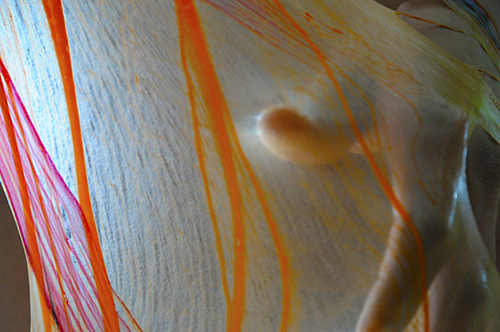
Feel Me by Jeffrey Scott Lewis

DCA: What are you currently working on?
Lewis: I just got a Kickstarter project approved to fund the production of an exhibit of my new work, photography.  I am very excited about this new work. It resulted from an effort to make images for photo transfers, and that’s something I’ve become very interested in this year.  The images turned out so far beyond what I anticipated that I decided they should be shown as photography, abstract photography.  These images actually moved me to tears as I reviewed them for the first time. That’s one thing I love about photography, you don’t see the image as you make it.  You only see it after it is uploaded to the computer.

The images are about self-acceptance and the shedding of layers of false identity and the resulting sense of freedom.  Even though they are photography, they still have a lot of the qualities of my paintings.  I plan to produce them on aluminum in limited editions.  The first show is scheduled at the Arts for ACT Gallery in downtown Fort Myers, the site of my first solo show, in April 2012.

DCA: What artistic achievement are you most proud of?
Lewis: When I was selected to be one of 39 artists in the RedBull Art of Can exhibit in 2007 at River East Art Center in Chicago. It was my first show out of the state of Florida.  Even though an 8’ tower made of crushed RedBull cans is not necessarily my most important work, seeing my name and work being selected for the marketing of the show was very exciting.  I had dreamed of seeing my name and work on a museum banner. Actually seeing it on the 60-foot banner that rose from the first floor to the roof of the six-story building took my breath away.  It got even better as I saw 8-foot versions of that banner all over downtown Chicago!  I felt like a famous artist.

DCA: Besides art, what are you most passionate about?
Lewis:
I’ve said before that the most important thing I’ll ever do is raising my three children. I would say I am very passionate about that.  I’ve been a single dad for over ten years now. The time I have spent as a stay at home dad is what allowed me to fully develop my own body of work and exhibition record as well as finish my Master of Fine Arts degree.

My kids are all adopted, and promoting the adoption of children waiting in the foster care system is another passion of mine.  No child should grow up without a permanent family when there are couples yearning for a child.  Adopting through the State of Florida is one of the best things I’ve ever done.  My Recycling Children series is my effort in that direction.  Sometimes art can change the world.  If only one child was adopted from foster care because a family was inspired by the message in my work, then I have changed the world.  That would make me a success.

DCA: What do you believe is the most valuable thing artists contribute to making Florida a great place to live, work and play?
Lewis:
The idea is the most important thing in art to me, and that is what makes having a strong and vital art community important to the State of Florida as a great place to live, work and play.  The process of making art often yields unexpected results from the simple exploration of an idea.  That is important to any community. The benefits of those unexpected results can have a positive affect on the business community, tourism, education and increasing the quality of life for our citizens and our visitors.  It is so much more important than decoration, which is how most people tend to think of art.

DCA: Why is Florida arts and culture important to you?
Lewis:
Arts and culture are important because it tells the world who we are. I believe Floridians should support that. What would South Beach be today if the visionary designers of the original Art Deco buildings had been considered extravagant, impractical or unnecessary? Between the design and the wonderful mix of cultures from around the world, South Beach is like nowhere else on earth.  That same formula works everywhere.  Every Florida town has a story and a history that can make it special.  Finding that special story, supporting it, preserving it and encouraging it is what supporting arts and culture is all about. It brings out the best in all of us.