A Day in the Life: Don Gruel and Noel Holland of Atlantic Coast Theatre

by Don Gruel and Noel Holland as told to Jennifer Hoesing

A Day in the Life will focus on careers and jobs in arts and culture. Our first post in this series features Don Gruel and Noel Holland of Atlantic Coast Theatre for Youth (ACT). Don and Noel tour with Atlantic Coast Theatre and are part of the Division of Cultural Affairs’ Florida Arts on Tour roster.

Don and Noel, a husband and wife team, founded ACT in 1999.  Since its inception, ACT has served more than half a million audience members with 1,800 performances in 17 states. ACT is a professional theatre company, and Don and Noel earn their living performing.

ACT recently performed new show, SHERLOCK HOLMES & THE OPERA MYSTERY for students in the Destin/Ft. Walton area, presented by the Mattie Kelly Arts Foundation. Here’s “A Day in the Life” with ACT during their trip.

Every good tour day starts with a good cup of coffee – the stronger, the betterI Noel and our “tour manager” Dijon take in the morning air at Henderson Beach State Park.

We make the drive to Destin Elementary, our first school for the day.  We’ve been here many times before, so we know which spot we can squeeze the RV into so it is out of the way of the busses.  The SHERLOCK HOLMES show has a lot of stuff to it.  Backdrop set pieces, set furniture, sound equipment, props, costumes and a violin.

No tour day is complete without having to fix something.  Today it happens to be the tire on our folding cart.

Consistently we make it our goal to design a one-cart show.  It doesn’t always work out, but we seem to have gotten lucky with this one.  Don will likely change “the pack” repeatedly over the run of the show to try to get the best possible use of space!

Every performance space is different.  We are lucky to have a great stage here at Destin Elementary with full curtains and lights.
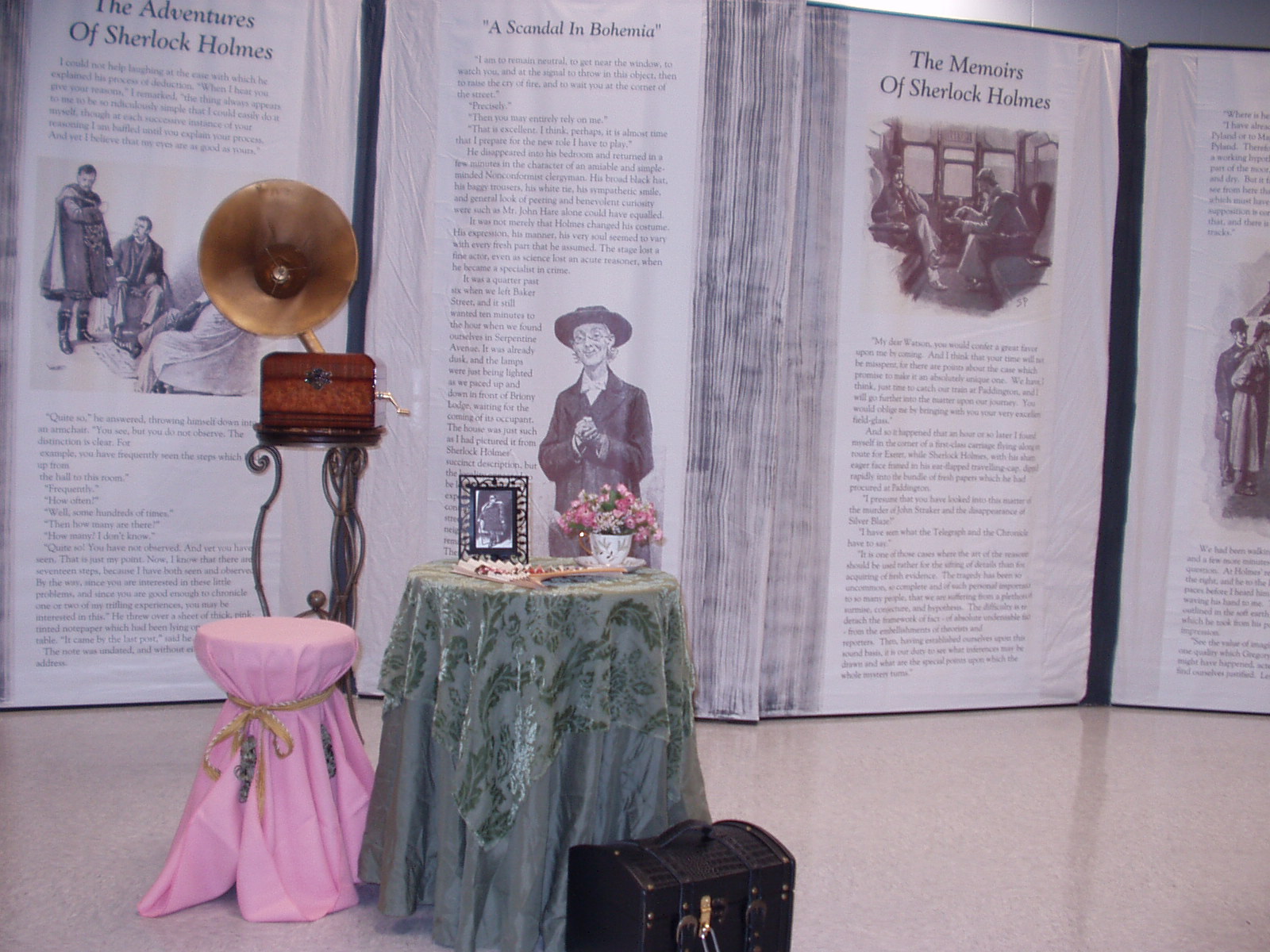
Here’s the front view of the set at Destin Elementary.  This background shows large pages of the Sherlock Holmes books.  We’ve heard many kids commenting about how big the books are and how much they like it while we wait backstage to begin.
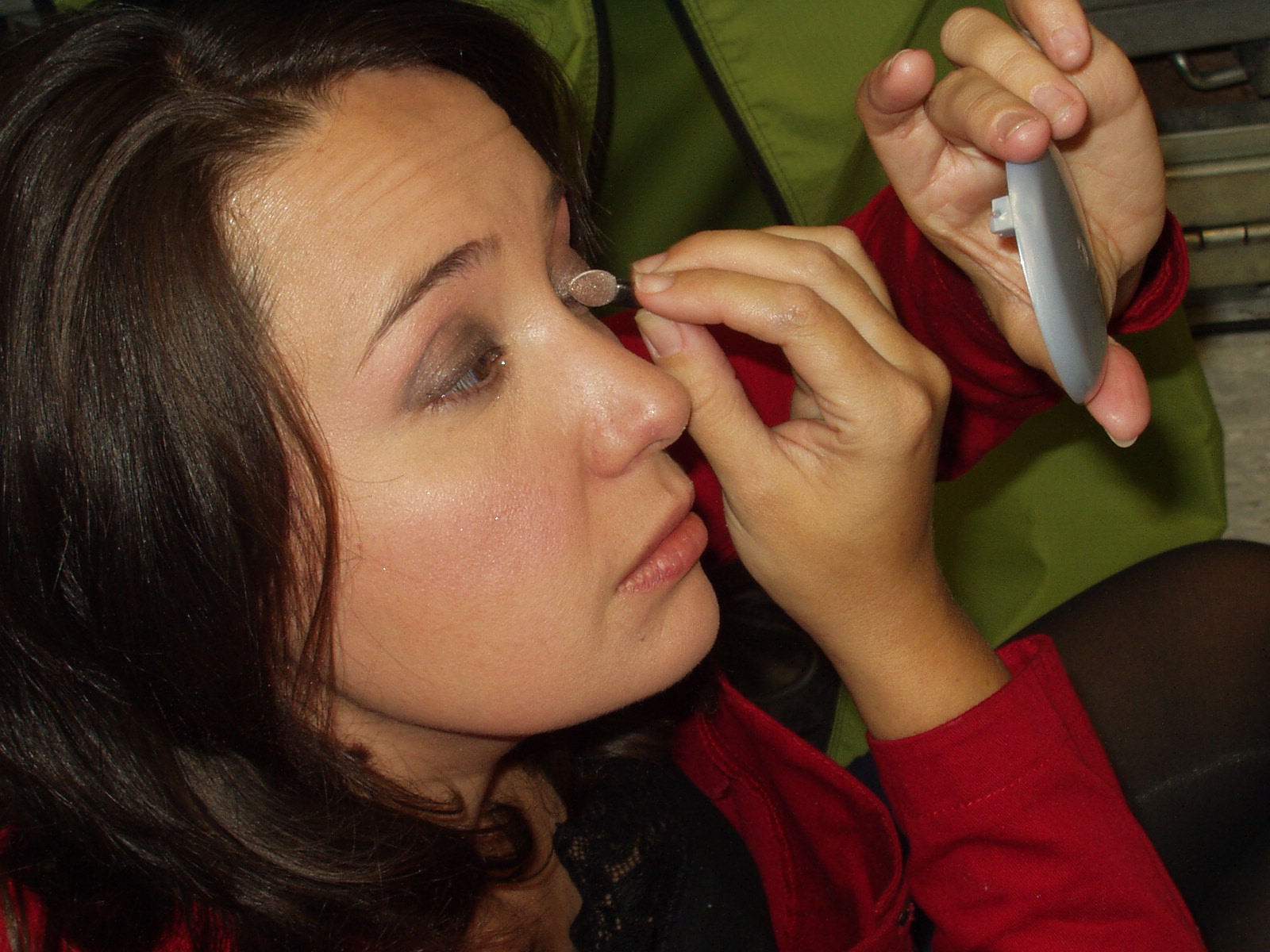
Here’s Noel getting into makeup in preparation for her two roles in the show.  First, he beautiful American opera singer, Irene Adler:
…and the charming Mr. Hinkleton who is arrested by Sherlock Holmes in our “James Bond” opening.

Our dressing room and makeup mirror are a bit different from a standard theatre.  Every day is different and we adapt to our space.  The folded chorus risers make great prop tables.
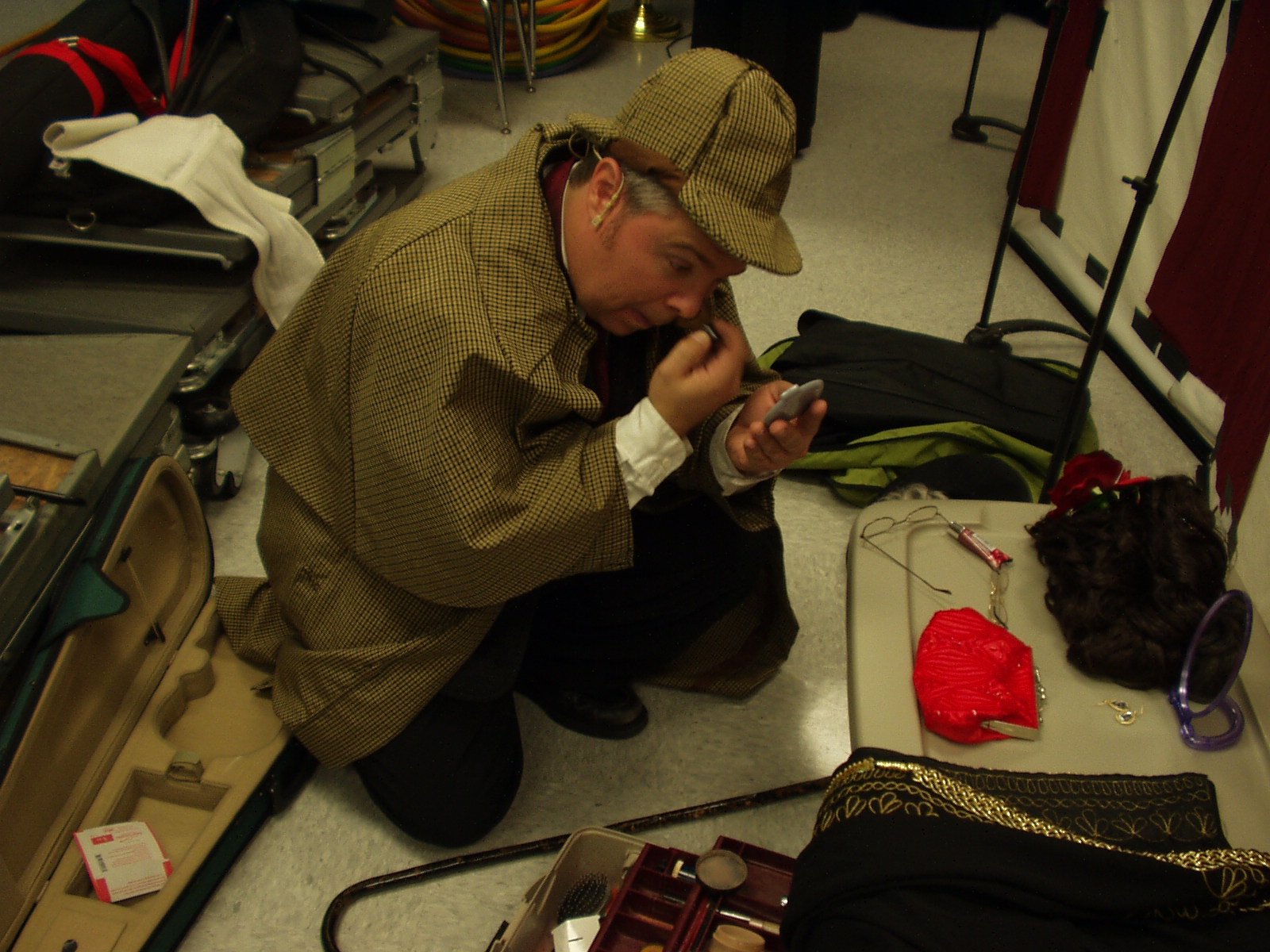
Noel has time to snap a picture backstage during the show after her costume change.  On the other side of the set, Don is investigating the mystery in front of around 400 students.  Sherlock Holmes always has his partner, Watson, with him.  Watson is picked from the audience every day. It’s so much fun for the kids to see their classmate onstage in a bowler hat!

After a great first show, Don deals with business end of things.   We take calls and emails throughout every tour day.  It can sometimes be a challenge to wear all the hats: we are actors, playwrights, accountants, composers, business managers, costume designers, mechanics and truck drivers all in one.

We grab lunch on the road and head for our second show at Bluewater Elementary School.  It’s a long way to the cafetorium from the parking lot, but the kids are always fantastic at this school.

Our sets are flexible to just about any performance space.  We can make things larger or smaller depending on our needs.  The stage at Bluewater is pretty wide, so Noel is making adjustments.

The set is up on the Bluewater stage.  We are now waiting for 400 third, fourth and fifth graders to file in and watch the mystery unfold.

After 18 years of working in touring theatre, Don has acquired the ability to sleep on any backstage surface – wood, tile, concrete, you name it. Here he is grabbing a little bit of rest before the show.

This show was terrific. We had great feedback afterwards from the audience during our question & answer. Students always want to know if Noel is really singing of The Habanera from Carmen. It is!
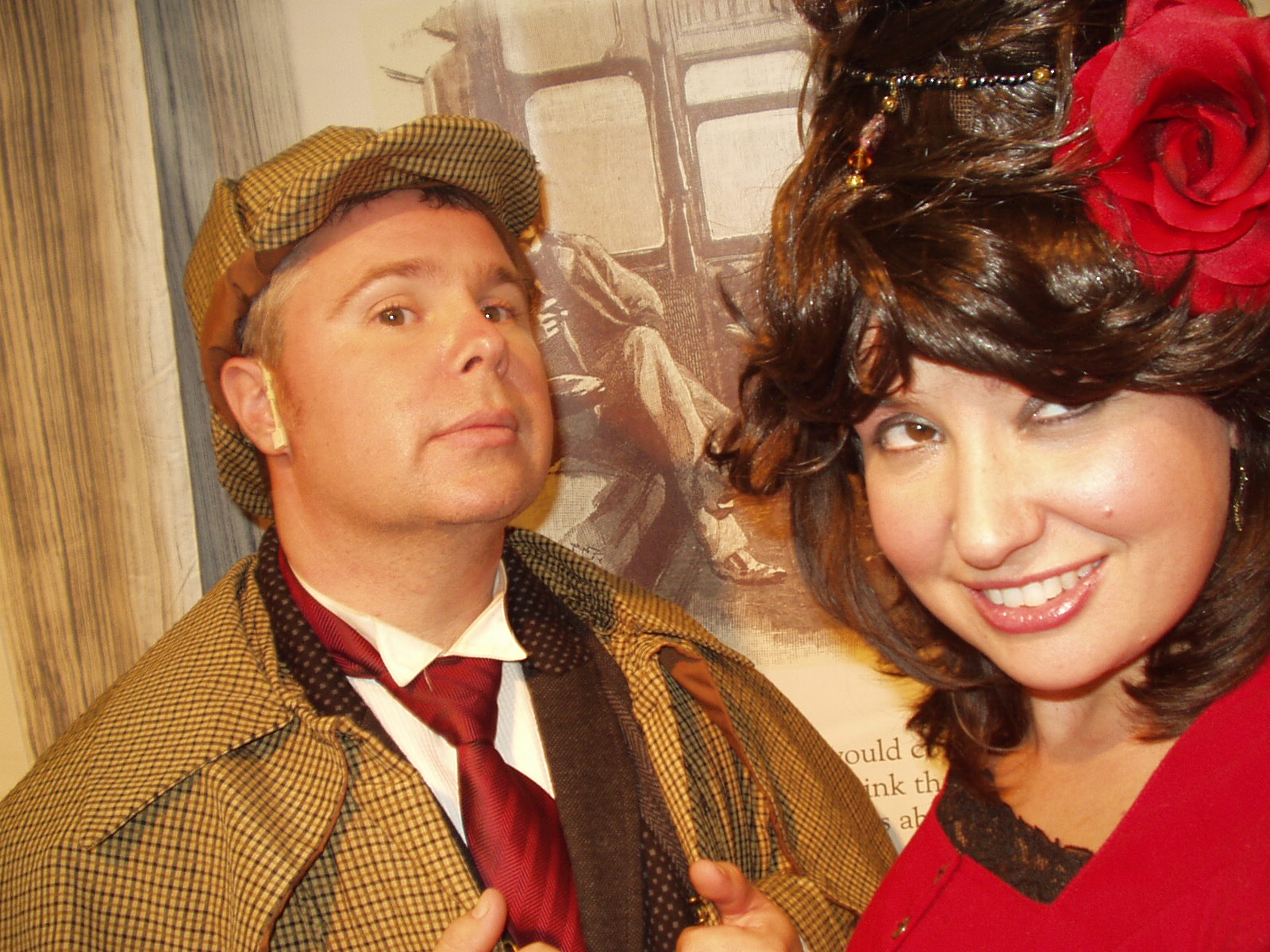
Well, you can’t control the weather. Remember how it was a really long way back to the RV in the parking lot? Seems even further in a torrential downpour!
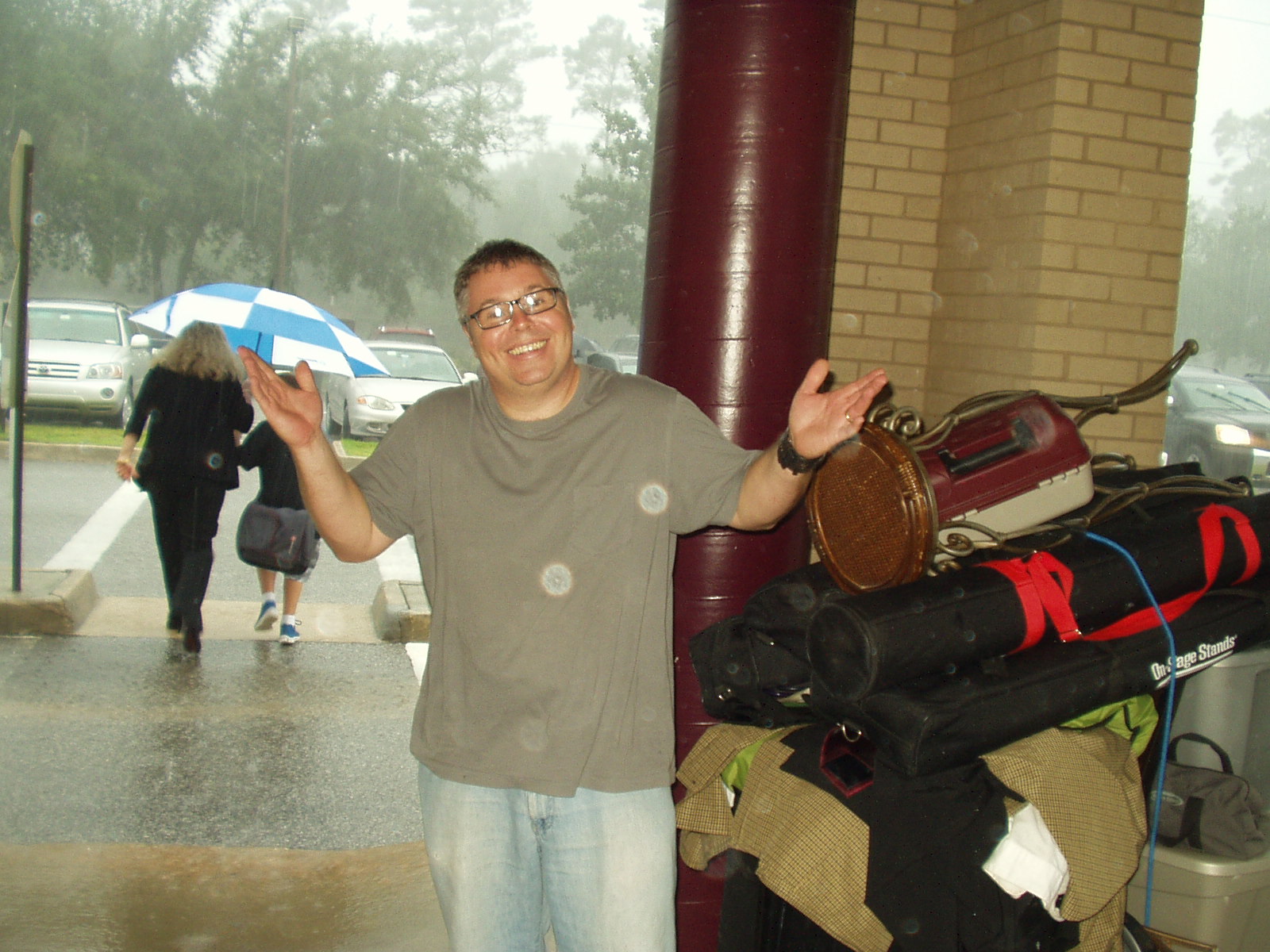
We have covered up the set and sound gear.  We are rarely at campground long enough to use the awning, but it comes in handy for rainy load-outs more than once.
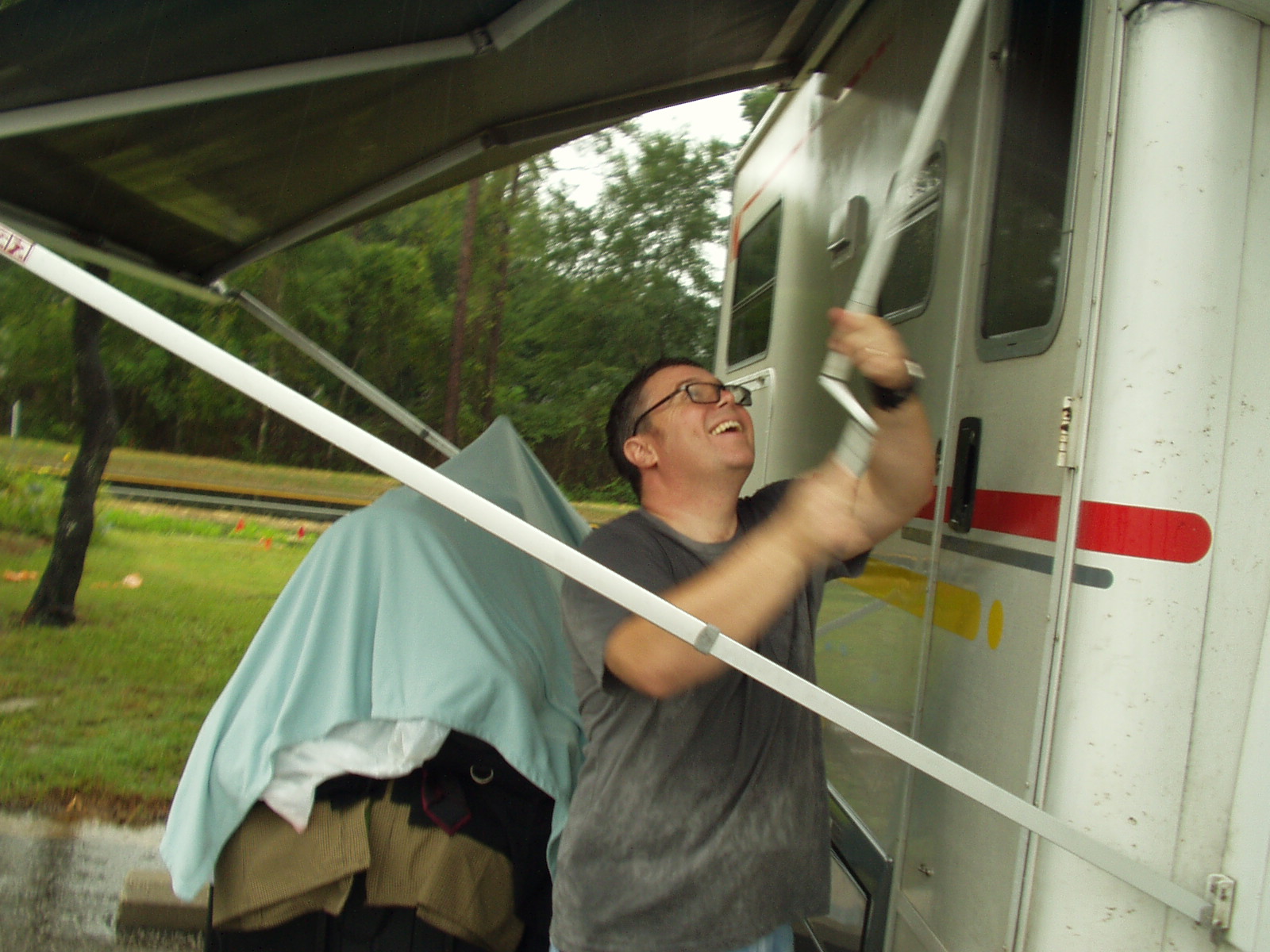
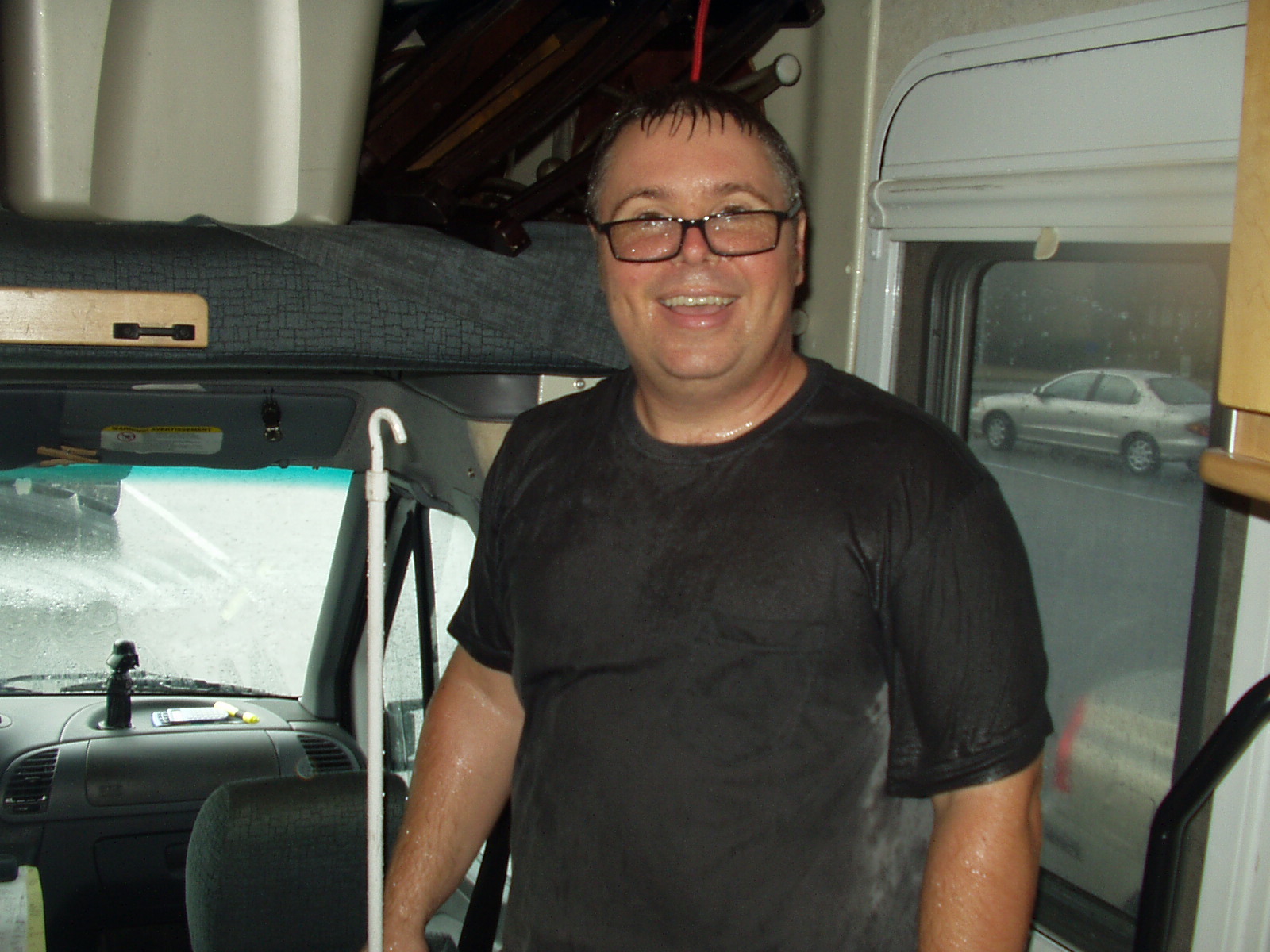
The gear stayed mostly dry while the actor did not.  Don got soaked.
Here’s perhaps the greater invention ever for our theatre company – GPS.  Sometimes you have outsmart it, but it still is quite helpful. This time the GPS did say “recalculating, recalculating, please drive to highlighted route” five times in a row on this drive.

Lovely thing about Florida weather: it is dry and sunny again a few minutes after we arrive back at Henderson Beach State Park, which makes us and the “tour manager” very happy. We’ll rest up tonight and do it all again tomorrow, ending with a drive to New Orleans for shows on Monday.

Life on the road can be challenging, but it is also incredibly rewarding. We are extremely fortunate to be able to make a living doing what we love together and bringing the arts to children in Florida and beyond!

Art Talk: Questions for Jeffrey Scott Lewis

by Jennifer Hoesing

Jeffrey Scott Lewis is a Fort Myers, Florida based painter. We asked him a few questions for our first Culture Builds Florida Art Talk.

Jeffrey Scott Lewis

Division of Cultural Affairs (DCA): Do your remember your first artwork?
Lewis:
Actually I do.  My drawing skills were noticed before I was in school.  The first time my talent was acknowledged in a public way was in the first grade when my teacher, Mrs. Baxter, appointed me to use the entire blackboard and her colored chalks to draw Santa Claus.  Of course, even then, I took it to the next level by drawing a big red sleigh drawn by eight reindeer, the first one with a red nose.  I was very excited by the colored chalks.  They were obviously special.

I still have my first painting.  It is a watercolor and pastel of a chihuahua, our family dog.  The first time I was paid for my efforts I was 15 years old and the local pharmacist hired me to hand letter some signs for his store. That led to me doing a pen and ink drawing of his store.  Throughout high school, I sold my pen and ink drawings, and many of them still grace the walls of the homes they were commissioned for.

DCA: How do you describe your current artwork?
Lewis:
My art, regardless of the medium, is always very process-oriented.  Meaning, the act of making it, the idea behind it, is usually more important that what the final piece actually is. To me the idea is important; not so much what it looks like, but the idea behind it.  I love making art, and I really love the process of making art.  Nothing excites me more than having an idea and then fully exploring the concept through trying various ways to realize the idea.

A New Day by Jeffrey Scott Lewis

As far as what my work looks like, it is usually very colorful, and my use of color is always very calculated in terms of the emotional impact.  I try to use texture as much as possible.

I also use found objects and recycled materials whenever I find inspiration.  I find beauty in the simplest objects. Right now, I’m working on a piece made of the red wax casings from miniature cheese rounds.  I have used gum wrappers, plastic caps, scrap metal, and videotape among other materials to make sculpture, collages and mixed media pieces.

Feel Me by Jeffrey Scott Lewis

DCA: What are you currently working on?
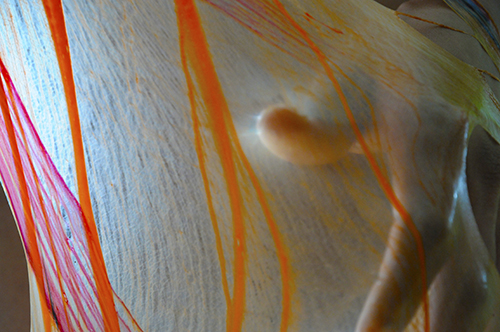
Lewis: I just got a Kickstarter project approved to fund the production of an exhibit of my new work, photography.  I am very excited about this new work. It resulted from an effort to make images for photo transfers, and that’s something I’ve become very interested in this year.  The images turned out so far beyond what I anticipated that I decided they should be shown as photography, abstract photography.  These images actually moved me to tears as I reviewed them for the first time. That’s one thing I love about photography, you don’t see the image as you make it.  You only see it after it is uploaded to the computer.

The images are about self-acceptance and the shedding of layers of false identity and the resulting sense of freedom.  Even though they are photography, they still have a lot of the qualities of my paintings.  I plan to produce them on aluminum in limited editions.  The first show is scheduled at the Arts for ACT Gallery in downtown Fort Myers, the site of my first solo show, in April 2012.

DCA: What artistic achievement are you most proud of?
Lewis: When I was selected to be one of 39 artists in the RedBull Art of Can exhibit in 2007 at River East Art Center in Chicago. It was my first show out of the state of Florida.  Even though an 8’ tower made of crushed RedBull cans is not necessarily my most important work, seeing my name and work being selected for the marketing of the show was very exciting.  I had dreamed of seeing my name and work on a museum banner. Actually seeing it on the 60-foot banner that rose from the first floor to the roof of the six-story building took my breath away.  It got even better as I saw 8-foot versions of that banner all over downtown Chicago!  I felt like a famous artist.

DCA: Besides art, what are you most passionate about?
Lewis:
I’ve said before that the most important thing I’ll ever do is raising my three children. I would say I am very passionate about that.  I’ve been a single dad for over ten years now. The time I have spent as a stay at home dad is what allowed me to fully develop my own body of work and exhibition record as well as finish my Master of Fine Arts degree.

My kids are all adopted, and promoting the adoption of children waiting in the foster care system is another passion of mine.  No child should grow up without a permanent family when there are couples yearning for a child.  Adopting through the State of Florida is one of the best things I’ve ever done.  My Recycling Children series is my effort in that direction.  Sometimes art can change the world.  If only one child was adopted from foster care because a family was inspired by the message in my work, then I have changed the world.  That would make me a success.

DCA: What do you believe is the most valuable thing artists contribute to making Florida a great place to live, work and play?
Lewis:
The idea is the most important thing in art to me, and that is what makes having a strong and vital art community important to the State of Florida as a great place to live, work and play.  The process of making art often yields unexpected results from the simple exploration of an idea.  That is important to any community. The benefits of those unexpected results can have a positive affect on the business community, tourism, education and increasing the quality of life for our citizens and our visitors.  It is so much more important than decoration, which is how most people tend to think of art.

DCA: Why is Florida arts and culture important to you?
Lewis:
Arts and culture are important because it tells the world who we are. I believe Floridians should support that. What would South Beach be today if the visionary designers of the original Art Deco buildings had been considered extravagant, impractical or unnecessary? Between the design and the wonderful mix of cultures from around the world, South Beach is like nowhere else on earth.  That same formula works everywhere.  Every Florida town has a story and a history that can make it special.  Finding that special story, supporting it, preserving it and encouraging it is what supporting arts and culture is all about. It brings out the best in all of us.

Spotlight on a Teacher’s Thoughts on Arts Education

by Jennifer Hoesing

During National Arts in Education Week 2010, we asked art teachers to share their thoughts about arts education. Joy Williams, an art teacher at Diplomat Middle School in Cape Coral, submitted these thoughts. Diplomat Middle School is an Arts Achieve! Model School.

[Last year] as I watched the Winter Olympics in Vancouver, I marveled at the athletes’ dedication, their perseverance against all odds, and the sustained practice they endure to shave seconds off the clock. That same drive to outperform one’s personal best is what is needed to become a great artist!  Therefore, it is fitting that our children will visit the new Art of the Olympians’ museum in Fort Myers.

This September I’m stopping to reflect on the impact of arts education in the lives of children.

In my observation, creating art develops a child’s eye/hand coordination, motor skills and spatial judgment.

Creating art develops a child’s intellectual creativity, memory recall and a willingness to attempt new challenges.  These creative problem-solving skills are used not only by artists, but inventors and entrepreneurs as well.

Art class is also a time for positive social interaction and a healthy exchange of ideas among students.  Art students learn to respect classmates and diverse points of view.

Cultural Conversation: Five Questions for Grace Maloy

by Jennifer Hoesing

Grace Maloy headshotGrace Maloy is Executive Director of the Gadsden Arts Center in Quincy, Florida. Gadsden Arts Center provides exhibitions of fine art and art education to the people of Gadsden County, a rural county that is highly diverse culturally, racially and ethnically.

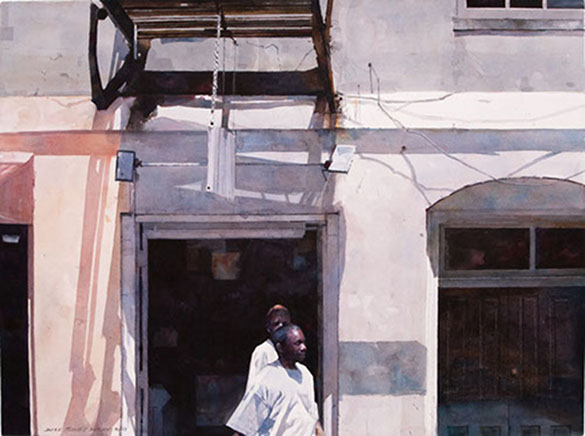
Gadsden Arts Center’s current exhibition, Dean Mitchell: Rich in Spirit, is on view through October 29, 2011. In addition, vernacular art from the Gadsden Arts Center collection is on view at the Gibbs Museum in Charleston, South Carolina through October.

Dean Mitchell PaintingSunshine in New Orleans by Dean Mitchell. Watercolor. 30 x 40 inches.  Now on view at Gadsden Arts Center.

DCA: How long have you had a career in the arts? How long have you worked in Florida?

Maloy: I supposed my career in the arts began in early childhood. My mother and both of her parents were fine artists, and mom often told stories of her beloved father, Rocco, who was a graphic designer and illustrator by trade. Our house was filled with original art, paintings by family members, paintings, drawings, and prints by their artist friends, handmade books, hand-crafted furniture. Many of my grandparents’ artist friends, like watercolorist Henry Keller, went on to become well regarded in the history 20th century art.

Growing up in a family of artists meant the family was raised with a particular approach to life, that a good life is achieved by design, and there is unlimited beauty in our immediate environment to appreciate. Growing up with an artist’s sensibility means that we have enjoyed a depth of awareness of our environment and ourselves that some people may not have.

I also drew and painted pictures from early childhood, as a natural form of thought and expression. By high school, I was asking my parents to enroll me in college-level art and design classes and drawing portraits for friends on commission. My first degree is in studio art, but I went on to learn commercial design and illustration, as my grandfather did. For some reason, I felt an emptiness in the  “working for a paycheck” life as a designer/illustrator, earned an Art Education Masters Degree, and taught high school art for a number of years. I love teaching art to teen-aged children, they are creative and thoughtful beyond measure.

All of this ultimately culminated in my present career as an arts administrator, a field I fell into without intent about 13 years ago, first as an Assistant Curator at the Center for the Arts, now known as the Vero Beach Museum of Art. What a fascinating field this is! We provide critical community services that are increasingly scarce. We are practical business managers, and at the same time, we are creative problem solvers and visionaries. We are inventing a field as we live it, responding to needs and challenges on an ever-changing basis. We are part of a larger family of nonprofit art professionals that move forward into an uncertain economy, seeing endless possibilities because the need is endless, rooted together in one foundation that is the expressive, unifying, thought provoking, enduring, healing, exciting power of art.

DCA: What is the single greatest contribution the Gadsden Arts Center makes to your community?

Maloy: I cannot really identify one overriding contribution. The Gadsden Arts Center completed a community survey last spring, with the aid of a highly experienced third party consultant, who spent about 100 hours interviewing members, donors, elected officials, and community leaders. Part of the process was to determine what they valued most highly in the Gadsden Arts Center. Their responses were the power of Gadsden Arts to draw diverse community groups together in a meaningful way; art education to help area children develop higher order thinking skills, self-discipline, and an avenue for self-expression; and cultural and historical content presented through our exhibitions.

DCA: What other challenges in your community have been addressed through the arts?

Maloy: I think the three greatest challenges addressed by the Gadsden Arts Center have been cross-cultural understanding, tourism and economic development and education.

First, cross-cultural understanding is addressed through the content of many exhibitions, and also through the very practical opportunity for volunteers to develop new social relationships here;

In terms of tourism and economic development, Gadsden Arts is broadly recognized for its historic buildings, museum-quality facilities, exhibitions and programs. We draw visitors from a broad geographic area, who enjoy their visit and leave with a positive impression that helps to dispel longstanding negative stereotypes of Gadsden County that are sometimes perpetuated in regional media.

And finally, education. Through the arts, children learn to solve problems creatively, finish what they start, evaluate the quality of their work, discuss complex concepts with others, and then enjoy visible, public recognition for good work and personal growth. Due to the recession, the arts have been cut from all district elementary schools this year. Gadsden Arts is working with area theatrical and music groups to provide art programs in the schools this year, in addition to existing programs and services for school children. The arts are critical to education – they are also therapeutic, and fun!

Spotlight On PACE Center for Girls/Harn Museum Collaboration

by Jennifer Hoesing

Everyone benefits from art. That’s the sentiment behind a project that connects at-risk girls from PACE School for Girls and the Harn Museum in Gainesville.

“We were thrilled to offer this program again because it aligns art with the students’ existing educational goals and the Harn’s mission to bring the university’s resources to the community as the community’s art museum,” said Rebecca Nagy, Harn Museum of Art director.

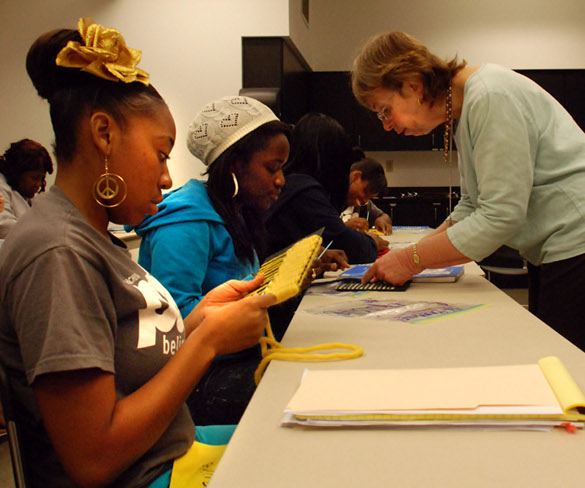
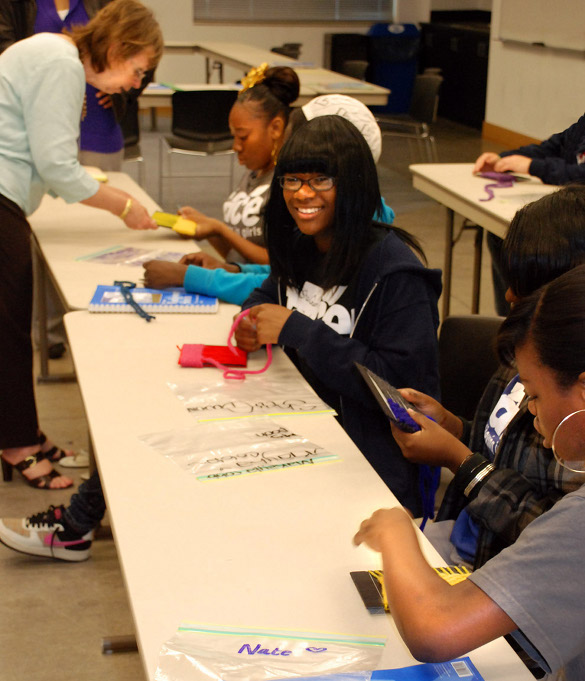
The Harn Museum, a previous Division of Cultural Affairs grantee, was awarded a matching grant from the National Endowment for the Arts to continue the partnership with PACE through 2012. In 2011, Harn Museum staff members visited PACE five times, and the PACE students visited the Harn Museum five times. The girls learned about the role of museums in society, art, history, artists and world cultures by linking exhibitions to popular culture.

“The girls gain a wider perspective by learning what artists do in the creation process, understanding other cultures, and meeting role models through working with interns, volunteers and staff,” said Bonnie Bernau, education curator of community outreach at the Harn.