Spotlight on Florida Heritage Month

by Jennifer Hoesing


Each year Florida celebrates its heritage with Florida Heritage Month, March 15 to April 15. Throughout the month, Florida residents and visitors will have special opportunities to experience and embrace the many historical sites, cultural activities and literary programs throughout the state. The activities are intended to help residents and visitors gain an understanding and appreciation of Florida’s commitment to supporting historic preservation, arts and culture, and libraries that create economic vitality, enhance quality of life and instill community pride.  Residents and visitors can find more information about Florida Heritage Month and related events at www.floridaheritagemonth.com.

From now until the close of Florida Heritage Month on April 15, we’ll be featuring some of the people and places that contribute to Florida’s cultural legacy. Join us for this Florida Heritage blogging blitz!

Art Talk: Division Staff Share Their First Arts Experiences

by Jennifer Hoesing

Last summer I asked my colleagues at the Division of Cultural Affairs to recall and share their first experiences in the arts. Originally posted on the Division of Cultural Affairs website, I wanted to share this post on the Culture Builds Florida blog.

Laura Blischke, Arts Consultant

Laura Blischke

I would love to say my first arts experience was shaking my bum to the Beatles and Simon and Garfunkel music in the 1960s, however, I would have to say my first REAL arts experience was in December 1968. Mother drove me from Griffin, GA to Atlanta for a matinée performance of Atlanta Ballet’s Nutcracker at the historic Fox Theatre. Mother bought me a corsage for my winter coat, and we got dressed up and went out to lunch at the hotel across the street from the Fox.
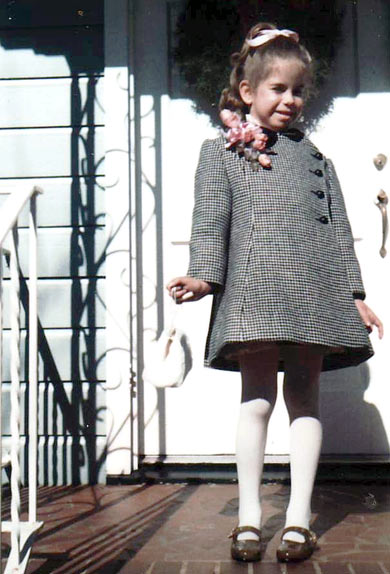
Laura on her way to the Nutcracker

Afterwards, we headed over to the theatre. I was absolutely in awe. Not only was the theatre stunning, with twinkling stars like a night sky on the ceiling, but to this day I can still remember the sets, costumes, the Atlanta Symphony Orchestra conducted by Robert Shaw and wanting to be Clara! I was hooked from then on. After much begging, at age eight, my parents relented and I started ballet classes in Orlando with the Royal School of Dance. After that, I was never far from a dance studio! And today, the arts live on, in my writing, my painting, my job, and through two daughters who also love the arts.

Ken Crawford, Arts Administrator

Ken Crawford

I was fortunate as a kid growing up in Manhattan with a huge city all around me to actually have a great-aunt who was a lifetime member of several important institutions including the Museum of Modern Art, the Museum of Natural History and the New York Historical Society. Each year, my grand aunt would give me a large raft of tickets and a membership card, which launched me on a voyage to meet some of the world’s great minds. On Saturdays, beginning about age 14, I took the bus or rode the subway to join others in a special presentation group at one of these sites.

Those were amazing mornings, with the opportunity to see people like Norman Rockwell and Andrew Wyeth, along with many modern artists, plus scientists like Margaret Mead and Louis Leakey, including one of Jane Goodall’s first presentations of her work in Africa. I was usually the youngest one there, with my brown bag lunch and limited allowance for transportation. Following the lectures, I would have an hour or two to explore the cavernous halls and galleries of these places, discovering new things every time I went there. These experiences got me excited about art and history at an early age, along with learning what belonging to a museum could bring to your life.

Afterwards, I would head to my grand aunt’s apartment and tell her what I’d witnessed. She wanted every detail, and questioned me minutely over tea and cookies. I realized later that she was able to have two experiences for the price of each one of those tickets: teaching a boy about his cultural heritage, while guaranteeing regular visits from me. It was a perfect fit.

Jennifer Hoesing, Arts Consultant

Jennifer Hoesing

They’re not moments I can recall, but my baby book reveals my first musical experiences in photos: me as a baby, atop my dad’s lap on the piano bench.

I didn’t become a great pianist like my dad, but by fifth grade I was poised to become a full-fledged clarinet playing band nerd. Music has been a mainstay in my life since that time. Thanks to music and art, I’ve forged incredible and lasting relationships, traveled the world, learned about discipline, determination and how to approach situations creatively, and found a fulfilling career. These days my husband (another musician) and I are introducing our baby to the arts. The cycle begins again!
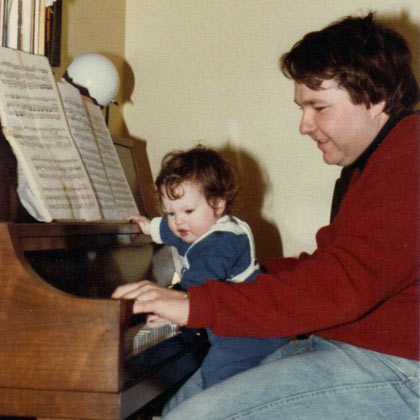
Jennifer and her dad at the piano

Gaylen Phillips, Associate Director of Arts Resources and Services

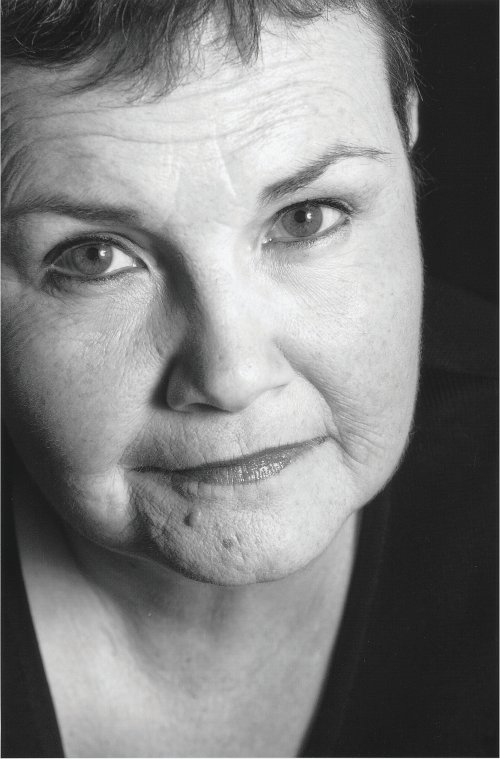
Gaylen Phillips

Well, my mother will tell you that I arrived performing and haven’t stopped since, but my very first arts experience is hard to pin down. Our house was filled with music – my father wired opera into every room – and he collected Roman architectural pieces and sculpture. But creating characters always appealed to me more than anything. I was the kid on the block who directed plays in our garage for the neighbors – and charged admission – so my parents figured out I was a theatre geek and enrolled me in my first formal acting training program in 1962 – the local children’s theatre – where I debuted as the Ogre in a production of Puss in Boots. This is an early photo of me as a cowgirl – I built all my props; in this case, I used Tinker Toys to make the rifle.

Aspiring cowgirl Gaylen Phillips

Sandy Shaughnessy, Division Director

Sandy Shaughnessy

My father was a carpenter and my mother a painter. The smell of sawdust and oil paints was my very first encounter with the arts. I’m sure my first actual arts experience was way too early for me to remember. However, my earliest arts memory was that of a marionette show. The stage in the school’s auditorium was pitch black and all of a sudden beautiful figures appeared floating across the stage. I remember thinking “how on earth is this happening?!” The colors were mesmerizing, the music was electrifying and the feeling was amazing. It was the magic of theatre and I was hooked for life!

Dale Scheetz, Grants Specialist III
Dale Scheetz

We all know my training is not in the arts, although I took seven years of piano lessons (after maybe two lessons in ballet) and played first chair clarinet in the high school band.

I’ve never taken any of that into a professional (or even armature) career. My mother was the artist in the family, having been trained as a commercial artist. While she sketched and painted all through my childhood, she mostly taught knitting to bored housewives (and a few husbands) in the many knitting shops that she owned and operated throughout and after my growing up years. Though it’s not my earliest memory, I have a clear image of myself sitting in the middle of my new bedroom floor at about three years of age, with a spool of thread and a pair of tapestry needles, trying to figure out how to cast on stitches.

My mother caught me just as I about had it figured out and took everything away from me (which made me very mad – probably why I remember it so well ). She decided I was too young to learn knitting but immediately taught me to crochet, and after a rather large rug project relented and taught me to knit. I am a knitter to this day, and am currently working at a fingerless glove pattern as well as making shawls for Christmas presents this year. Along with the cooking arts, it’s what I do, in addition writing.

Sarah Stage, Arts Administrator

Sarah Stage

The arts were always a part of my life since my mother was a music professor and also taught voice at home. My parents were in a renaissance group and I would go to most of the performances. I would help my mother get dressed in her costumes before they performed. She was the soprano in the group and played the recorder and my father played the Sackbut. I took my first art lessons when I was about five from a local artist/professor during the summer with a couple other kids. Her garage studio was painted on the outside in fabulous brightly colored designs. She made these colorful textile sculptures that she had hanging in her house. Recently my parents brought me one of the paintings that I made in those classes. They had it framed and it hung in their house for 30 some years. I went to the Smithsonian Hirshhorn Museum and Sculpture Garden around that time and I can still visualize the exhibition space and the color field paintings I was looking at. I thought they were amazing and gigantic! My parents couldn’t get me out of that exhibit!

 Patty Warren, Associate Director of Government and Finance

Patty Warren

My father owned an auto body repair shop and could draw but was usually too tired from hammering out dents to draw for me. One day he brought home a Ford show room easel with the current year’s models in bright colors. By turning the pages over, I found my own canvas for drawing. And I did! I copied Mickey Mouse characters from a comic book. I remember the freedom and the exuberance of being able to draw on such a large scale and I was good! I seemed to have inherited my father’s talent. From there, I went on to draw my own paper dolls and designed entire wardrobes with my own sense of color. I should mention that I invented the combination of lime green and pink before Lily Pulitzer! I saw my first theatre production at an Orlando supper club courtesy of my sophomore high school teacher and fell in love with the theater then and there. I went on to perform in the senior play as a sophomore when one of the cast members broke a leg. I was the stage manager and had two days to memorize the lines. It was a small part where I played a tipsy old lady. The audience laughed at the appropriate time and I was again enthralled. I didn’t get to an art museum until I was well into my 30s but I finally made it to the Metropolitan Museum of Art and took in my first Broadway play, Evita with Patty Luponi. Not bad for a young girl whose world was so small that she didn’t even think that she would have the opportunity to go community college, let alone a university.
Art Talk: Division Staff Member Gaylen Phillips

by Ashley Kerns, Florida State University School of Theatre

Gaylen Phillips first hit the boards of a stage growing up in Jacksonville, Florida. “I did my first play when I was ten years old, and I haven’t stopped since,” says Phillips, as she prepared for her role as Jeannette Burmeister in the Florida State University School of Theatre’s performance of The Full Monty.

Dr. Gaylen Phillips

Phillips’ theatre career brought her to Florida State more than twenty years ago when she received her PhD from the School of Theatre. “I didn’t do any performing when I was getting my doctorate because I didn’t have time. Working on my PhD was the hardest thing I have ever done.” Through the years, however, Phillips has hit the FSU stage periodically to take in the energy of the student-driven environment. “I have performed several times at FSU, including Pippin and The Fifth of July. This is tremendous training for these kids. It is a special program with really high standards, which I think is evident when people from the community support it so much. They know that you’re going to get a good production.”

Phillips’ involvement in the world of the arts extends far beyond her roles on stage. She serves as the Associate Director of Arts Resources and Services for the Division of Cultural Affairs at the Florida Department of State, where she fosters the arts in Florida through grant, information, and education programs. “I never imagined that I’d end up in a government arts job but it is exciting. Over the years I’ve come to see the necessity of government funding for the arts. At the state level one of our main goals is to provide equal access to the arts. From whenever you’re born to whenever you die, we’re all over the place. The arts are involved in so much that we do that we don’t even think about it,” Phillips says with a smile. Her work at the Department of State has helped lead to arts exposure for millions of people through the years, specifically to students in grades k-12. Since opening in 1979, the State Touring Program (Florida Arts on Tour), which Phillips heads, has served over 4 million people.

When asked about the greatest challenge facing the arts today, Phillips cleverly notes that the economy isn’t necessarily the only roadblock, but that people feeling like the arts aren’t accessible to them is something that needs to be addressed. “Of course financing is a big thing but that is so obvious. It is interesting to get people to stop and think about how the arts impact their daily lives. I think if they did that they would not feel excluded. People say to me ‘well I don’t have anything to do with the arts’ and I say to them, “do you sing in your church choir?  Do you knit afghans, do you do embroidery? Do you drive a car? Someone had to design that car. There are all sorts of things that impact us. It’s broad, it is everywhere and I think that message is a hard one to convey. It’s not just about going to the theatre, although you really need to and you should, it is about everything.”

That enthusiasm for the presence of art everywhere is what brings Phillips back to FSU to share her joy with students. “These kids are just so wonderful and wild, I love listening to them. When I have the opportunity to come back to FSU and perform, it is just a dream. Everybody knows and does what they are supposed to do. It is the closest to a professional theatre and it is an amazing opportunity for these kids. Everybody is held to a high standard – these kids know it and it is a marvelous training ground for them. I wish them all luck.” Phillips says that part of what FSU (and all arts exposure) provides is the opportunity to become part of the larger world, “We cannot create kids that are so narrowly educated that then they become narrowly engaged in society as they grow up. You need to be a whole person; you need to be happy and healthy, you need to be able to contribute to society.” Nobody lives that philosophy as enthusiastically as Phillips. If all the world’s a stage then the many parts that she plays come together seamlessly, shining a very bright spotlight on all that the arts can do.

Spotlight On Jacksonville Comedy from The Florida Memory Blog

by Katrina Harkness, blogger for The Florida Memory Blog

Portrait of Oliver Hardy

Portrait of Oliver Hardy from The Florida Memory Project

You might not think of the words Jacksonville and comedy together. But in the early years of American movies, Jacksonville, Florida, experienced a brief turn in the spotlight as one of the hubs for filmmaking on the east coast.

The Vim Comedy Company, based in Jacksonville and New York, was one of several film studios operating in the Jacksonville area in the first three decades of the 20th century. Before going out of business in 1917, it employed such stars as Oliver “Babe” Hardy, Ethel Burton, Walter Stull, and Kate Price, as well as Swedish-born director Arvid Gillstrom.

Oliver Hardy began his film career and rise to international fame in Jacksonville, first at the Lubin studio, then with Vim and his own production company, and finally with the King Bee studio, which took over Vim after its repeated financial troubles.

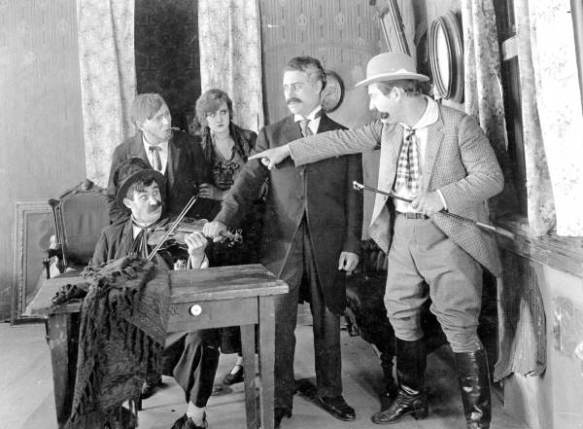
Motion picture scene from "Strangled Harmony"

Motion picture scene from "Strangled Harmony," from The Florida Memory Project

Hardy, Price, and many of the other Jacksonville actors made permanent moves to Hollywood soon after the political atmosphere in Jacksonville turned against the movie industry due to accusations of fraud, ties to political corruption, and fear of endangering the public welfare with elaborate stunt sequences staged without city approval. The film Bouncing Baby shows stunts shot in the streets of Jacksonville.

Motion picture scene

Motion picture scene from The Florida Memory Project

In a recent episode of the TV show Downton Abbey, Mrs. Hughes was surprised that Carson knew who Theda Bara was. Who was Theda Bara and what was her connection to Florida?

Today’s post features content from The Florida Memory Blog. The blog, launched earlier this month, makes resources from the State Library and Archives of Florida available to the public and encourages the study of Florida’s rich history and culture.

Art Talk: Kelvin Hair

by Jennifer Hoesing

Florida artist Kelvin Hair is this year’s Black History Month featured artist. Kelvin’s work is on view in the 22nd Floor Capitol Gallery in Tallahassee through March 29 as a part of the Division of Cultural Affairs’ Capitol Complex Exhibitions program. Exhibit hours are Monday – Friday, 8:00 am – 5:00 pm. Admission is free.

Kelvin Hair grew up surrounded by art. A self-described passionate artist fueled by bold imagination, Kelvin was introduced to art as a toddler and has been creating original works of art since middle school. These days Kelvin is a widely collected Florida artist with a loyal fan base.

As a Lieutenant and 23-year veteran of the St. Lucie Fire Department, Kelvin treats art as an escape from his hectic work life. “When I paint I go into my own world and there are no worries,” Kelvin said. “I love my job as a firefighter but it is very stressful most of our calls are ambulance runs, so painting is my way of getting away from the stress at work.”

Kelvin Hair at work on a painting. (photo submitted)

Kelvin was first introduced to art by his father, famed Highwayman Alfred Hair. The younger Hair started painting on oils at age sixteen. That year A.E. “Beanie” Backus supported Hair by critiquing his artwork and encouraging his painting. Later another Highwayman, Johnny “Hook” Daniels, served as a mentor to Kelvin. “Working with these artists has been a remarkably positive thing. They have told me stories of the days of working with my father, and it gives me a feeling of being with him,” he said.

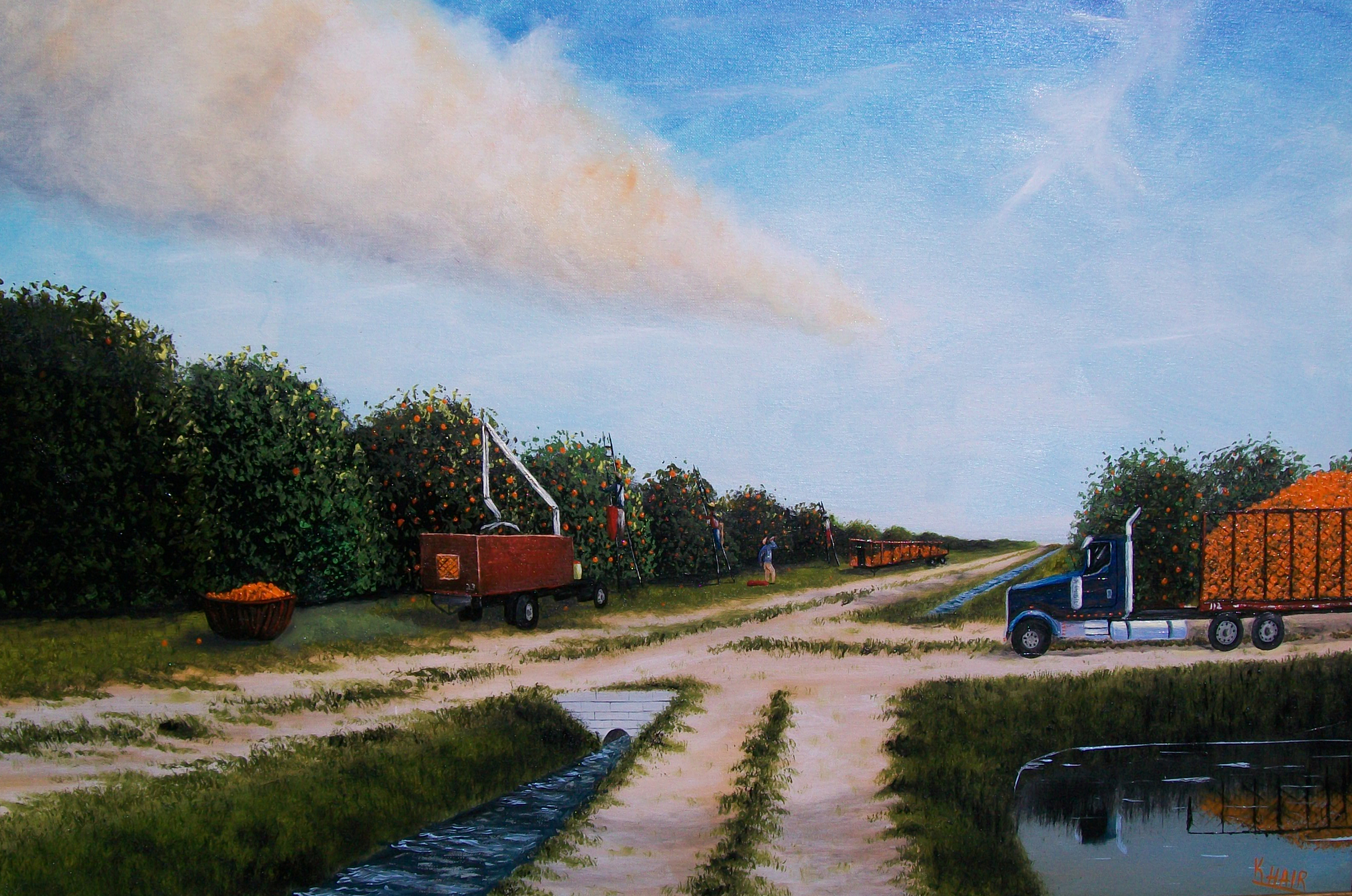
"Harvest Time" oil on canvas by Kelvin Hair on view in the 22nd Floor Capitol Gallery through March 29, 2012.

Teachers have been important and influential in Kelvin’s life and work, and in that great tradition, Kelvin is passing along art to students. He teaches at his home studio, and by offering free classes at the Children’s Home Society in Fort Pierce as well as at Macadonia Church in Gifford. “When I teach kids it is not only about the art. It’s also about teaching them to trust themselves and create something new out of what appears to be nothing,” Kelvin said. “Painting lets them know through experience that they can achieve.”

Kelvin told me all Floridians can benefit from arts and culture. “Art and culture preserve Florida’s rich history. Art & culture also show the world Florida’s creative abilities, and without those abilities you can not compete in the ever-changing world we live in.”

For more information about Kelvin and his artwork, visit www.khairart.com.

Art Talk: Colleen Duffley

by Heather Stuyverson

Today’s “Art Talk” features Colleen Duffley, an Panhandle-based professional photographer who has been photographing people, places, and things for more than 28 years. Colleen’s creative and vibrant spirit has brought artistic inspiration to Florida and beyond.

Colleen Duffley knows a lot about success in today’s arts marketplace.

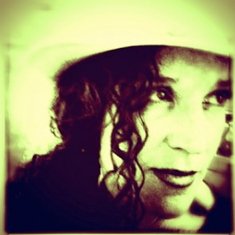
Colleen Duffley (image submitted)

Her professional photography business and arts organization are both known for bringing artistic opportunity and vision to scenic 30A in the Florida Panhandle. “In order be a successful artist in this world you have to be a great business person as well,” Colleen told me in an email interview late last year. “You have to be well spoken to get your message across and to grow the concepts and ideas that you, as an artist, believe in.”

Colleen’s concepts, ideas and messages are indeed successful. With Colleen Duffley Productions, her professional photography business, she shoots, produces, directs, and designs advertising concepts. She has made a name for herself in the field of photography, with clients including Neiman Marcus, Traditional Home magazine and Carnival Cruise Lines.  Colleen says photography has given her the opportunity to meet the most amazing people and see the most incredible places.  She says, “I have often truly pinched myself, thinking, ‘I’m getting paid to do this?’”

photograph by Colleen Duffley (submitted by the artist)

In addition to her photography business, Colleen also owns and operates Studio b. Studio b. brings together the best of the best in the fields of photography, art, design, literature, food, and wine by hosting seminars, classes, and lectures.

Workshop at Studio b. (submitted by Colleen Duffley)

Studio b. also serves as an art gallery throughout the year and is currently featuring an exhibit entitled “Light Impressions: A Celebration of iPhone® Photography.” The exhibit features the curated work of 40 iPhoneographers from around the world, with their work showcased on 40 iPad 2® units.  Colleen says this is the first iPhone® photography exhibit of its kind, and there are plans to tour the exhibit internationally.

Light Impressions at Studio b. (submitted by Colleen Duffley)

At the end of the day, Colleen says her business ventures have helped her become a focused, resilient and disciplined person. Colleen summed it all up, saying that her work in the arts is truly a part of her. “Working hard and being creative defines who I am as an individual.”

Postcard from Sarasota: The Sarasota Film Festival

submitted by Dania Permesly, The Sarasota Film Festival Outreach Coordinator

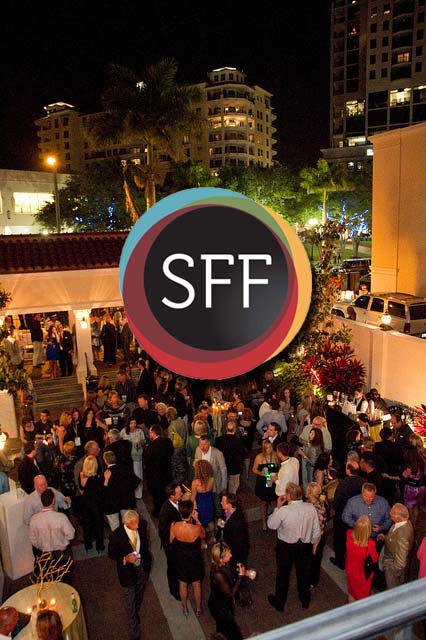
For fourteen years, The Sarasota Film Festival (SFF) has been inspiring audiences with the finest in international, independent and non-fiction cinema. The SFF celebrates the art of filmmaking and the contribution of filmmakers by hosting an international film festival. The SFF also brings important economic, educational and cultural benefits to the Sarasota community.

photo submitted by The SFF

The SFF truly believes that the future of film is built upon creative interaction between filmmakers and audiences. Along with screenings, which are often paired with introductions and Q&A sessions with filmmakers, the festival offers an “In Conversation” series with the most famous faces, a “Tribute” event with celebrated guests, and a variety of events encouraging mingling with industry guests in a more casual setting.

photo submitted by The SFF

The SFF invites attendees to “See Things Differently.” Through films and educational programs, The SFF provides opportunities to engage with people from different cultures, religions, genders and ages. Visitors to the festival have the opportunity to attend screenings of over 180 films from more than 45 nations.

The SFF hosted more than 50,000 patrons last year, making it one of the top ten regional film festivals in the U.S.  About half of these attendees are from outside Sarasota County and the city enjoys a great influx of enthusiasm and excitement during the Festival. Each year, local and out-of-town audience members alike enjoy the film selections and the dialogue with more than 100 filmmakers, actors and producers.

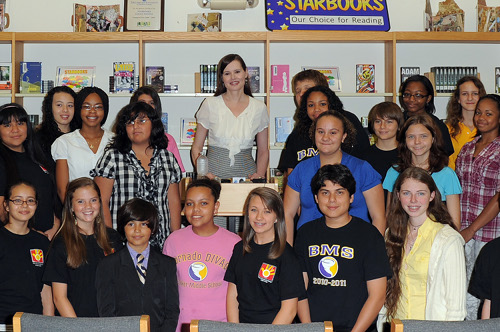
Beyond the annual festival, The SFF offers a number outreach programs. Last April, The SFF introduced a new partnership as a part of its year-round outreach activities. See Jane at SFF, is an exciting partnership with The Geena Davis Institute on Gender In Media. By encouraging young boys and girls to consider the ways gender roles are portrayed in film and in their own creative projects, the partnership creates opportunities for new cinematic stories and storytellers. The project will culminate in a film program where young filmmakers address their own ideas and concerns regarding gender representation, with Ms. Davis attending The 2012 SFF to view the completed projects and work with the young filmmakers.

Geena Davis with students participating in See Jane at SFF. Photo submitted by The SFF.

With women still dramatically underrepresented in Hollywood, The SFF is committed to putting the accomplishments of women in the film industry in the spotlight. Having established partnerships with additional organizations including The Gulf Coast Chapter of U.N. Women, Women Make Movies, and creating the Side By Side Women In Film mentoring program, SFF Women promotes independent films by women filmmakers that seek to expand awareness of the lives of women around the world.

The SFF is committed to building innovative programs to foster that growth within the community, offering a variety of ways for patrons to experience the art of filmmaking.  The SFF 2012 takes place April 13-22. Learn more at www.sarasotafilmfestival.com.

photo submitted by The SFF

Spotlight On: Faces of HIV

by Jennifer Hoesing

We Make the Change, a statewide campaign designed to increase the awareness of HIV/AIDS and its impact on communities throughout Florida, is using art to tell the story of Floridians living with HIV. Faces of HIV uses larger-than-life portraits, journal entries and interviews to explore the effects of stigmas, the personal relationships, and care issues associated with being HIV-positive.

The Faces of HIV mobile exhibit truck

It’s all part of a mobile art exhibit traveling the state.  The exhibit truck takes to the streets today at the Florida State University College of Medicine. The exhibit stops tomorrow at Tallahassee’s Governor’s Square Mall before traveling to Orlando, Miami, Jacksonville, and Tampa later this year.

“We need to eradicate stigmas,” said Thomas Liberti, Chief of the Bureau of HIV/AIDS for the Florida Department of Health, in a press release. “The Faces of HIV project allows people from across the state to experience real-life stories of inspirational and courageous individuals who have shared their difficulties, battles, and triumphs.”

Visit the Faces of HIV website to view photos, read journal entries and see videos from the participants.

A Day in the Life: Brian Owens

submitted by Brian R. Owens

Last November we featured Mr. Owens’ sculpture, the St. Augustine Foot Soldiers Monument. In today’s post, Mr. Owens shares details about a typical day in his life as a working sculptor. 

8:00 AM
The first thing I see when I open my eyes is a pile of art supplies. Eight o’clock is early for me. I’m not really awake. Carefully, I follow a path to my computer to play some upbeat light classical music that I found online. For me, music is like coffee. While my primary studio is in my home, the place only resembles a home from the outside. Inside, it would be a proper studio were it not for my current sculpture project that has transformed the studio into an unbelievable mess. This arrangement works for me but it’s easier to start working on art if I leave home and come back. I think it changes the chemistry of my brain.

9:00 AM – 10:30 AM
I start the day by re-drawing my concept for a sculpture commission that I’m competing for over coffee at a local cafe. I’ll continue this daily ritual until I’ve developed a composition I’m happy with. Naturally, I look outside myself for ideas and inspiration but I don’t wait to feel inspired before I put pen to paper. For me, habit succeeds over inspiration. Leonard Cohen said it best: “as a writer, you have to show up and go to work everyday. But you do so knowing that today it may not come … that you are not in command of this enterprise.” Today it came. I return home with a coffee in one hand and some good drawings in the other.

10:30 AM – 3:00 PM
Like most artists I know, I push myself hard. But I was unprepared for the level of sustained effort that goes into marketing and self-promotion. It’s 3 o’clock already and all I’ve done is move paper around. On average, I spend nearly half of my time doing this; a sobering statistic that I try not to think about. In a perfect world, I would have a spouse handle marketing and act as the central nervous system of this enterprise. I would also like to work in a castle overlooking the ocean, sculpt entirely from life and be loved by all. I’m not holding my breath.

5:00 PM – whenever
It’s five o’clock. Now the fun begins as I shift gears and continue work on my current sculpture commission. This one is paying the bills. Happily, I’m done with tasks that involve getting up early and working in daylight such as welding. For the next few weeks, I get to ignore the clock, work late into the night until exhaustion or collapse and wake up whenever I want, as is my custom. The plan is to apply clay to the armature I just completed. I’ve been looking forward to this part and to nightfall. With darkness comes tranquility. I enjoy company but I’m at my best when the rest of my world is asleep. The schedule requires that I accelerate progress and that’s fine, because the foundation of the sculpture is correct. One gentle, forward push of the throttle is all it will take now. The night-time is the right time.

Five questions for Lyudmilla Fuentes, VSA Florida Young Artist

by Jennifer Hoesing

VSA Florida sponsors the Florida Young Soloists program, now in its fifth year. A statewide call for musicians and vocalists with disabilities age 25 and under is sent each spring. Three prominent music professionals adjudicate the applications and select the top two as Florida’s nominations to the VSA International Young Soloists program. The Florida finalists appear with the Florida Orchestra. Today we have five questions for Lyudmilla Fuentes, one of this year’s Young Soloists.

Lyudmilla Fuentes

DCA: What do you enjoy most about making music?
Lyudmilla:  What I love the most about making music is that I feel completely free and that I can just let it all go. When and if I’ve had a bad day, I can start singing and all my cares in the world just float away. It’s my comfort zone, I guess I can say.

DCA: Why do you think it is important for people to make music?
Lyudmilla:  I believe that music is the universal language and that it tells a story in a language that other people from other countries can also understand. I also believe that in times of trouble, it can bring the world together.

DCA: Do you think you will always perform music?
Lyudmilla:  I am planning on pursuing my music as a career but also help those in need by raising money with my performances and bring awareness to people in other countries such as my homeland, Russia.

DCA: Who are your favorite musicians or artists?
Lyudmilla:  My favorite musicians are Bocelli, Anna Netrebko and Pavarotti.

DCA: Why are music and art important to Florida?
Lyudmilla: Music and art are important to Florida because they enhance cultural development and provide for a source of expression and human interaction.