Art Talk: Division Staff Share Their First Arts Experiences

by Jennifer Hoesing

Last summer I asked my colleagues at the Division of Cultural Affairs to recall and share their first experiences in the arts. Originally posted on the Division of Cultural Affairs website, I wanted to share this post on the Culture Builds Florida blog.

Laura Blischke, Arts Consultant

Laura Blischke

I would love to say my first arts experience was shaking my bum to the Beatles and Simon and Garfunkel music in the 1960s, however, I would have to say my first REAL arts experience was in December 1968. Mother drove me from Griffin, GA to Atlanta for a matinée performance of Atlanta Ballet’s Nutcracker at the historic Fox Theatre. Mother bought me a corsage for my winter coat, and we got dressed up and went out to lunch at the hotel across the street from the Fox.

Laura on her way to the Nutcracker

Afterwards, we headed over to the theatre. I was absolutely in awe. Not only was the theatre stunning, with twinkling stars like a night sky on the ceiling, but to this day I can still remember the sets, costumes, the Atlanta Symphony Orchestra conducted by Robert Shaw and wanting to be Clara! I was hooked from then on. After much begging, at age eight, my parents relented and I started ballet classes in Orlando with the Royal School of Dance. After that, I was never far from a dance studio! And today, the arts live on, in my writing, my painting, my job, and through two daughters who also love the arts.

Ken Crawford, Arts Administrator
Ken Crawford

I was fortunate as a kid growing up in Manhattan with a huge city all around me to actually have a great-aunt who was a lifetime member of several important institutions including the Museum of Modern Art, the Museum of Natural History and the New York Historical Society. Each year, my grand aunt would give me a large raft of tickets and a membership card, which launched me on a voyage to meet some of the world’s great minds. On Saturdays, beginning about age 14, I took the bus or rode the subway to join others in a special presentation group at one of these sites.

Those were amazing mornings, with the opportunity to see people like Norman Rockwell and Andrew Wyeth, along with many modern artists, plus scientists like Margaret Mead and Louis Leakey, including one of Jane Goodall’s first presentations of her work in Africa. I was usually the youngest one there, with my brown bag lunch and limited allowance for transportation. Following the lectures, I would have an hour or two to explore the cavernous halls and galleries of these places, discovering new things every time I went there. These experiences got me excited about art and history at an early age, along with learning what belonging to a museum could bring to your life.

Afterwards, I would head to my grand aunt’s apartment and tell her what I’d witnessed. She wanted every detail, and questioned me minutely over tea and cookies. I realized later that she was able to have two experiences for the price of each one of those tickets: teaching a boy about his cultural heritage, while guaranteeing regular visits from me. It was a perfect fit.

Jennifer Hoesing, Arts Consultant
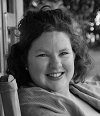
Jennifer Hoesing

They’re not moments I can recall, but my baby book reveals my first musical experiences in photos: me as a baby, atop my dad’s lap on the piano bench.

I didn’t become a great pianist like my dad, but by fifth grade I was poised to become a full-fledged clarinet playing band nerd. Music has been a mainstay in my life since that time. Thanks to music and art, I’ve forged incredible and lasting relationships, traveled the world, learned about discipline, determination and how to approach situations creatively, and found a fulfilling career. These days my husband (another musician) and I are introducing our baby to the arts. The cycle begins again!
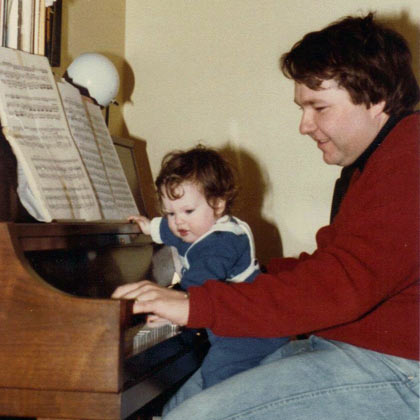
Jennifer and her dad at the piano

Gaylen Phillips, Associate Director of Arts Resources and Services

Gaylen Phillips

Well, my mother will tell you that I arrived performing and haven’t stopped since, but my very first arts experience is hard to pin down. Our house was filled with music – my father wired opera into every room – and he collected Roman architectural pieces and sculpture. But creating characters always appealed to me more than anything. I was the kid on the block who directed plays in our garage for the neighbors – and charged admission – so my parents figured out I was a theatre geek and enrolled me in my first formal acting training program in 1962 – the local children’s theatre – where I debuted as the Ogre in a production of Puss in Boots. This is an early photo of me as a cowgirl – I built all my props; in this case, I used Tinker Toys to make the rifle.

Aspiring cowgirl Gaylen Phillips

Sandy Shaughnessy, Division Director

Sandy Shaughnessy

My father was a carpenter and my mother a painter. The smell of sawdust and oil paints was my very first encounter with the arts. I’m sure my first actual arts experience was way too early for me to remember. However, my earliest arts memory was that of a marionette show. The stage in the school’s auditorium was pitch black and all of a sudden beautiful figures appeared floating across the stage. I remember thinking “how on earth is this happening?!” The colors were mesmerizing, the music was electrifying and the feeling was amazing. It was the magic of theatre and I was hooked for life!

Dale Scheetz, Grants Specialist III

Dale Scheetz

We all know my training is not in the arts, although I took seven years of piano lessons (after maybe two lessons in ballet) and played first chair clarinet in the high school band.

I’ve never taken any of that into a professional (or even armature) career. My mother was the artist in the family, having been trained as a commercial artist. While she sketched and painted all through my childhood, she mostly taught knitting to bored housewives (and a few husbands) in the many knitting shops that she owned and operated throughout and after my growing up years. Though it’s not my earliest memory, I have a clear image of myself sitting in the middle of my new bedroom floor at about three years of age, with a spool of thread and a pair of tapestry needles, trying to figure out how to cast on stitches.

My mother caught me just as I about had it figured out and took everything away from me (which made me very mad – probably why I remember it so well ). She decided I was too young to learn knitting but immediately taught me to crochet, and after a rather large rug project relented and taught me to knit. I am a knitter to this day, and am currently working at a fingerless glove pattern as well as making shawls for Christmas presents this year. Along with the cooking arts, it’s what I do, in addition writing.

Sarah Stage, Arts Administrator

Sarah Stage

The arts were always a part of my life since my mother was a music professor and also taught voice at home. My parents were in a renaissance group and I would go to most of the performances. I would help my mother get dressed in her costumes before they performed. She was the soprano in the group and played the recorder and my father played the Sackbut. I took my first art lessons when I was about five from a local artist/professor during the summer with a couple other kids. Her garage studio was painted on the outside in fabulous brightly colored designs. She made these colorful textile sculptures that she had hanging in her house. Recently my parents brought me one of the paintings that I made in those classes. They had it framed and it hung in their house for 30 some years. I went to the Smithsonian Hirshhorn Museum and Sculpture Garden around that time and I can still visualize the exhibition space and the color field paintings I was looking at. I thought they were amazing and gigantic! My parents couldn’t get me out of that exhibit!

 Patty Warren, Associate Director of Government and Finance

Patty Warren

My father owned an auto body repair shop and could draw but was usually too tired from hammering out dents to draw for me. One day he brought home a Ford show room easel with the current year’s models in bright colors. By turning the pages over, I found my own canvas for drawing. And I did! I copied Mickey Mouse characters from a comic book. I remember the freedom and the exuberance of being able to draw on such a large scale and I was good! I seemed to have inherited my father’s talent. From there, I went on to draw my own paper dolls and designed entire wardrobes with my own sense of color. I should mention that I invented the combination of lime green and pink before Lily Pulitzer! I saw my first theatre production at an Orlando supper club courtesy of my sophomore high school teacher and fell in love with the theater then and there. I went on to perform in the senior play as a sophomore when one of the cast members broke a leg. I was the stage manager and had two days to memorize the lines. It was a small part where I played a tipsy old lady. The audience laughed at the appropriate time and I was again enthralled. I didn’t get to an art museum until I was well into my 30s but I finally made it to the Metropolitan Museum of Art and took in my first Broadway play, Evita with Patty Luponi. Not bad for a young girl whose world was so small that she didn’t even think that she would have the opportunity to go community college, let alone a university.
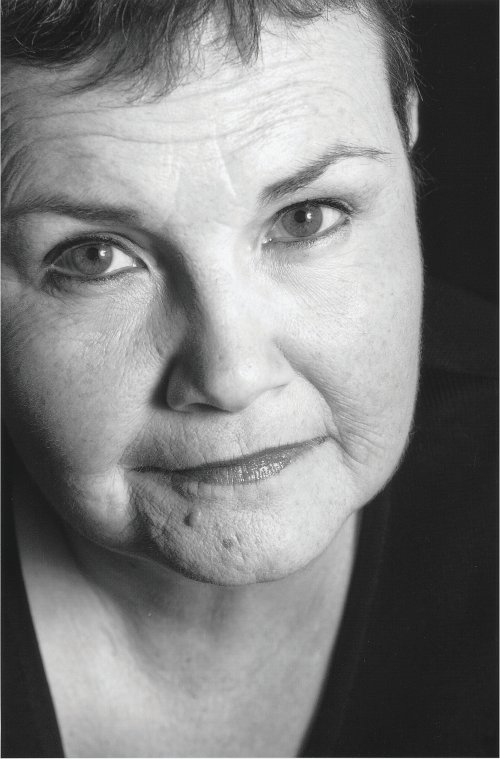
Art Talk: Division Staff Member Gaylen Phillips

by Ashley Kerns, Florida State University School of Theatre

Gaylen Phillips first hit the boards of a stage growing up in Jacksonville, Florida. “I did my first play when I was ten years old, and I haven’t stopped since,” says Phillips, as she prepared for her role as Jeannette Burmeister in the Florida State University School of Theatre’s performance of The Full Monty.

Dr. Gaylen Phillips

Phillips’ theatre career brought her to Florida State more than twenty years ago when she received her PhD from the School of Theatre. “I didn’t do any performing when I was getting my doctorate because I didn’t have time. Working on my PhD was the hardest thing I have ever done.” Through the years, however, Phillips has hit the FSU stage periodically to take in the energy of the student-driven environment. “I have performed several times at FSU, including Pippin and The Fifth of July. This is tremendous training for these kids. It is a special program with really high standards, which I think is evident when people from the community support it so much. They know that you’re going to get a good production.”

Phillips’ involvement in the world of the arts extends far beyond her roles on stage. She serves as the Associate Director of Arts Resources and Services for the Division of Cultural Affairs at the Florida Department of State, where she fosters the arts in Florida through grant, information, and education programs. “I never imagined that I’d end up in a government arts job but it is exciting. Over the years I’ve come to see the necessity of government funding for the arts. At the state level one of our main goals is to provide equal access to the arts. From whenever you’re born to whenever you die, we’re all over the place. The arts are involved in so much that we do that we don’t even think about it,” Phillips says with a smile. Her work at the Department of State has helped lead to arts exposure for millions of people through the years, specifically to students in grades k-12. Since opening in 1979, the State Touring Program (Florida Arts on Tour), which Phillips heads, has served over 4 million people.

When asked about the greatest challenge facing the arts today, Phillips cleverly notes that the economy isn’t necessarily the only roadblock, but that people feeling like the arts aren’t accessible to them is something that needs to be addressed. “Of course financing is a big thing but that is so obvious. It is interesting to get people to stop and think about how the arts impact their daily lives. I think if they did that they would not feel excluded. People say to me ‘well I don’t have anything to do with the arts’ and I say to them, “do you sing in your church choir?  Do you knit afghans, do you do embroidery? Do you drive a car? Someone had to design that car. There are all sorts of things that impact us. It’s broad, it is everywhere and I think that message is a hard one to convey. It’s not just about going to the theatre, although you really need to and you should, it is about everything.”

That enthusiasm for the presence of art everywhere is what brings Phillips back to FSU to share her joy with students. “These kids are just so wonderful and wild, I love listening to them. When I have the opportunity to come back to FSU and perform, it is just a dream. Everybody knows and does what they are supposed to do. It is the closest to a professional theatre and it is an amazing opportunity for these kids. Everybody is held to a high standard – these kids know it and it is a marvelous training ground for them. I wish them all luck.” Phillips says that part of what FSU (and all arts exposure) provides is the opportunity to become part of the larger world, “We cannot create kids that are so narrowly educated that then they become narrowly engaged in society as they grow up. You need to be a whole person; you need to be happy and healthy, you need to be able to contribute to society.” Nobody lives that philosophy as enthusiastically as Phillips. If all the world’s a stage then the many parts that she plays come together seamlessly, shining a very bright spotlight on all that the arts can do.

Art Talk: Kelvin Hair

by Jennifer Hoesing

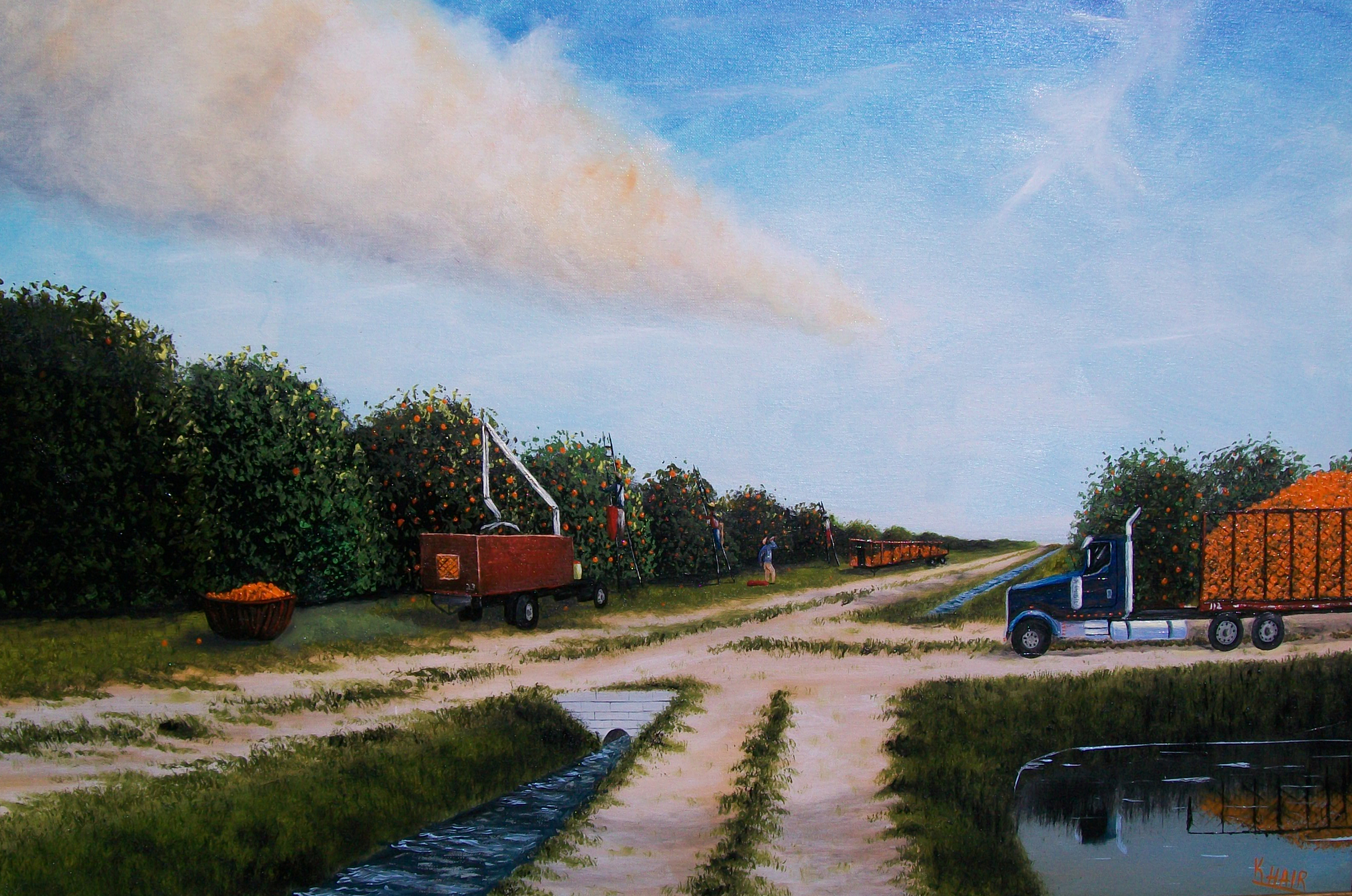
Florida artist Kelvin Hair is this year’s Black History Month featured artist. Kelvin’s work is on view in the 22nd Floor Capitol Gallery in Tallahassee through March 29 as a part of the Division of Cultural Affairs’ Capitol Complex Exhibitions program. Exhibit hours are Monday – Friday, 8:00 am – 5:00 pm. Admission is free.

Kelvin Hair grew up surrounded by art. A self-described passionate artist fueled by bold imagination, Kelvin was introduced to art as a toddler and has been creating original works of art since middle school. These days Kelvin is a widely collected Florida artist with a loyal fan base.

As a Lieutenant and 23-year veteran of the St. Lucie Fire Department, Kelvin treats art as an escape from his hectic work life. “When I paint I go into my own world and there are no worries,” Kelvin said. “I love my job as a firefighter but it is very stressful most of our calls are ambulance runs, so painting is my way of getting away from the stress at work.”

Kelvin Hair at work on a painting. (photo submitted)

Kelvin was first introduced to art by his father, famed Highwayman Alfred Hair. The younger Hair started painting on oils at age sixteen. That year A.E. “Beanie” Backus supported Hair by critiquing his artwork and encouraging his painting. Later another Highwayman, Johnny “Hook” Daniels, served as a mentor to Kelvin. “Working with these artists has been a remarkably positive thing. They have told me stories of the days of working with my father, and it gives me a feeling of being with him,” he said.

"Harvest Time" oil on canvas by Kelvin Hair on view in the 22nd Floor Capitol Gallery through March 29, 2012.

Teachers have been important and influential in Kelvin’s life and work, and in that great tradition, Kelvin is passing along art to students. He teaches at his home studio, and by offering free classes at the Children’s Home Society in Fort Pierce as well as at Macadonia Church in Gifford. “When I teach kids it is not only about the art. It’s also about teaching them to trust themselves and create something new out of what appears to be nothing,” Kelvin said. “Painting lets them know through experience that they can achieve.”

Kelvin told me all Floridians can benefit from arts and culture. “Art and culture preserve Florida’s rich history. Art & culture also show the world Florida’s creative abilities, and without those abilities you can not compete in the ever-changing world we live in.”

For more information about Kelvin and his artwork, visit www.khairart.com.

Art Talk: Questions for Jeffrey Scott Lewis

by Jennifer Hoesing

Jeffrey Scott Lewis is a Fort Myers, Florida based painter. We asked him a few questions for our first Culture Builds Florida Art Talk.

Jeffrey Scott Lewis

Division of Cultural Affairs (DCA): Do your remember your first artwork?
Lewis:
Actually I do.  My drawing skills were noticed before I was in school.  The first time my talent was acknowledged in a public way was in the first grade when my teacher, Mrs. Baxter, appointed me to use the entire blackboard and her colored chalks to draw Santa Claus.  Of course, even then, I took it to the next level by drawing a big red sleigh drawn by eight reindeer, the first one with a red nose.  I was very excited by the colored chalks.  They were obviously special.

I still have my first painting.  It is a watercolor and pastel of a chihuahua, our family dog.  The first time I was paid for my efforts I was 15 years old and the local pharmacist hired me to hand letter some signs for his store. That led to me doing a pen and ink drawing of his store.  Throughout high school, I sold my pen and ink drawings, and many of them still grace the walls of the homes they were commissioned for.

DCA: How do you describe your current artwork?
Lewis:
My art, regardless of the medium, is always very process-oriented.  Meaning, the act of making it, the idea behind it, is usually more important that what the final piece actually is. To me the idea is important; not so much what it looks like, but the idea behind it.  I love making art, and I really love the process of making art.  Nothing excites me more than having an idea and then fully exploring the concept through trying various ways to realize the idea.

A New Day by Jeffrey Scott Lewis

As far as what my work looks like, it is usually very colorful, and my use of color is always very calculated in terms of the emotional impact.  I try to use texture as much as possible.

I also use found objects and recycled materials whenever I find inspiration.  I find beauty in the simplest objects. Right now, I’m working on a piece made of the red wax casings from miniature cheese rounds.  I have used gum wrappers, plastic caps, scrap metal, and videotape among other materials to make sculpture, collages and mixed media pieces.

Feel Me by Jeffrey Scott Lewis

DCA: What are you currently working on?
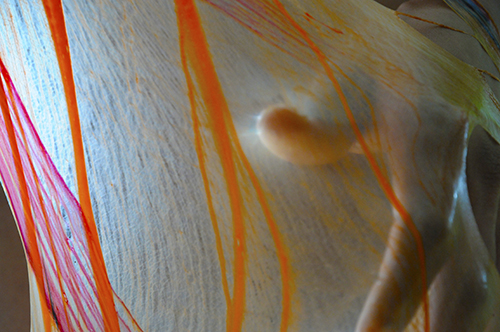
Lewis: I just got a Kickstarter project approved to fund the production of an exhibit of my new work, photography.  I am very excited about this new work. It resulted from an effort to make images for photo transfers, and that’s something I’ve become very interested in this year.  The images turned out so far beyond what I anticipated that I decided they should be shown as photography, abstract photography.  These images actually moved me to tears as I reviewed them for the first time. That’s one thing I love about photography, you don’t see the image as you make it.  You only see it after it is uploaded to the computer.

The images are about self-acceptance and the shedding of layers of false identity and the resulting sense of freedom.  Even though they are photography, they still have a lot of the qualities of my paintings.  I plan to produce them on aluminum in limited editions.  The first show is scheduled at the Arts for ACT Gallery in downtown Fort Myers, the site of my first solo show, in April 2012.

DCA: What artistic achievement are you most proud of?
Lewis: When I was selected to be one of 39 artists in the RedBull Art of Can exhibit in 2007 at River East Art Center in Chicago. It was my first show out of the state of Florida.  Even though an 8’ tower made of crushed RedBull cans is not necessarily my most important work, seeing my name and work being selected for the marketing of the show was very exciting.  I had dreamed of seeing my name and work on a museum banner. Actually seeing it on the 60-foot banner that rose from the first floor to the roof of the six-story building took my breath away.  It got even better as I saw 8-foot versions of that banner all over downtown Chicago!  I felt like a famous artist.

DCA: Besides art, what are you most passionate about?
Lewis:
I’ve said before that the most important thing I’ll ever do is raising my three children. I would say I am very passionate about that.  I’ve been a single dad for over ten years now. The time I have spent as a stay at home dad is what allowed me to fully develop my own body of work and exhibition record as well as finish my Master of Fine Arts degree.

My kids are all adopted, and promoting the adoption of children waiting in the foster care system is another passion of mine.  No child should grow up without a permanent family when there are couples yearning for a child.  Adopting through the State of Florida is one of the best things I’ve ever done.  My Recycling Children series is my effort in that direction.  Sometimes art can change the world.  If only one child was adopted from foster care because a family was inspired by the message in my work, then I have changed the world.  That would make me a success.

DCA: What do you believe is the most valuable thing artists contribute to making Florida a great place to live, work and play?
Lewis:
The idea is the most important thing in art to me, and that is what makes having a strong and vital art community important to the State of Florida as a great place to live, work and play.  The process of making art often yields unexpected results from the simple exploration of an idea.  That is important to any community. The benefits of those unexpected results can have a positive affect on the business community, tourism, education and increasing the quality of life for our citizens and our visitors.  It is so much more important than decoration, which is how most people tend to think of art.

DCA: Why is Florida arts and culture important to you?
Lewis:
Arts and culture are important because it tells the world who we are. I believe Floridians should support that. What would South Beach be today if the visionary designers of the original Art Deco buildings had been considered extravagant, impractical or unnecessary? Between the design and the wonderful mix of cultures from around the world, South Beach is like nowhere else on earth.  That same formula works everywhere.  Every Florida town has a story and a history that can make it special.  Finding that special story, supporting it, preserving it and encouraging it is what supporting arts and culture is all about. It brings out the best in all of us.