Provided by Great Explorations Children’s Museum
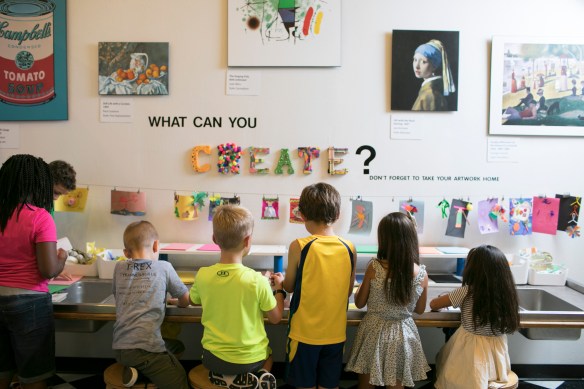
For over 30 years, Great Explorations Children’s Museum has been committed to bringing innovative, hands-on, educational programs to area youth while also providing invaluable family support services that promote safe and healthy caregiver-child relationships. Known as “Great Ex” to locals, the museum’s mission is to stimulate learning through creativity, play and exploration.
 Founded in 1986 as the result of a movement to create a children’s museum by the Junior League of St. Petersburg, Great Explorations maintains a significant presence in the Tampa Bay area and nationwide. A member of the Association of Science-Technology Centers and the Association of Children’s Museums, Great Explorations was the first mid-sized children’s museum to receive accreditation from the American Alliance of Museums. It is the only accredited children’s museum in Tampa Bay and one of fewer than a hundred accredited children’s museums nationwide. Great Explorations is committed to upholding museum standards of excellence through its work with children and families in the St. Petersburg community and beyond.
 Since its founding, Great Explorations has remained steadfastly committed to education through a variety of avenues both inside the museum and out in the community. We provide S.T.E.A.M. based educational exhibits and programs daily on the museum floor for visitors and school field trip groups. Our Museum InReach field trips provide elementary-aged children with opportunities for unrestricted self-guided “purposeful play,” providing a unique multi-sensory approach to the traditional classroom subjects taught in school. As funding permits, Title 1 schools and nonprofits are granted free field trips and bus vouchers to ensure students access to our museum; and for many of these students, it is their first visit to a museum in their lifetime.
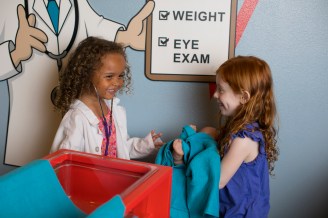 Our educational programming for school-aged children extends to summer camp opportunities as well as after school programming that not only provides homework assistance but extends learning opportunities beyond school hours in our nurturing, enriching and fun environment. Our community outreaches also allow us to take our educational programs mobile, bringing hands-on interactive S.T.E.A.M. activities directly into the most at-risk communities, providing access to high-quality, fun, educational experiences to those that are unable to access these programs at the museum due to monetary or transportation barriers.
Great Explorations is committed to accessibility for all children in our community. In addition to providing reduced admission rates to those in need, after hours museum access for nonprofits and community groups, and resources and educational workshops for families, parents, and caregivers, Great Explorations has developed programming specifically to reach those on the autism spectrum as well as those experiencing memory loss.
GREAT CONNECTIONS
 After consulting with the Center for Autism and Related Disabilities, Great Explorations launched “Great Connections” in January 2014. The goal of the program was to provide a less crowded and stimulating time for families of children with special needs to explore the museum. We provide extra staff for increased safety and supervision and a “cool down room” for children who need a break.
We are able to offer half-off of our standard admission price to families attending these sessions, and regularly distribute free family passes through our community partners. We also provide an opportunity for families of children with special needs to connect with community resources in a low-pressure and casual way. In the past, we have connected families with therapeutic drummers, arts organizations, chiropractors, therapy centers, urgent care clinics, and many others.
 We are thankful to be one of many organizations that have begun to offer sensory-friendly experiences. It has always been our goal to represent a more inclusive environment that might encourage families to feel more comfortable participating in other museum programs like camps, Parents’ Night Out, and special events, opening the door to a more inclusive experience for all families at all times. We are thrilled to say that we have witnessed this to be the case since the program’s inception. Many families continue exploring the museum even after we open to the general public, and many speech and occupational therapists use our “child-sized world” as a safe place for therapy during standard operating hours.
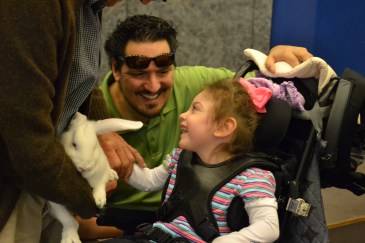 In the five years since its launch, Great Connections has been a huge benefit to our community because it connects people. It connects family members to each other through interactive engagement fostered by play, it connects families to other families facing similar challenges, and it connects families to services and support from local organizations. We hope to continue to adapt to the needs of the community and to represent the holistic benefits of providing inclusive environments that celebrate the diversity of our community’s children.
MEMORY MONDAY
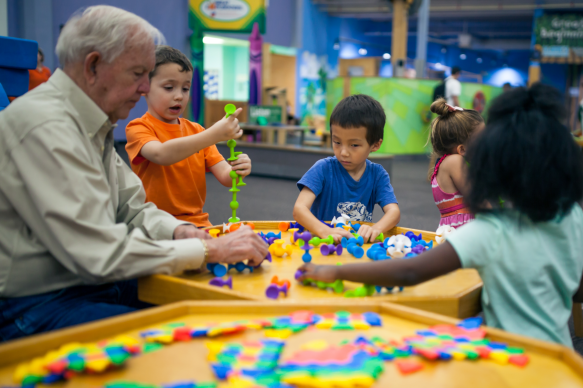 Great Explorations is also committed to engaging differently abled adults. In 2017, the museum was approached by three women, now affectionately known as the “Brain Dames”, about being involved in an ongoing program that would provide experiences that could benefit adults with memory loss. In partnership with AARP and the “Brain Dames”, as well Great Ex’s Director of Community Initiatives, Lael Arango, we launched “Memory Monday” in 2018.
Memory Monday is a free, two-hour event that takes place on the first Monday of the month. The core programming includes music, movement, art, humor, intergenerational interaction, and brain boosts, which are strategies, tips and recipes to engage the mind even when memory challenges make other activities difficult.
Since February 2018, 118 people with memory challenges (affectionately called “cared-fors”) and 82 caregivers have attended Memory Monday. In its second year, we have moved the program to a larger space to accommodate the high number of participants, volunteers and presenters.
 Memory Monday is unique in that it goes beyond providing a social experience or a “keep Grandma occupied” experience by presenting high-quality activities that enrich and engage participants. For example, the Florida Orchestra brought violins to one event and everyone had the opportunity to play them – one table of participants even pieced together “Twinkle, Twinkle Little Star” and played it in unison in an impromptu performance. Each month, an instructor from Arts4All Florida facilitates Mindful Moves, during which one dance is made up of movements inspired by a conversation with participants about love, or nature, or whatever the theme of the month is. The instructor puts the movements in a sequence and sets them to music, allowing participants to do a memory activity tied to physical movement and the sensory experience of listening to beautiful music.
Small groups of children from the museum’s educational programs come participate in an activity with the adults each month. One month they may all be learning about the bassoon together, while another month they are painting flower pots and planting seeds together. One month last year they made cards and put together hygiene bags for families at our local Ronald McDonald House together. Many people cite the interaction with the children as their favorite part of the program, and the children’s enjoyment shows on their faces.
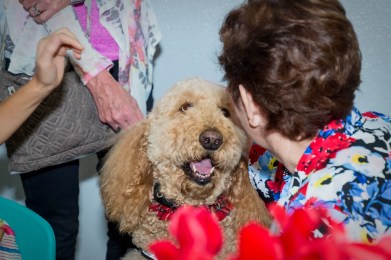 Memory Monday benefits the community by reminding people with memory challenges that their brains are still able to learn and that they are still able to enjoy new experiences. We have also created numerous partnerships with organizations that aren’t necessarily on the front lines of serving families with memory loss, bringing diverse organizations together to serve a growing population in a unique and creative way.
In the future, we hope to be able to reach even more people in the community. We often have requests to hold Memory Monday more frequently, and we’d love to be able to expand our services to caregivers or to provide service-based experiences for our cared-fors. We are honored to provide a safe, nurturing, explorative environment for children and families across the ability continuum and lifespan.
To learn more about Great Explorations Children’s Museum, visit our website: https://greatex.org/.
The Division thanks Lael Arango, Mandy Paige, and Great Explorations staff for their participation in this post.
Interested in seeing your organization featured on Culture Builds Florida? Please fill out this form: https://goo.gl/forms/3sMwuJWA3bM1orPl2.
 In 2012, we were “reborn” as Arts Alive Nassau and started offering three programs: a dulcimer class, an elementary school band, and a visual art class. Originally, we worked with three elementary schools and provided the classes after school. Over the past six years, we have grown to providing 20 after school classes and two classes with the ESE program during the school day. We are now a presence in each of the nine elementary schools in the county. The schools don’t charge us anything for the use of the space and we are able to offer our instruction free of charge, in exchange. It’s a wonderful relationship because finding space and getting kids on location is often a problem. Through our partnership, the instruction happens right where they are and it has worked very well.
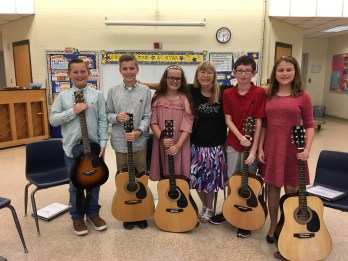 Jane: We offer music lessons, violin, ukulele, band… one of the elementary schools has both a brass ensemble and a drumline. We still offer our dulcimer classes as well as visual arts classes in painting, drawing, and puppetry. We also have a great partnership with a theater company in South Carolina, the Baillie Players, that has helped us produce musicals at Callahan Elementary School for the past five years. This year they are doing “Snow White”. The teacher at Callahan has all the music, scripts, choreography and casts the show and then our partner company will come down to coach the kids and bring the sets, costumes, and props. There are usually 40-50 students involved and it’s such a wonderful thing for the children. In Callahan, which has a population of around 1,300, the community members and families come out in droves to see the children perform– even the mayor usually makes an appearance! It’s a great event not only for the students involved but for the community, as well.
 Jane: Each year, close to 600 students are involved in our activities. Currently, we have 255 students in our classroom-based programs. We’d love to be able to reach more students but are limited, like many organizations, by our budget.
 It’s definitely seeing the children’s faces. When they get excited and they’ve just learned how to play something, they are so proud of themselves. I think that arts education presents the opportunity for children to find out who they are inside because to me, that’s what the arts give us. They allow children the opportunity to find out who they are through creativity. To see the awakening that takes place in every student and the self assurance and self esteem that comes from learning that they can perform and create in front of people is just amazing. I think that the arts are wonderful because you can have so much fun while you’re learning.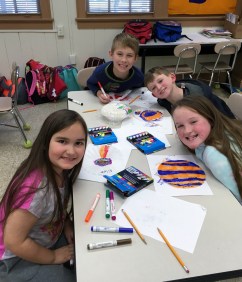
 Culture Builds Florida