Culture in Florida: December

Culture In Florida

by Tim Storhoff

Culture In Florida is a monthly news roundup to show our state’s wonderful diversity, spotlight the organizations and artists that contribute so much to our communities, and stress the comprehensive benefits of arts and culture to Florida’s economy and quality of life.

December kicked off with Art Basel in Miami Beach. Beyond being a successful and high-profile arts event, it also did a lot to give back to the surrounding community. A number of artists who came to the area for Art Basel stuck around to restore murals in West Grove. Keif Schleifer, an arts advocate and sculptor from Atlanta who organized the effort, said, “We’ve been humbled by this community and the kids who’ve been painting with us since the day we arrived. I see Art Basel as more than an event of the moment. It’s a meeting ground for people to come together and grow something bigger that continues.” Art Basel has also helped transform the nearby Wynwood neighborhood into a more vibrant area for visitors, and the neighborhood’s connection to Art Basel was covered in the New York Times. Those interested in learning from Art Basel’s success should check out 8 Tips for Courting Influencers the Art Basel Way from the pARTnership Movement.
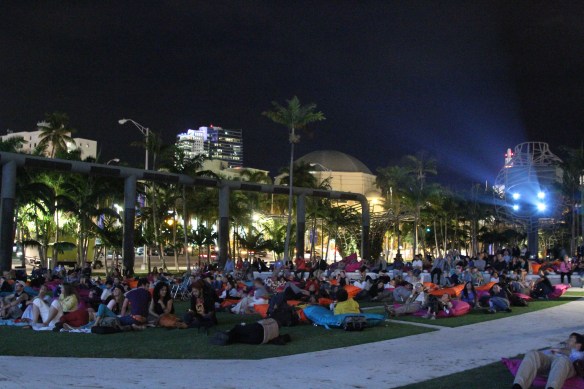
Art Video on December 5, 2012 during Art Basel 2012.  (Photo by John Parra/Getty Images for Art Basel Miami 2012, Courtesy of Art Basel)

Art Video on December 5, 2012 during Art Basel. (Photo by John Parra/Getty Images for Art Basel Miami 2012, Courtesy of Art Basel)

Other events across the state have been big hits this month too. This includes the Bradenton Blues Festival (mentioned last month), which sold 3126 tickets and exceeded expectations for its first year. Boynton Beach has continued its rebranding campaign with the opening of the Plein-Air Exhibition in the Boynton Beach Library. Many events centered around the holidays. The very first Christmas celebration in North America was held in Florida, and that holiday spirit continues today. Three million lights helped make St. Augustine’s historic district sparkle, the Thomas Edison & Henry Ford Estates held their annual Holiday Nights, and the Tampa Theatre had a packed showing of It’s a Wonderful Life. Many other holiday events related to Christmas, Hanukkah, and Kwanzaa were held across the state that incorporated the performing and visual arts in various ways.

We want to acknowledge all of the Florida arts and culture organizations that have recently had success receiving grants. The Miami City Ballet received a $5 million grant from the John S. and James L. Knight Foundation. The grant, which will come in $1 million increments over 5 years, is the largest the company has received in its 27-year history. Sixteen Florida Organizations also received ArtWorks Grants from the National Endowment for the Arts worth a total of $412,000. Additionally, the group Citizens Interested in the Arts (CIA) donated $1 million to thirty visual and performing arts organizations in South Florida for the year 2013. On an individual level, Viera resident David Saylor received a great honor when his photo “Discovering Limits” was chosen in Canon’s “Project Imaginat10n” contest to be the inspiration for short films by celebrity directors.

This has been an exciting month for museums across the state. The Safety Harbor Museum and Cultural Center celebrated its Grand Opening after closing in March for a complete remodeling and repurposing, and the staff at the Elliott Museum in Stuart started moving items into their new building set to open March 2, 2013. The Polaseck Museum in Winter Park has acquired a bust of Woodrow Wilson, created by Albin Polasek himself, that was targeted for destruction by the Nazis. This piece of art was believed to have been destroyed during World War II but is now on display in the museum. In Sarasota, the Ringling Museum opened a new exhibition featuring sixteenth century Venetian art by Paolo Veronese, and the Norton Museum of Art in West Palm is exhibiting the work of Sylvia Plimack Mangold, an American painter known for her landscapes and “portraits” of trees, as part of the museum’s effort to highlight the contributions of women artists. In a special article for the Gainesville Sun, Rebecca Nagy, director of the Harn Museum of Art at UF, asked how brick and mortar museums can stay relevant in the digital age.

The Norton Museum of Art in West Palm Beach. Photo by Wally Gobetz and made available by a CC BY-NC-ND 2.0 license.

The Norton Museum of Art in West Palm Beach. (Photo by Wally Gobetz and made available by a CC BY-NC-ND 2.0 license.)

With the New Year comes the official start of Viva Florida 500, the commemoration of Florida’s 500th anniversary so be on the lookout for related events in January and all year long. Looking forward, the Miami New Times presented “Nine New Years Resolutions for Miami’s Arts Community” and the Carrollwood Cultural Center is already preparing for a busy winter season starting in January.

Happy New Year from everyone at the Division of Cultural Affairs, and we hope that 2013 brings you health, happiness, and many opportunities to experience and share the great arts and culture events Florida has to offer!
A Day in the Life: Composer Chuck Owen, Individual Artist Fellowship Recipient

by Tim Storhoff

While Chuck Owen directs the Center for Jazz Composition at the University of South Florida School of Music in Tampa, his compositions reflect a musical taste that include many genres alongside jazz. He has said, “Years of classical piano training, performance with jazz rock/funk bands as a trombonist, and ongoing appreciation of American folk music traditions as well as those from many other countries – particularly in Latin America & Europe – have all shaped my outlook as a composer. Although I never set out with the notion of forcibly trying to ‘fuse’ these elements – I delight in playing with what, at least to me, seems like their natural intersections.” In playing with these intersections, Owen has amassed an evocative and delightful body of work.

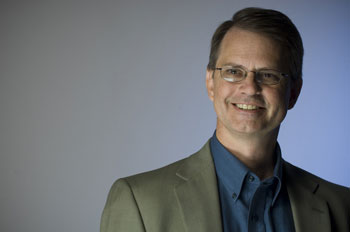
Individual Artist Fellowship Recipient Chuck Owen. Photo used by permission of Chuck Owen.

Individual Artist Fellowship Recipient Chuck Owen. Photo used by permission of Chuck Owen.

Many of Owen’s compositions have been performed by Jazz Surge, his big band founded in 1995. Additionally, he has composed for the Smithsonian Jazz Masterworks Orchestra, Netherlands Metropole Orchestra, Tonight Show Orchestra, Cincinnati Pops Orchestra, Dave Liebman Big Band, and Roger Williams. His compositions have won him previous Individual Artist Fellowships from the Florida Division of Cultural Affairs, an ASCAP/IAJE Commission in honor of Louis Armstrong, and a John Simon Guggenheim Memorial Fellowship. He has also served as a panelist for major awards, most recently chairing the Pulitzer Prize in Music panel in 2011. In addition to composition, Owen is a dedicated educator who has received numerous accolades for his teaching at USF and served as President of the International Association for Jazz Education from 2006 to 2008.

Owen received his BM from North Texas State University and an MA in orchestral conducting from California State University-Northridge. While both of these degrees included formal composition instruction, Owen claims he has primarily grown and continues to grow musically through listening and studying the scores of great works while remaining actively engaged with other musicians, composers, and students. He said, “As a jazz composer, I feel one of the greatest educational experiences I had was years of gigging as a professional pianist. Since so much of jazz performance practice extends beyond written notation, there simply is no substitute for a jazz composer.”

Recently, Owen has devoted much of his time to the creation and release of his project River Runs: A Concerto for Jazz Guitar, Saxophone, and Orchestra, which will be issued in early April 2013 on Summit Records. He describes this composition below:

“The product of a 2009 Guggenheim Fellowship, this concerto spans 5 movements and runs almost an hour in length.  I drew on a lifetime love of rivers as well as specific raft/canoe trips for inspiration. Each movement is linked to a specific river but also tries to portray characteristics of the rivers. While it’s clearly a mixed genre piece – incorporating aspects of jazz, contemporary classical, American folk, and other musics; I’ve tried to retain the loose, improvisational feel of jazz throughout.” The movements of the piece are:

  • Prologue – Dawn at River’s Edge  1:54
  • Mvmt. I – Bound Away  17:53  Greenbrier & New Rivers (West Virginia)
  • Mvmt. II – Dark Waters, Slow Waters   12:37 Hillsborough River (Florida)
  • Mvmt. III – Chutes and Wave Trains  11:29  Chattooga River (Georgia, South Carolina)
  • Mvmt. IV – Side Hikes – A Ridge Away  7:56  Green & Colorado Rivers  (Colorado, Utah, Arizona)
  • Mvmt. V – Perhaps the Better Claim  11:42  Salmon River (Idaho) – The River of No Return

This piece, which evokes a sense of place that stretches across the nation, also stretches Owen’s music into new areas, reaches new audiences, and has fostered new professional relationships with musicians outside the jazz world. Featured soloists for the recording are Jack Wilkins (tenor saxophone) and LaRue Nickelson (guitar). Also prominent though not in featured roles are Corey Christiansen (acoustic guitars), Rob Thomas (jazz violin), and Danny Gottlieb (drums). In addition, Owen used the members of the Jazz Surge big band (some of whom have been with him for over 15 years) as the core ensemble which he then surrounded with orchestral players – most of whom hail from the Florida Orchestra.

Watch for River Runs: A Concerto for Jazz Guitar, Saxophone, and Orchestra in April. To learn more about Chuck Owen’s career and hear some musical examples, go to http://www.chuckowen.com, and to learn more about the jazz program at USF, visit the program’s webpage here. We would like to congratulate Mr. Owen on his receiving another Individual Artist Fellowship from the Florida Division of Cultural Affairs, and we look forward to working with him over the next year.

Art Talk: Accessibility with Division Staff Member Maureen McKloski

By Tim Storhoff

Maureen McKloskiMaureen McKloski joined the Division’s staff in July of 2012. Prior to her work at the Division, she was the visual arts coordinator for Pyramid Studios, an art center serving developmentally disabled adults. She is a painter and restorer of fine art and antiques. Maureen earned Bachelor of Fine Art degrees in Art Education and Ceramics. As the Division’s Accessibility Coordinator, I wanted to ask her about the importance of accessibility in the arts.

Along with managing grant programs, overseeing arts in education and underserved communities, you are the Division’s accessibility coordinator. Accessibility is clearly important to all aspects of life, but what makes accessibility especially important to the arts?

Accessibility is a word that simply envelops and provides inclusion for all.  People with disabilities are as diverse as any people. They have diverse experiences, expectations, and preferences. They use diverse interaction techniques, adaptive strategies, and assistive technology configurations. People have different disabilities: auditory, cognitive, neurological, physical, speech, and visual — and some have multiple disabilities. Even within one category, there is extreme variation; for example, “visual disability” includes people who have been totally blind since birth, people who have distortion in their central vision from age-related degeneration, and people who temporarily have blurry vision from an injury or disease.

As we all age, we find ourselves utilizing more provided accessibility services, whether we fully recognize and label them as disabilities or not. We find that these considerations, when seamlessly integrated, are helpful to every user. Accessibility is especially important in the arts because it encompasses and directly affects everyone – whether they are an audience member, a listener, a patron or an artist.

The therapeutic aspects of art, whether we are actively or passively engaged, have the potential to greatly impact our physical, emotional, and mental well-being.  It also can have an economic impact on the individuals that create or perform art – opening up an opportunity for individuals to earn income, as well as benefit of increased revenue for arts communities that hold accessible and inclusive events.

The Division believes in the motto “Culture Builds Florida” and stressing the economic value the arts have for our state. How do you see accessibility relating to Culture Builds Florida? 

The arts are integral to the lives of our citizens. We appreciate them for their intrinsic benefits — their beauty and vision and how they inspire, soothe, provoke, and connect us. The arts ennoble us as people. They provide bridges between cultures. They embody the accumulated wisdom, intellect, and imagination of humankind. Government and private-sector support are essential to promote full access to and participation in exhibitions, performances, arts education, and other cultural events regardless of family income.  The arts are essential to the health and vitality of our communities and our nation. They improve the quality of life in our cities and towns. They enhance community development; spur urban renewal; attract new businesses; draw tourism dollars; and create an environment that attracts skilled, educated workers which build an innovative workforce.

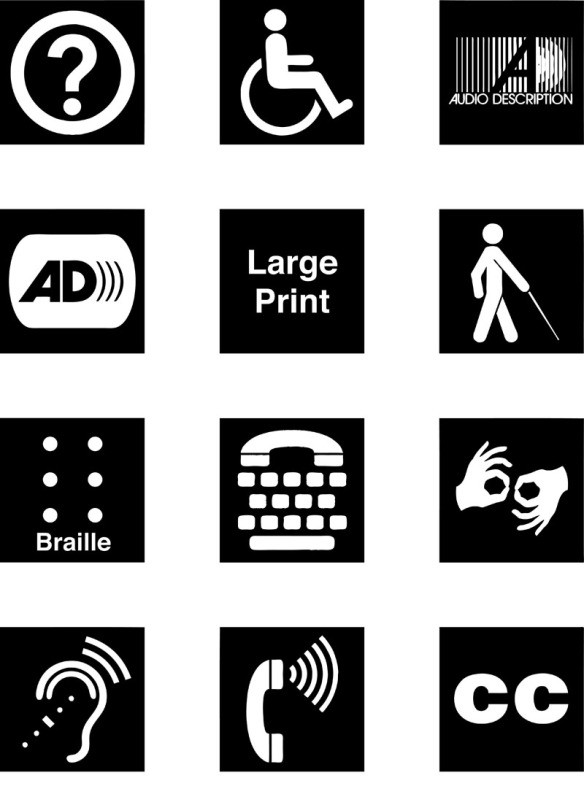
Do you know what all of the Disability Access Symbols mean? Learn about them and download them for your own use at https://www.graphicartistsguild.org/resources/disability-access-symbols/

Do you know what all of the Disability Access Symbols mean? Learn about them and download them for your own use at https://www.graphicartistsguild.org/resources/disability-access-symbols/

If you could name just one or two low-cost things that arts organizations and businesses can do to improve their accessibility, what would they be?

Many organizations are already accessible in a number of ways.  One of the first things that an organization can do is to include appropriate accessibility symbols in all of their marketing materials – from brochures to email blasts. Another low-cost practice would be to provide large print versions of all printed material. Generally information is typed out in word format before included in a distributed format. If an organization changed the font and the font size, they could easily provide information in this format. Another low-cost practice would be to walk through their facility with a three-foot ruler or stick to make sure that all routes are easily accessible to wheelchairs and make sure that nothing blocks doorways or access to any of the facilities amenities.

Where should arts organizations and businesses go for more information about accessibility in the arts?

We have provided information to our grantees regarding their 504 plan, people first language, accessibility symbols, and more.  We are providing this information on our website, and the informative links there are continually updated. We are also providing a series of six webinars in 2013 for our constituents catered to their desire to learn more about and provide services to those individuals with disabilities in partnership with VSA. For more information on the upcoming webinars, subscribe to our e-mail list and like us on Facebook.